
Enterprises no longer treat a data centre as real estate for servers. In a hybrid and multi-cloud operating model, colocation combined with high-quality interconnection is the platform on which mission-critical compute, storage and internal systems sit — and the point at which those systems meet the public clouds, carriers, partners and users they depend on. This guide sets out the criteria that decide whether that platform helps or hinders, the process for evaluating it, and the red flags that separate a facility that markets well from one that performs.
Executive summary
A colocation and interconnection decision is a three-to-seven year commitment that sets the ceiling on your hybrid architecture. Get it right and you gain lower latency to cloud and users, materially cheaper data movement, certified resilience, and room to grow into higher densities. Get it wrong and you inherit a set of constraints you cannot engineer around: a facility that cannot power the racks you will need in year three, an interconnection ecosystem too thin to reach your cloud regions privately, or a contract with no expansion rights and punishing exit terms.
The single most common strategic error is treating colocation as a procurement exercise in space and power. Space and power are the commodity layer; they are broadly comparable between credible operators in the same market. Interconnection is where the durable difference lies — it determines your latency to cloud, your cost per gigabyte of data movement, your ability to reach partners privately, and how quickly you can stand up a new path when the architecture changes.
What each executive should care about
| Role | Primary interest | The question to ask | The risk of a poor choice |
|---|---|---|---|
| CEO / Board | Strategic optionality and reputational exposure | Does this choice keep our options open, or lock a multi-year architecture to one site and one operator? | A commitment that outlives its usefulness and cannot be unwound without a migration programme |
| CFO | Predictable operating cost and capital avoidance | What is the modelled five-year total cost, including power escalators, cross-connects and exit? | A low headline rate that inflates through metered power, interconnection fees and stranded capacity |
| CIO / CTO | Latency, interconnection reach and technical headroom | Which clouds, carriers and exchanges are natively reachable here, and at what rack density? | Backhauled circuits, avoidable latency and a density ceiling that blocks the next hardware generation |
| CISO | Physical and logical control, and evidence for auditors | Which certifications are current, what does the access log show, and do we hold audit rights? | A multi-tenant environment you cannot evidence to a regulator or a customer |
| CRO / Risk | Concentration, geography and recovery capability | What is the site's hazard profile, and can we meet our recovery objectives from a second location? | Correlated failure across a single campus, or recovery targets documented but never tested |
Why colocation and interconnection matter now
Enterprise workloads increasingly split. Systems that need control, cost predictability or data residency stay on infrastructure you own; systems that need elasticity or specialised cloud services run in a public cloud. The colocation facility is where the two halves meet. It hosts dedicated compute and storage, provides private on-ramps to AWS Direct Connect, Azure ExpressRoute and Google Cloud Interconnect, and offers peering at internet exchanges alongside cross-connects to carriers, content networks and partners.
Four forces have raised the stakes since the last time most enterprises ran this evaluation. Power has become the binding constraint, not floor space — in several major markets, including Singapore, new capacity is now rationed administratively rather than simply built. Rack density is climbing fast, and the gap between a conventional hall and an AI-capable one is now an order of magnitude. Sustainability has moved from marketing into disclosure obligations that reach both operators and their tenants. And regulatory attention has intensified, both sector-specific rules for regulated industries and, increasingly, licensing regimes aimed at data centres themselves.
For the engineering fundamentals underneath this guide — how power reaches a rack, what redundancy notation means, how heat leaves the building — see our explainer on how data centres work. For Singapore pricing, operator selection and market structure, see the enterprise buyer's guide to data centres in Singapore. This article is the decision framework that sits between them.
Criterion 1 — Location and geographic strategy
Location is the criterion you cannot renegotiate later. It fixes your latency floor, your regulatory exposure and your hazard profile simultaneously.
- Proximity to what actually matters. Not the head office — the users, the cloud regions you consume, and the network hubs your carriers use. Measure round-trip time to your target cloud regions from the specific facility, not the metro.
- Hazard profile. Flood plain, seismic zone, storm surge, wildfire interface, and proximity to industrial risk. Ask for the site's own hazard assessment and check it against an independent index rather than accepting a summary.
- Data sovereignty and residency. Where the data physically rests, which jurisdiction's authorities can compel access, and whether sector rules or contracts constrain either.
- Accessibility versus concentration. Staff, auditors and hardware need to reach the site; but a facility in a dense urban core inherits that core's risks. Balance deliberately.
- Power and tax incentives that materially change long-run cost — and their duration, since incentives expire.
The multi-site question is the one executives most often defer. If any workload requires synchronous replication, geography is decided by physics rather than preference. Vendor limits are consistent and tight: VMware vSAN stretched clusters require no more than 5 ms round-trip between data sites, Dell PowerStore metro volumes expect under 5 ms, and NetApp MetroCluster IP tolerates at most 10 ms round-trip over inter-switch links of roughly 700 km. Oracle sets no fixed ceiling for Data Guard synchronous transport but its guidance flags materially rising commit latency in the low single-digit milliseconds. In practice, synchronously paired sites sit tens of kilometres apart — close enough to share some hazards, which is precisely the trade-off risk committees need to see stated.
Criterion 2 — Connectivity and the interconnection ecosystem
This is the highest-value differentiator for a hybrid enterprise, and the one most often scored last. Two facilities can offer identical space, power and certifications while offering completely different network positions.
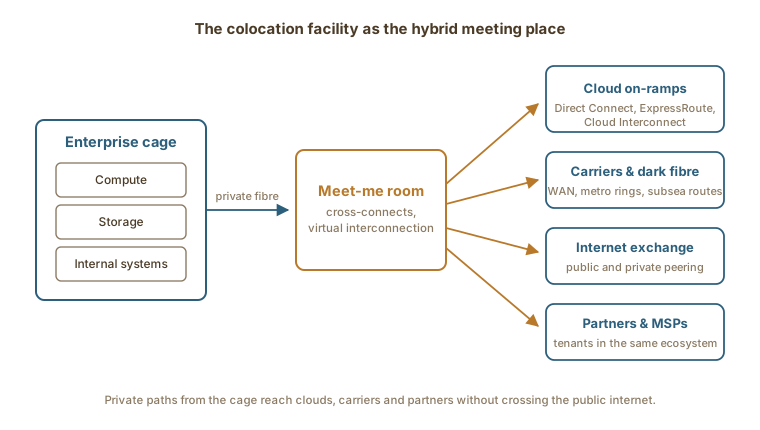
What to evaluate
- Carrier neutrality and meet-me room density. Count the unique carriers actually present and lit in the building, not the parent operator's global figure. Dozens is a healthy ecosystem; a handful is a captive one.
- Native cloud on-ramps. Which hyperscalers terminate in this facility or on this campus, at what port speeds, and how quickly a new virtual circuit can be provisioned — hours through a software-defined portal, or weeks through a carrier order.
- Internet exchange access for public and private peering, which changes both the economics and the resilience of internet-facing traffic.
- Cross-connect economics and lead times. Ask for the price list, the typical installation interval, and whether pricing is capped over the contract term.
- Physical path diversity. Diverse conduits, diverse building entrances, and diverse routes to the metro ring — verified on a drawing, not asserted.
- Tenant ecosystem. The managed service providers, integrators and industry counterparties already in the building that you could reach with a cross-connect rather than a circuit.
The economics of private interconnection
Direct interconnection changes the unit cost of moving data out of a cloud, and this is usually the largest quantifiable financial benefit in the business case. At published list prices in August 2026, egress over a dedicated interconnect is billed well below standard internet egress — but the gap is smaller in Asia than the figures commonly quoted from United States price lists.
| Provider | Egress over dedicated interconnect | Standard internet egress (first tier) | Also payable |
|---|---|---|---|
| AWS Direct Connect | US$0.041/GB from the Singapore region; US$0.02/GB in US regions | US$0.12/GB from Singapore; US$0.09/GB in US regions | Port-hour charges — roughly US$219/month for a 1 Gbps dedicated port |
| Azure ExpressRoute | US$0.05/GB metered in Zone 2, which includes Singapore; US$0.025/GB in Zone 1 | US$0.12/GB in Zone 2; US$0.087/GB in Zone 1 | Circuit fee; an unlimited plan trades per-gigabyte charges for a flat monthly fee |
| Google Cloud Interconnect | US$0.042/GiB for Asia-to-Asia traffic; US$0.02/GiB US-to-US | From US$0.12/GiB on the premium network tier | Circuit and VLAN attachment charges per hour |
On list rates that is roughly a 55 to 65 per cent reduction per gigabyte for Singapore-region traffic, and 70 to 80 per cent in United States regions. Treat those percentages as a ceiling, not a forecast. They apply to the variable rate only; the fixed port, circuit and cross-connect charges must be recovered before any saving is realised, which typically requires a few terabytes of monthly egress per port before a dedicated connection beats internet egress on cost alone. Below that threshold the case for interconnection rests on latency, predictability and security rather than price — all legitimate reasons, but different ones, and the CFO deserves to see which is doing the work.
Criterion 3 — Power, cooling and density readiness
Power is the largest long-term cost driver and the most common hard constraint on growth. It is also the criterion where the gap between what a facility can deliver today and what your estate will need in three years is widest.
The density gap is now an order of magnitude
Conventional enterprise and colocation racks remain modest. The Uptime Institute's 2025 Global Data Center Survey put typical reported rack density at just under 9 kW, with deployments in the 10 to 30 kW band growing and relatively few facilities exceeding 30 kW. Meanwhile a single NVIDIA GB200 NVL72 rack is specified at roughly 120 kW nominal — around 132 kW in vendor configurations — and is liquid-cooled by design, not by option. The Uptime Institute's 2026 survey reports high-density rack deployment rising fast.
Most enterprises will not deploy a 120 kW rack. The point is the direction of travel and the asymmetry of the mistake: a facility that cannot grow past 10 to 15 kW per rack forecloses options you have not yet chosen, while paying a modest premium for a hall with a credible path to higher density preserves them. Ask specifically what the facility can deliver per cabinet today, what it could deliver after a defined upgrade, and whether liquid cooling — direct-to-chip or rear-door — is supported in the suite you are being offered, rather than somewhere else in the estate.
Redundancy, efficiency and the numbers worth pinning
- Redundancy topology stated precisely — N, N+1, 2N or 2N+1 — for each of utility feed, generation, uninterruptible power supply and cooling. The distinction that matters commercially is whether the facility is concurrently maintainable: whether any component can be serviced without taking your load down.
- Available capacity, not designed capacity. A hall designed for 20 MW that has sold 19 MW offers you 1 MW. Ask for a power availability letter naming your specific requirement.
- Utility interconnection certainty for any growth you are counting on — grid connection queues are now a real constraint in several markets.
- Continuous cooling capability, so a power transfer does not become a thermal event, and headroom in the cooling plant for the density you plan to grow into.
On power usage effectiveness, calibrate expectations before you read a marketing figure. The industry average has been flat for years: the Uptime Institute's 2025 survey reported a weighted average of 1.54, the sixth consecutive year without meaningful movement, and its 2026 survey reported only minor improvement. Best-in-class new builds are designed to roughly 1.3 or better at full IT load, and the largest hyperscale fleets report far lower — Google publishes a fleet-wide figure of 1.09. Climate matters: tropical regions average above 1.7 against roughly 1.5 in North America and Europe, which is why efficiency commitments in equatorial markets are demanding engineering targets rather than easy claims.
Criterion 4 — Reliability, uptime and operational resilience
Resilience is the criterion most distorted by marketing language, and the one where a small amount of precision saves the most money and argument.
What Tier ratings actually promise
The Uptime Institute's Tier Standard defines four levels: Tier I (Basic Capacity), Tier II (Redundant Capacity Components), Tier III (Concurrently Maintainable) and Tier IV (Fault Tolerant). Tier III means any capacity component or distribution path can be taken offline for planned maintenance without affecting IT load. Tier IV adds the ability to absorb a single unplanned failure without interruption. Those are the claims — and they are claims about topology, not about availability percentages. Uptime removed availability figures from the Tier Standard in 2009, so a vendor quoting "Tier III equals 99.982 per cent" is citing a retired document.
The distinction that matters most commercially is between certification stages. Tier Certification of Design Documents is a paper review that the Institute itself treats as provisional, and awards issued after 1 January 2014 expire two years after the award date. Tier Certification of Constructed Facility requires an on-site visit with live demonstrations of the built site. The Institute reports that constructed-facility visits routinely surface post-design changes that would break compliance — which is exactly why "designed to Tier III" is not a certification. Nor are marketing coinages such as "Tier III plus", which have no standing in the Standard at all. If the claim matters to you, ask which certification is held, on what date it was awarded, and confirm the facility appears on the Institute's own award registry.
Design certification says nothing about how the site is run day to day. The Institute assesses that separately: Tier Certification of Operational Sustainability, awarded Bronze, Silver or Gold, is available to facilities that already hold design and constructed-facility certification, while the Management & Operations Stamp of Approval is open to any data centre and covers staffing, training, maintenance discipline and operating processes. For mission-critical internal systems, the operational assessment is often the more informative document.
Beyond the certificate
- Historical performance, not just the contractual SLA. Ask for the incident history for this facility over three to five years, with root causes. A remedy of one month's service credit does not compensate a four-hour outage of a core banking system.
- Do the availability arithmetic. A 99.999 per cent target permits roughly 5.3 minutes of downtime per year. Confirm what the SLA actually measures — power at the rack, cooling within band, or network availability — because these are commonly conflated.
- Maintenance discipline. How often is the generator load-tested, is the uninterruptible power supply tested on real load, and what is the process when a test fails.
- Remote hands. Twenty-four-hour on-site expertise, a defined response time, and a tested escalation path. Test it during due diligence rather than during an incident.
- Incident transparency. Whether the operator publishes post-incident reviews to customers, and how quickly.
Criterion 5 — Security, compliance and governance
In a multi-tenant facility you are outsourcing physical control while retaining accountability. The evaluation should therefore concentrate on evidence you can put in front of an auditor, not on the visible security theatre of the tour.
- Layered physical security — perimeter, building, hall, cage and cabinet — with biometrics, interlocked entry and continuous monitoring, plus a documented process for how contractors and couriers are handled.
- Current audit reports, not certificate logos. ISO/IEC 27001, SOC 1 and SOC 2 Type II, PCI DSS, and any sector-specific scheme. Request the report itself and check the scope covers the facility and services you are buying, and that the period is current.
- Access logging and reporting you can query, retained for a period that satisfies your own obligations.
- Contractual audit and inspection rights extending to sub-contractors — the point at which many negotiations stall, and the point regulated buyers cannot concede.
- Chain of custody for media and hardware, including certified disposal for storage-heavy estates.
Regulated buyers should map obligations onto the contract explicitly rather than assume a certificate covers them. In Singapore, financial institutions work to the Monetary Authority of Singapore's technology risk requirements — reissued in May 2024 under the Financial Services and Markets Act as licence-class notices, with Notices 644 and 655 cancelled at that point, so a provider still citing those numbers as current is quoting a superseded rulebook. The substance carried over and it is specific: a recovery time objective of no more than four hours for each critical system, total unscheduled downtime for a critical system capped at four hours in any rolling twelve-month period, and incident notification to the regulator within one hour. The outsourcing notices, in full effect since December 2024, require audit and access rights over the service provider and its sub-contractors. Those obligations sit on the institution; they reach the colocation provider only through the contract you negotiate.
Criterion 6 — Scalability, flexibility and future-proofing
The question is not whether the provider can accommodate growth somewhere in its portfolio. It is whether it can accommodate your growth in this hall, without a migration.
- Start small, expand in place. The ability to begin with a partial cage or a handful of cabinets and grow within the same suite or campus, keeping your existing cross-connects and latency profile intact.
- Contracted expansion rights with pricing defined at signature. A right of first refusal on adjacent space with the rate to be agreed later is not a growth plan.
- Modular power and cooling delivery, so additional kilowatts per cabinet do not require rebuilding the suite.
- Software-defined interconnection, so a new cloud region or partner connection is a portal request measured in hours rather than a carrier order measured in weeks.
- Contractual flexibility — term length, power and space ramps, consolidated multi-site billing, and exit provisions with defined notice and de-installation terms.
Future-proofing also means anticipating regulation aimed at facilities themselves. Singapore is the clearest example: after an effective moratorium on new builds from 2019 until March 2022, capacity has been allocated administratively. A pilot Call for Application awarded roughly 80 MW in July 2023 against more than twenty bids; the Green Data Centre Roadmap of May 2024 set out at least 300 MW of additional capacity with a further 200 MW reserved for operators using green energy; and a second Call for Application opened in December 2025 offering at least 200 MW on tighter terms, including a PUE of 1.25 or better at full IT load. A proposed Digital Infrastructure Bill, consulted on in July 2026, would move this from periodic allocation to standing licensing for facilities above defined load thresholds. Efficiency and resilience are becoming licence conditions rather than differentiators — which makes an operator's current regulatory standing part of your risk assessment, not just theirs.
Criterion 7 — Cost structure and total cost of ownership
The headline rate per rack or per kilowatt is the least informative number in the proposal. It is also the only one most comparisons use.
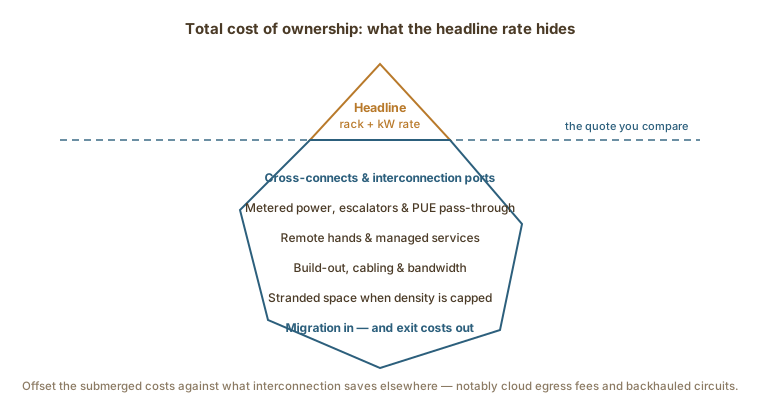
What belongs in the model
- Power, and how it is billed. Metered actual consumption or allocated capacity — the difference is substantial for estates that run well below their provisioned draw. Establish who bears the facility's overhead, and how efficiency is passed through.
- Escalators. The annual uplift, whether it is capped, and whether it is indexed to a published measure or set at the operator's discretion.
- Cross-connects and interconnection ports, recurring and non-recurring, priced per connection you will actually need — including the ones you will add in year two.
- Build-out, cabling and installation, and who owns the infrastructure at the end of the term.
- Remote hands and managed services, at realistic volumes rather than the notional allowance.
- Stranded capacity. If the hall caps you below your target density, you pay for cabinets you cannot fill — a cost that never appears as a line item.
- Migration in, and exit out. Early termination terms, notice periods, de-installation obligations and the cost of the next migration.
Then offset the benefits the same way. Reduced cloud egress is the most quantifiable, but the model should also capture circuits retired because traffic now stays inside the facility, capital avoided by not building or refurbishing your own hall, and the value of predictable operating cost against variable cloud consumption. Run the model over the full term at your projected year-three and year-five footprint, not today's. A lower initial quote from a facility that constrains density, interconnection or expansion routinely becomes the more expensive option before the contract ends.
Criterion 8 — Sustainability and ESG
Sustainability has moved from a procurement preference to a reporting obligation, and the relevant question has shifted with it — from whether an operator has a target to whether it can give you data your own disclosures can rely on.
Electricity dominates the operational carbon footprint of a colocation deployment: your IT load, multiplied by the facility's overhead. Whether that lands in your Scope 2 or Scope 3 inventory is genuinely unsettled — the Uptime Institute recommends treating tenant IT electricity as tenant Scope 2 with facility overhead as Scope 3, but operator practice varies, with some reporting all facility energy as their own Scope 2 and passing emissions to tenants as Scope 3. Ask for both location-based and market-based emissions figures, with the detail of how renewable energy purchase agreements and certificates are matched, since renewable procurement reduces the market-based figure only.
Disclosure obligations now reaching both sides
- Singapore. All SGX-listed issuers must report Scope 1 and 2 emissions from FY2025. Full disclosures aligned to the international sustainability standards begin with Straits Times Index constituents from FY2025, extending to other listed issuers from FY2028 and FY2030 by market capitalisation, and to large non-listed companies from FY2030 — timelines extended by the regulators in August 2025.
- European Union. Under the recast Energy Efficiency Directive, data centres with at least 500 kW of installed IT power demand must report energy performance annually to an EU database — energy consumption, PUE, water use, waste-heat reuse and renewables share — with reports due each 15 May. Separately, the corporate sustainability reporting regime, narrowed in February 2026 to companies above 1,000 employees and €450 million turnover, obliges those in scope to disclose value-chain emissions that include outsourced data-centre use.
- Efficiency as a licence condition. In markets that ration capacity, efficiency commitments are increasingly conditions of operating rather than voluntary targets — which makes them auditable, and makes an operator's track record against them worth examining.
Criterion 9 — Provider stability, support and ecosystem
You are entering a multi-year dependency. The operator's own durability is part of the risk, and it is assessable.
- Financial strength and ownership model. Whether the operator owns its facilities or leases them, its investment record, and how it is capitalised. A leased site introduces a landlord whose interests you never negotiated with.
- Portfolio and expansion track record — whether announced capacity has historically been delivered on schedule.
- Customer experience and automation. Portal and API access for power, environmental and interconnection data, so your operations team can see and script against the facility rather than raise tickets.
- Support model. Local presence and language coverage alongside global escalation, with named accountability rather than a shared queue.
- Partner ecosystem of managed service providers, integrators and specialist vendors already operating in the building.
- Reference customers running comparable hybrid workloads — and a conversation with them without the operator in the room.
The evaluation process, step by step
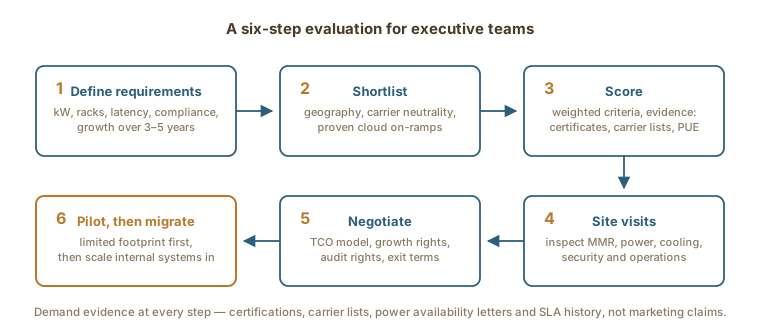
1. Define the requirement before you talk to anyone. Quantify space, power in kilowatts total and per cabinet, latency budgets to named cloud regions and user populations, compliance obligations, interconnection destinations, and growth projections over three to five years with a stated confidence. Convene network, security, applications, finance and business continuity together — a requirement assembled by infrastructure alone reliably omits the constraint that later decides the outcome.
2. Shortlist by geography and ecosystem fit. Filter to carrier-neutral facilities with proven cloud on-ramps in your target markets and an acceptable hazard profile. This is a short list of buildings, not of operators — a strong operator with a weak building in your market is not a match.
3. Score against weighted criteria. Weight the nine criteria above according to your workload mix and risk appetite, then score each facility on importance multiplied by fit. Weighting is where the executive judgement happens: a latency-sensitive trading estate and a bulk archive should not produce the same weights. Request the evidence at this stage — current certifications and audit reports, the carrier list for the building, a power availability letter for your requirement, PUE at a stated load, cross-connect price list, and incident history.
4. Visit, and conduct technical due diligence. Inspect the meet-me room and count what is actually there. Walk the power train and the cooling plant. Check the security layers you were told about. Ask to see a maintenance record and a post-incident review. Test remote hands with a real request and time the response.
5. Negotiate commercially and legally. Concentrate on the terms that are expensive to fix later: modelled total cost across the term, contracted expansion rights with defined pricing, interconnection service levels, audit and inspection rights extending to sub-contractors, and exit provisions. Providers with multi-site portfolios can often give you future geographic diversity under one contractual framework — worth pricing explicitly.
6. Pilot before you migrate. Place a limited, real workload — ideally one with genuine interconnection requirements — and run it long enough to see an operational cycle including a maintenance window. The pilot tests the operator's processes, which is the part no certificate covers.
The evidence checklist
Common pitfalls to avoid
- Selecting on the headline rate. The lowest quote frequently carries the tightest density cap, the thinnest carrier list and the least favourable escalator — all of which surface after the contract is signed.
- Accepting a Tier claim at face value. Design certification, constructed-facility certification and self-declared "designed to" language are three different things, and only two of them are certifications.
- Underestimating future density. Provisioning for today's kilowatts per cabinet is the mistake that most reliably forces an unplanned migration.
- Treating colocation as space and power. The interconnection ecosystem is what you cannot replicate elsewhere, and it is routinely scored last or not at all.
- Signing without expansion rights and cross-connect pricing. Both become the operator's leverage precisely when you have the least ability to move.
- Ignoring geographic and sovereignty constraints until an auditor or a regulator raises them.
- Quoting egress savings without the fixed costs. Per-gigabyte savings are real, but ports, circuits and cross-connects must be recovered first.
- Overlooking operations. A well-built facility run poorly fails more often than a modest facility run well — and only the operational assessments tell you which you are buying.
Conclusion and immediate next steps
Choosing a colocation and interconnection partner is a multi-year strategic decision that sets the performance, cost, resilience and agility of your enterprise compute, storage and internal systems in a hybrid cloud world. The facilities worth shortlisting combine robust, independently certified infrastructure with a genuinely neutral and dense interconnection ecosystem, transparent growth economics, and an operator willing to be measured against evidence rather than claims.
Apply the same rigour here that you would to a major cloud platform or core application decision. The two are more alike than they appear: both are multi-year architectural commitments where the constraints you accept at signature are the constraints you live with, and where the expensive mistakes are made in the requirements phase rather than the negotiation.
Immediate actions for leadership teams
- Convene a cross-functional evaluation committee spanning infrastructure, network, security, applications, finance and business continuity, and give it a named executive owner.
- Document current and projected workload requirements — kilowatts total and per cabinet, latency budgets, compliance obligations and growth over three to five years, with confidence levels attached.
- Map your target cloud regions, latency budgets and compliance boundaries, and identify which workloads genuinely require synchronous replication, since that decides your geography.
- Model total cost over the full term at year-three and year-five footprints, including interconnection, escalators, stranded capacity and exit — then model the egress and circuit savings against it.
- Issue a structured request for proposal demanding the evidence checklist above, and treat non-responses as findings.
- Visit the shortlisted facilities and verify power, connectivity, security and operational maturity in person before committing.
The data centre is no longer just a building. It is a node in the enterprise digital supply chain, and it should be selected like one.
Find data centre and interconnection providers
Browse data centre operators, network carriers and interconnection specialists listed in the TechDirectory directory.
Frequently asked questions
What is the difference between colocation and interconnection?
Colocation is the space, power, cooling and physical security you rent to house your own equipment. Interconnection is the set of network connections available from that space — cross-connects to carriers, private on-ramps to public clouds, peering at internet exchanges, and connections to other tenants in the building. Colocation is broadly comparable between credible operators in the same market; interconnection is where facilities differ most, and it usually has the larger effect on hybrid cloud performance and cost.
How much does private cloud interconnection actually save on egress?
At published August 2026 list prices, egress over a dedicated interconnect runs roughly 55 to 65 per cent below standard internet egress for Singapore-region traffic and 70 to 80 per cent below in United States regions — for example AWS Direct Connect at US$0.041/GB from Singapore against US$0.12/GB for internet egress. Those are variable rates only. Port, circuit and cross-connect charges are payable regardless of volume, so a dedicated connection typically needs a few terabytes of monthly egress before it beats internet egress on cost alone. Below that threshold the case rests on latency, predictability and security instead.
Does an Uptime Institute Tier III rating guarantee a level of uptime?
No. Tier III means the facility is concurrently maintainable — any capacity component or distribution path can be taken offline for planned maintenance without affecting IT load. It is a statement about topology, not availability. The Uptime Institute removed availability percentages from the Tier Standard in 2009, so figures such as 99.982 per cent for Tier III come from a retired document. Ask instead which certification the facility actually holds, when it was awarded, and whether it covers the constructed facility or only the design documents.
What rack density should we plan for?
Most enterprise and colocation racks still draw under 10 kW — the Uptime Institute's 2025 survey put typical density at just under 9 kW — with 10 to 30 kW deployments becoming more common and relatively few facilities exceeding 30 kW. AI infrastructure is far higher: a single NVIDIA GB200 NVL72 rack is specified at roughly 120 kW and requires liquid cooling. Plan for the density you may need in years three to five rather than today's, because a hall that caps below your future requirement forces an unplanned migration, while a modest premium for headroom preserves options.
How far apart can two data centres be for synchronous replication?
Vendor limits are tight and consistent. VMware vSAN stretched clusters require no more than 5 ms round-trip between data sites, Dell PowerStore metro volumes expect under 5 ms, and NetApp MetroCluster IP tolerates at most 10 ms round-trip over links of roughly 700 km. Oracle publishes no fixed ceiling for Data Guard synchronous transport but flags rising commit latency in the low single-digit milliseconds. In practice synchronously paired sites sit tens of kilometres apart, which means they may share some regional hazards — a trade-off that belongs in the risk assessment rather than the design document.
What should regulated financial institutions check before signing a colocation contract?
Map the regulatory obligations onto contract terms rather than assuming a certificate covers them. In Singapore, MAS technology risk requirements — reissued in May 2024 under the Financial Services and Markets Act, replacing the cancelled Notices 644 and 655 — set a recovery time objective of no more than four hours for each critical system, cap total unscheduled downtime for a critical system at four hours in any rolling twelve-month period, and require incident notification within one hour. The outsourcing notices require audit and access rights over the provider and its sub-contractors. Those duties sit on the institution and reach the provider only through the contract.
How do we account for colocation emissions in our own ESG reporting?
Electricity dominates: your IT load multiplied by the facility's overhead. Whether that falls in your Scope 2 or Scope 3 inventory is not settled — the Uptime Institute recommends tenant IT electricity as tenant Scope 2 with facility overhead as Scope 3, but operator practice varies, and some report all facility energy as their own Scope 2 and pass emissions to tenants as Scope 3. Request both location-based and market-based figures with detail on how renewable purchase agreements and certificates are matched, since renewable procurement reduces only the market-based number.
Sources and further reading
- Uptime Institute — Tier Classification System
- Uptime Institute — Tier Certification of Constructed Facility
- Uptime Institute Journal — Myths and misconceptions regarding the Tier Certification system
- Uptime Institute — Management & Operations (M&O) Stamp of Approval
- Uptime Institute — Global Data Center Survey 2025 (average PUE 1.54, rack density)
- AWS — Direct Connect pricing
- Microsoft Azure — ExpressRoute pricing
- Google Cloud — Cloud Interconnect pricing
- NVIDIA — GB200 NVL72
- Broadcom — vSAN stretched cluster bandwidth and latency requirements
- NetApp — MetroCluster IP inter-switch link requirements
- IMDA — Singapore announces Green Data Centre Roadmap (May 2024)
- EDB and IMDA — Launch of the second Data Centre Call for Application (December 2025)
- ACRA — Sustainability reporting and assurance requirements and timeline
- EUR-Lex — Commission Delegated Regulation (EU) 2024/1364 on data centre energy reporting
- Uptime Institute Journal — Accounting for digital infrastructure GHG emissions
- How Data Centres Work: Power, Cooling, Tiers and Singapore's Capacity Rules
- Dark Fibre in Singapore: Technical Use Cases, Regulations, and Data Centre Connectivity
- Submarine Cable Landing Stations in Singapore: Sites, Systems and How New Cables Come Ashore
- Enterprise Connectivity Solutions: A 2026 Buyer's Guide to Private Lines, Optical Transport and SD-WAN
- AI Data Centre Cooling: Liquid Cooling for High-Density Racks
- structured cabling data centres