
A data centre is the least visible part of most IT estates and the part with the least forgiving physics. Understanding how data centres work matters because almost every failure mode that takes an application offline for hours — rather than minutes — originates in the building rather than the software: a power path that could not be maintained without a shutdown, a cooling loop with no second route, a rack that drew more current than its circuit allowed.
This explainer covers the engineering layer: how power reaches a server, what redundancy notation means, how heat leaves the building, what Tier ratings do and do not promise, and why Singapore — a market where capacity is rationed by policy rather than sold by the square metre — is a useful place to see all of those constraints at once. For pricing, operator selection and evaluation checklists, see our enterprise buyer's guide to data centres in Singapore; this article is the technical grounding underneath it.
- You buy power and cooling, not floor space. Critical IT load in kW or MW is the unit that matters; racks and square metres are secondary.
- Redundancy notation is precise: N is exactly enough, N+1 adds one spare unit, 2N duplicates the entire path. They fail differently and cost differently.
- Uptime Institute removed availability percentages from the Tier Standard in 2009. Tier III means concurrently maintainable; it is not a 99.982 per cent SLA.
- Global average PUE has been flat at roughly 1.55–1.59 since 2020. Singapore's regulatory targets are far tighter than that, in a climate that makes them harder to hit.
- Singapore allocates new capacity through competitive calls with binding efficiency conditions, and is moving to licence data centres outright under the proposed Digital Infrastructure Bill.
What is a data centre?
A data centre is a building engineered to keep computing equipment powered, cooled, connected and secure without interruption. Strip away the terminology and it is three systems wrapped around a fourth: an electrical system that never stops, a thermal system that removes everything the electrical system delivers, a network system that carries the traffic, and the IT equipment those three exist to serve.
White space, grey space and critical IT load
The floor area splits into white space — the data halls where racks sit — and grey space, the plant rooms holding switchgear, UPS systems, generators, chillers and pumps. In a modern high-density facility, grey space and external plant can occupy as much area as the data halls themselves.
The number that governs everything is critical IT load: the power available to the IT equipment itself, measured in kilowatts per rack and megawatts per facility. It is the basis of colocation pricing, the constraint the grid imposes, the figure regulators cap, and the input to every cooling calculation. A facility described as 58 MW is describing its critical IT load, not its floor area or its total electrical draw.
Rack density — critical IT load divided by rack count — is where the last decade of change concentrates. A general-purpose enterprise rack has historically drawn 4 to 8 kW. Racks built for AI training draw 40 to 130 kW and cannot be cooled by air alone, which is why density, not floor space, now determines what a building can host. Our AI data centre explainer covers that shift in detail.
How data centres work: from the grid to the rack
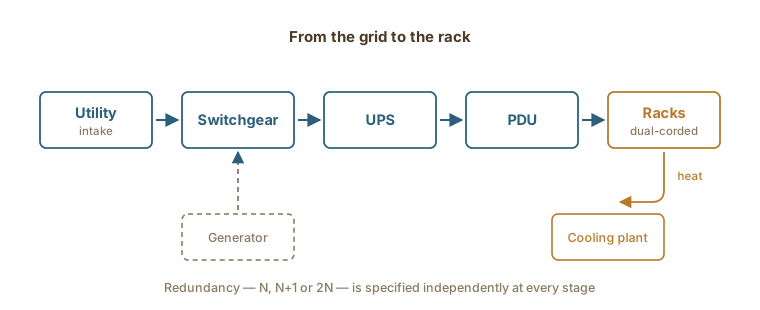
Electricity arrives from the utility at high voltage and is stepped down and subdivided until it reaches a power supply in a server. Every stage in that chain is a potential single point of failure, and the design of the facility is largely the story of how each one is duplicated.
- Utility intake and transformers — incoming high-voltage supply, ideally from more than one substation, stepped down for distribution within the site.
- Main switchgear — the switching and protection layer that isolates faults and transfers load between sources.
- Standby generators — diesel or gas sets that carry the full load during a utility outage, typically starting within seconds and sized with their own spare capacity.
- UPS systems — battery or flywheel plant that holds the load during the seconds between a utility failure and generators reaching full output, and filters power quality problems continuously.
- Power distribution units — floor or rack-level distribution that subdivides supply into the circuits feeding individual cabinets.
- Rack power supplies — dual-corded equipment drawing from two independent feeds, so either can fail without dropping the server.
Redundancy: what N, N+1 and 2N mean
Redundancy notation describes how much spare capacity sits behind each system, where N is the capacity required to carry the design load. The distinction is not academic — it determines whether the facility can be maintained without a shutdown.
| Topology | What it means | Behaviour under maintenance or failure |
|---|---|---|
| N | Exactly enough capacity, no spare. | Any component failure or planned maintenance takes the load down. |
| N+1 | One spare unit beyond requirement. | Survives a single component failure; shared distribution paths can still force a shutdown. |
| 2N | Two complete, independent systems. | Either full path can be taken offline entirely with no impact on IT load. |
| 2(N+1) | Two independent systems, each with a spare. | Tolerates a failure while one path is already down for maintenance. |
The practical difference sits between component redundancy and path redundancy. N+1 chillers behind a single set of pipework still leave the pipework as a single point of failure. This is why the useful question to an operator is not how many units are installed but whether every distribution path can be isolated without dropping load. Our shorter reference on data centre power design summarises the same chain component by component.
Cooling, PUE and the tropical penalty
Essentially all electrical energy delivered to IT equipment becomes heat. A 10 MW data hall is a 10 MW heater, and the cooling system exists to move that heat outside the building continuously.
In a conventional air-cooled hall, computer room air handlers push cold air under a raised floor or through overhead ducting into cold aisles; servers draw it across their components and exhaust it into hot aisles; containment panels stop the two streams mixing. The warm return air passes through a chilled water loop, and the heat is finally rejected outdoors through chillers and cooling towers — the airflow and containment mechanics are set out in our data centre cooling reference. Where rack density exceeds roughly 30 kW, air stops being viable and coolant is brought to the rack or to the chip itself, covered in our explainer on liquid cooling for high-density racks.
PUE and what it does not tell you
Power Usage Effectiveness is total facility energy divided by IT equipment energy. A PUE of 1.5 means every watt of computing costs half a watt of overhead; a PUE of 1.2 means 0.2 watts. It is the industry's default efficiency metric and it has barely moved: Uptime Institute's surveys put the global average at roughly 1.56, within a 1.55 to 1.59 band every year since 2020, held there by legacy facilities and by climates where efficient cooling is harder.
PUE has real limits as a comparison tool. It is a ratio, so a facility running inefficient servers can post an attractive number while wasting more energy overall. It varies with load — a half-empty hall reports a worse PUE than the same hall full — which is why serious specifications state the load point, as Singapore's do. And it says nothing about water consumption, now tracked separately as Water Usage Effectiveness.
Singapore's climate makes low PUE materially harder to achieve. Free cooling — using outside air when it is cold enough — is unavailable year-round, and high humidity reduces the effectiveness of evaporative heat rejection, because moisture evaporates poorly into air that is already close to saturated. The national response has been to raise the operating temperature instead: the Tropical Data Centre Standard, SS 697, sets out how to run halls safely at 26°C and above, with roughly 2 to 5 per cent cooling energy saved for each additional degree.
Data centre tiers and what they actually guarantee
The Uptime Institute Tier Standard classifies facility infrastructure into four levels by what the topology can tolerate. It is the most cited and most misquoted framework in the industry.
| Tier | Design characteristic | What it tolerates |
|---|---|---|
| Tier I | Basic capacity: single path, no redundant components. | Nothing. Any maintenance or failure means downtime. |
| Tier II | Redundant capacity components, single distribution path. | A component failure; the shared path still forces shutdowns. |
| Tier III | Concurrently maintainable: multiple distribution paths, one active. | Any component or path can be removed for service without dropping IT load. |
| Tier IV | Fault tolerant: multiple active paths, compartmentalised. | An unplanned single failure anywhere, with no impact on IT load. |
The widely quoted availability figures attached to these levels — 99.982 per cent for Tier III, 99.995 per cent for Tier IV — were removed from the Tier Standard in 2009 and are not part of it. Uptime's reasoning is worth understanding: operational practice affects real availability more than topology does. A Tier IV facility run badly can deliver worse uptime than a well-operated Tier II. Treat a Tier rating as a description of what the building can tolerate, not as a service level.
Two distinctions matter when reading marketing material. Uptime certifies at three separate stages — design documents, constructed facility, operational sustainability — and a certified design proves nothing about what was built. And "Tier III-ready" or "designed to Tier III" are self-assessed claims, not certifications. Ask which certificate exists, for which building, issued when.
Why organisations use purpose-built data centres
The case for moving equipment out of an on-premises server room is rarely about the servers. It is about everything wrapped around them:
- Power resilience an office cannot replicate. Dual utility feeds, generators with fuel contracts and UPS plant tested under load are impractical in a commercial building.
- Connectivity density. A carrier-neutral facility hosts many networks in one meet-me room, so adding a carrier or cloud on-ramp becomes a cross-connect rather than a construction project — compounded in Singapore by the systems that land at our cable landing stations.
- Cooling designed for the load. Sustained high-density heat rejection needs plant that office air conditioning cannot provide.
- Physical security and audit evidence. Layered access control, surveillance and logged entry produce the artefacts ISO 27001, PCI DSS and financial-sector audits ask for.
- Latency and regulatory placement. Some workloads must sit near an exchange or inside a jurisdiction. Placement is a design decision, not an afterthought.
Constraints and limitations
The honest limitations determine what is actually achievable in a given market:
- Power is the binding constraint, not space. Most mature markets ration grid connections, and a signed lease without a confirmed power allocation is not capacity.
- Density limits are structural. A hall designed for 6 kW racks cannot host 60 kW racks without rebuilding cooling, distribution and often the floor — frequently dearer than new build.
- Cooling consumes water. Evaporative systems trade electricity for water, a live constraint where water is imported or scarce.
- Long lead times. Grid connections, approvals and plant such as transformers and switchgear run to multi-year lead times, so supply cannot respond quickly to demand.
- Operational risk dominates. Most outages trace to process failures — untested transfers, mislabelled circuits, deferred maintenance — rather than to missing equipment.
Singapore's capacity rules in 2026
Singapore is unusual in that new data centre capacity is allocated administratively rather than simply built. Data centres consume roughly 7 per cent of national electricity, a share projected to reach about 12 per cent by 2030, on an island with no hydro, limited land and an almost entirely imported energy supply. That arithmetic produced a distinctive policy sequence.
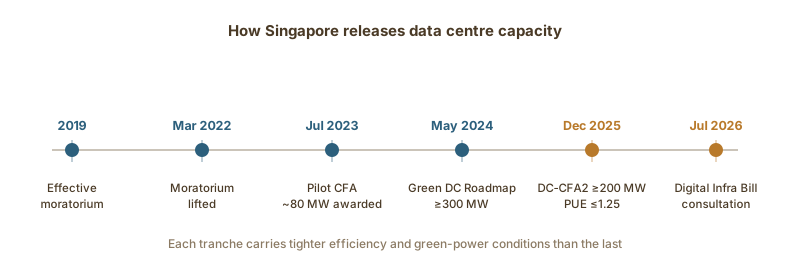
An effective moratorium on new builds ran from 2019 until March 2022. A pilot Call for Application then allocated roughly 80 MW in July 2023 across Equinix, GDS, Microsoft and an AirTrunk–ByteDance consortium, against more than twenty bids. The Green Data Centre Roadmap of May 2024 set out at least 300 MW of additional capacity in the near term, with a further 200 MW reserved for operators using green energy.
The second Call for Application, DC-CFA2, opened on 1 December 2025 offering at least 200 MW and closed to submissions on 31 March 2026, with awards not yet announced as of July 2026. Its conditions show the direction of travel: at least 50 per cent of power from eligible green pathways, BCA-IMDA Green Mark for Data Centres 2024 Platinum certification, a PUE of 1.25 or better at 100 per cent IT load, and compliance with SS 715:2025 on IT equipment energy efficiency. A 1.25 PUE commitment in an equatorial climate is a demanding engineering target, not a marketing figure.
The proposed Digital Infrastructure Bill would move this from allocation to standing regulation. Public consultation ran from 1 to 22 July 2026 and the Bill has not yet been tabled. As drafted it creates two regimes: a data centre licence for facilities with a critical IT load of 3 MW or more, carrying facility-level efficiency obligations including PUE; and a Major Foundational Digital Infrastructure licence for third-party colocation and cloud facilities at 10 MW or more, and for cloud providers averaging at least S$100 million in annual Singapore revenue, carrying security, resilience and business-continuity duties. Critically, PUE standards would reach existing facilities, not only new builds — so efficiency becomes an operating obligation rather than a condition of winning capacity.
On-premises, colocation and cloud compared
The building is one of three ways to host a workload, and the choice turns on who carries which risk.
| Model | You provide | Best suited to | Main drawback |
|---|---|---|---|
| On-premises server room | Building, power, cooling, hardware, operations. | Small estates, edge sites, equipment that must sit next to a process. | Resilience is limited by the host building; generators and dual feeds are rarely viable. |
| Colocation | Hardware and operating systems; the facility provides power, cooling, security and interconnection. | Regulated workloads, latency-sensitive systems, hardware you must control. | Capital and lifecycle risk on hardware stays with you; capacity is contracted years ahead. |
| Cloud | Configuration only; the provider owns everything below. | Variable demand, rapid change, managed platform services. | Sustained predictable load can cost more, and control over placement is limited. |
| Hybrid | A split, usually colocation for steady systems and cloud for burst. | Most enterprises of scale. | Two operating models, and an interconnect that must be engineered properly. |
Cloud does not remove the data centre; it moves it behind an API and out of your control. That is the right trade for many workloads and the wrong one where placement, hardware or interconnection is the requirement — which is why colocation demand has grown alongside cloud rather than being displaced by it.
Future outlook
Three trajectories are firm enough to plan around. Density keeps rising, which makes liquid cooling a default design assumption rather than a specialist option and steadily strands older halls that cannot be economically retrofitted. Efficiency becomes a licence condition rather than a differentiator — the Digital Infrastructure Bill would apply PUE standards to existing facilities, so operators who treated efficiency as marketing acquire a compliance programme.
And the region absorbs what Singapore cannot. Johor and Batam are building the capacity that the island will not approve, while Singapore retains the connectivity, ecosystem and regulatory certainty that keep latency-sensitive and regulated workloads here. The practical pattern is a split estate: control plane, financial systems and interconnection in Singapore, bulk training and storage next door. That makes the link between the two sites part of the architecture rather than a procurement detail.
Find data centre providers in Singapore
Browse directory profiles for colocation, wholesale and carrier-neutral data centre operators, with recorded facility and connectivity fields where available.
Frequently asked questions
What is critical IT load in a data centre?
Critical IT load is the electrical power available to the IT equipment itself, stated in kilowatts per rack or megawatts per facility, excluding cooling, lighting and losses. It is the unit colocation is priced in, the figure regulators cap, and the basis of cooling design — so a facility described as 58 MW is stating its critical IT load, not its floor area.
What is the difference between N+1 and 2N redundancy?
N is exactly the capacity needed to carry the design load. N+1 adds one spare unit, so a single component failure does not take the load down — but shared distribution paths can still force a shutdown for maintenance. 2N duplicates the entire system, including distribution, so a whole path can be taken offline with no impact. The useful question is not how many units are installed but whether every path can be isolated without dropping IT load.
Does a Tier III data centre guarantee 99.982 per cent uptime?
No. The Uptime Institute removed availability percentages from its Tier Standard in 2009, and they are not part of the current standard. Tier III means the facility is concurrently maintainable — any component or distribution path can be serviced without dropping the IT load. Actual availability depends more on operational practice than on topology, which is why a well-run Tier II site can outperform a poorly run Tier IV one.
What is a good PUE, and why is it harder to achieve in Singapore?
Power Usage Effectiveness is total facility energy divided by IT energy. The global average has sat between roughly 1.55 and 1.59 since 2020, so anything near 1.2 is strong. Singapore's tropical climate makes it harder: free cooling is unavailable year-round and high humidity reduces evaporative heat rejection. The local response is to run halls warmer under the Tropical Data Centre Standard SS 697, which targets 26°C and above and saves roughly 2 to 5 per cent of cooling energy per additional degree.
Why is data centre capacity restricted in Singapore?
Data centres already consume around 7 per cent of Singapore's electricity, projected to reach about 12 per cent by 2030, on an island with limited land and almost entirely imported energy. An effective moratorium ran from 2019 to March 2022. Capacity is now released in controlled tranches through competitive Calls for Application — roughly 80 MW in 2023, at least 200 MW under DC-CFA2 — each carrying binding efficiency and green-power conditions.
Will Singapore start licensing data centres?
That is the intent of the proposed Digital Infrastructure Bill, which went through public consultation from 1 to 22 July 2026 and has not yet been tabled. As drafted it requires a data centre licence at a critical IT load of 3 MW or more, carrying efficiency obligations including PUE, plus a Major Foundational Digital Infrastructure licence for colocation and cloud facilities at 10 MW or more and for large cloud providers. PUE standards would reach existing facilities, not only new builds.
Sources and further reading
- Uptime Institute — Tier Standard and Tier Certification
- Uptime Institute — Global Data Center Survey Results 2025
- IMDA — Green Data Centre Roadmap and Tropical DC Standard (SS 697)
- IMDA — Call for Application, Data Centre 2 (DC-CFA2)
- MDDI — Public Consultation on the Digital Infrastructure Bill
- Cushman & Wakefield — Asia Pacific Data Centre Update
Related resources
Go deeper on this topic
Knowledge base
- Data Centre Power Design: Redundancy Topology, Capacity and Operations
- Data Centre Cooling Explained: Airflow, Containment and Tropical Efficiency
- AI Data Centres Explained: Inside the AI Factory, From GPU Racks to Gigawatts
- AI Data Centre Cooling: Liquid Cooling for High-Density Racks
- Submarine Cable Landing Stations in Singapore: Sites, Systems and How New Cables Come Ashore
- Structured Optical Fibre Cabling in Singapore: Standards, Certifications and Design Best Practices
Vendor directories
Research cluster
Related analysis
Recent TechDirectory Insights coverage from the same research cluster.