
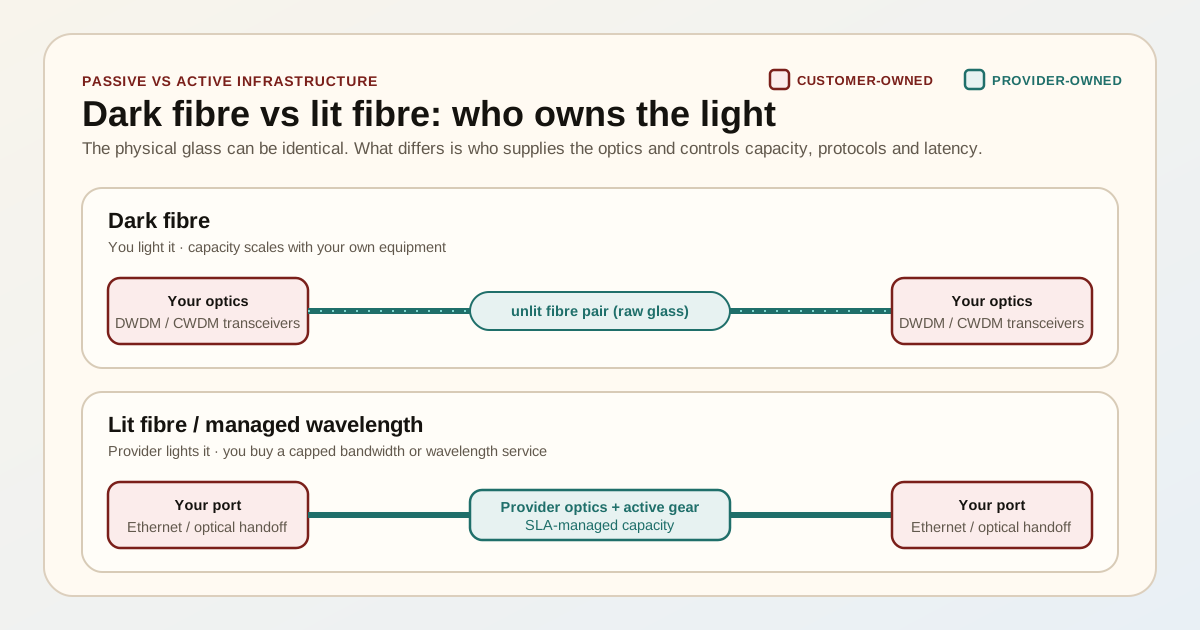
Dark fibre (also spelled dark fiber) is optical fibre that has been installed in ducts and along routes but left unlit — with no active transmission equipment attached by the provider. The customer leases one or more fibre pairs and lights them with its own transceivers and multiplexers. In Singapore, this raw terrestrial layer underpins the country's role as an Asia-Pacific connectivity and data centre hub, linking submarine cable landing stations, colocation campuses and enterprise sites into one low-latency mesh.
The model differs fundamentally from lit fibre or managed wavelength services, where the provider supplies and operates the active gear and sells you a bandwidth tier. With dark fibre, you own the light. That control is why financial institutions, hyperscalers and carriers pay for it, and it is also why dark fibre carries more operational responsibility than an ordinary circuit.
What is dark fibre? Core concepts
A dark fibre service hands over a continuous optical path between two termination points and nothing else. The provider installs, splices and maintains the glass inside ducts and manholes; the customer installs the optics that turn that glass into usable capacity. Because the provider's equipment never touches the traffic, the service is defined by the physical layer rather than by a service tier.
Four characteristics separate dark fibre from every managed alternative:
- Dedicated physical layer. Each leased strand or pair operates independently, with no bandwidth contention against other tenants.
- Protocol and equipment agnosticism. The customer chooses the transceivers, modulation format, wavelength plan and multiplexing scheme, and can change them without renegotiating a service.
- Long-term capacity control. Capacity scales by upgrading your own optics — from a single 100G wave to a fully populated DWDM system — rather than by moving up a provider's price tiers.
- Physical isolation. Traffic stays on dedicated glass, which reduces exposure compared with shared active infrastructure and simplifies encryption and compliance arguments.
Singapore's dark fibre routes benefit from an unusually dense duct network, much of it originally built for legacy telecommunications and power distribution and now reused for modern point-to-point fibre. That inherited civil infrastructure is part of why the island can support so many diverse fibre paths in a small area.
How dark fibre works: the technical breakdown
Fibre type and optical budget
Deployed dark fibre is almost always single-mode fibre compliant with ITU-T G.652.D. Modern single-mode fibre attenuates roughly 0.2 dB per kilometre at 1550 nm, comfortably within the G.652.D envelope, which keeps the optical power budget healthy over metro distances. Connections normally use a fibre pair — one strand to transmit, one to receive — although single-fibre bidirectional optics exist for links where strand count is scarce. For the underlying optics, dispersion and connector fundamentals, see optical fibre communications systems explained.
DWDM and capacity
The reason dark fibre scales so far is wavelength division multiplexing. By putting many light wavelengths onto the same pair, a customer can carry dozens of independent channels; a single fibre pair can move anywhere from 100 Gbps to several Tbps once it is populated with DWDM channels running at 100G, 400G or 800G per wave. Coarse WDM (CWDM) is a cheaper, lower-channel-count option for shorter or less demanding links. Crucially, all of this capacity is added by upgrading the customer's own transponders — the leased glass does not change.
Distance, latency and diversity
Light travels through glass at about two-thirds of its vacuum speed, or roughly 5 microseconds per kilometre one way, so propagation delay on a metro dark fibre link is dominated by physics rather than by equipment. Most intra-Singapore routes are under 50 km, which usually means little or no optical amplification is required. That short, predictable path is what makes dark fibre attractive for latency-sensitive workloads such as trading and synchronous storage replication.
Deployment runs through a site survey, fibre assignment by the provider, and customer-side installation of patch panels, transceivers and monitoring. Where resilience matters, providers can offer diverse routing — physically separate duct paths between the same two points — so a single cable cut cannot sever both legs. Diversity is a design choice that has to be specified and paid for; it is not automatic.
Core dark fibre use cases in Singapore
Building-to-data-centre (enterprise-to-cloud)
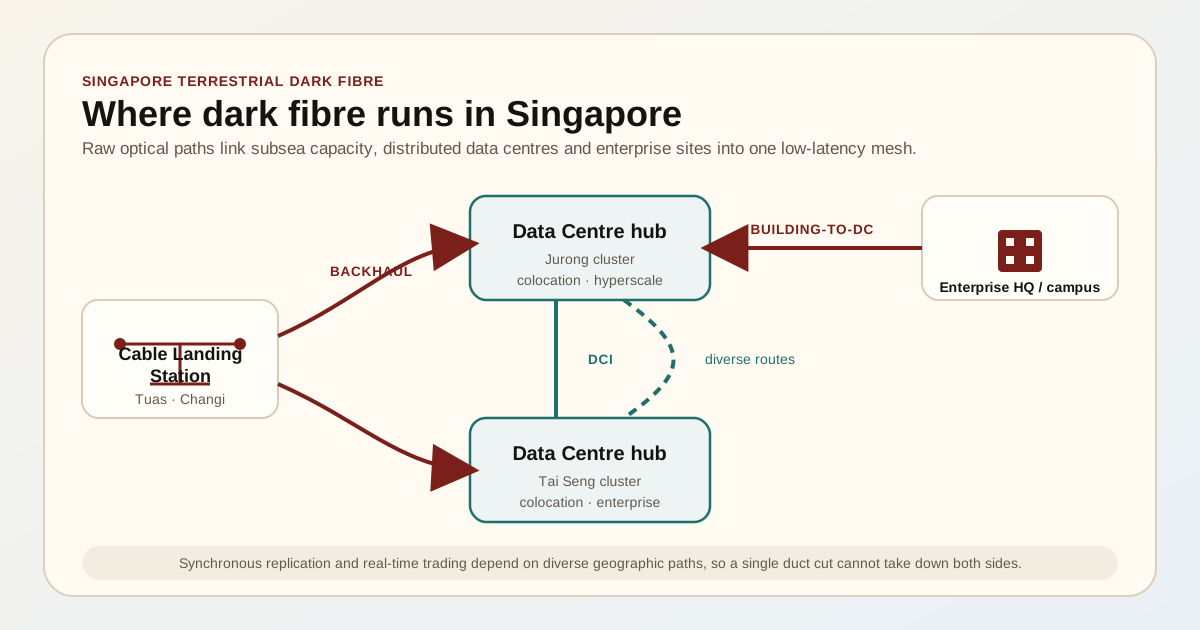
Banks, high-frequency trading firms and large enterprises use dark fibre to connect a headquarters or trading floor directly into colocation racks or a cloud on-ramp. This removes public-internet routing from the path, supports very large dataset transfers, and gives the security and latency profile that regulated workloads expect. For the assurance context that surrounds these links, see data centre certifications for banks and financial services.
Cable landing station backhaul
When a new submarine cable lands at a Singapore station such as Tuas or Changi, the raw international capacity still has to reach the data centre hubs where customers actually consume it. Hyperscalers and international carriers lease terrestrial dark fibre to backhaul that capacity from the cable landing station to clusters in Jurong or Tai Seng with minimal added latency. This is where the subsea and terrestrial worlds meet — see global connectivity: submarine cables, IXPs and BGP and submarine network operations and maintenance for the wet-plant side of the story.
Data centre interconnect (DCI)
Singapore's data centres operate as a distributed cluster rather than a single site, and dark fibre is the fabric that ties them together. High-core-count cables, ideally over diverse geographic paths, carry synchronous replication, load balancing and disaster recovery between facilities. DCI is typically built as a Layer 1 optical or Layer 2 Ethernet service — the distinction is covered in Layer 1 vs Layer 2 point-to-point circuits — and it terminates in the meet-me rooms and structured cabling that every carrier-neutral facility runs. Rising AI cluster density is now adding pressure to this layer as operators move larger training and inference datasets between sites; see AI data centre infrastructure.
Campus links and non-building address points
Universities, technology parks and corporate campuses use point-to-point dark fibre to extend a single private LAN across multiple buildings without touching a public network. A related pattern is the non-building address point (NBAP): connecting 5G small cells, IoT mesh networks or roadside sensor arrays that sit outside conventional buildings back to a core network.
IMDA regulation and structural separation
Dark fibre in Singapore sits inside one of the most deliberately structured telecom markets in the region. The framework exists to guarantee non-discriminatory wholesale access and to keep the party that owns the passive infrastructure separate from the parties that sell active services over it.
FBO and SBO licensing
Under the Telecommunications Act 1999, anyone who wants to build, own or operate physical infrastructure — ducts, manholes and fibre cables — needs a Facilities-Based Operations (FBO) licence. An operator that does not own the physical pipes but wants to acquire indefeasible-right-of-use (IRU) capacity or lease dark fibre to provide services needs a Services-Based Operations (SBO) licence. The distinction, and who needs which, is set out in our guide to FBO licences in Singapore.
The NetCo, OpCo and RSP layers
Singapore's Next Gen Nationwide Broadband Network mandated a structural separation of the network into distinct layers so that no single player controls both the glass and the retail relationship:
| Layer | Role | Who |
|---|---|---|
| NetCo | Owns and operates the passive infrastructure — the underground dark fibre. | NetLink Trust is the sole designated network company. |
| OpCo | Leases dark fibre from the NetCo and lights it to offer active wholesale services. | Licensed operating companies. |
| RSP | Buys wholesale services and sells end-user broadband and enterprise packages. | Retail service providers. |
RIO, ICO, COPIF and the CSD
Two wholesale instruments do most of the work. Singtel is designated a Dominant Licensee in specific wholesale spaces and must publish a Reference Interconnection Offer (RIO); Schedule 7A of that RIO governs the terms, provisioning and service levels under which Singtel must provide its Wholesale Dark Fibre Service to other FBOs on a point-to-point basis. NetLink Trust operates under an IMDA-approved Interconnection Offer (ICO) that sets out point-to-point and data centre connection services on non-discriminatory terms.
Two further codes shape how fibre physically reaches a site. The Code of Practice for Info-communication Facilities in Buildings (COPIF) requires developers to provide the lead-in ducts, riser space and main distribution frame rooms that let licensed operators terminate fibre into a building — the discipline covered in in-building telecommunications in Singapore. The Common Services Duct (CSD) framework governs how telecom ducts are laid under public roads, coordinating civil works so that routes are shared rather than dug up repeatedly.
Key dark fibre providers in Singapore
The market splits into infrastructure owners with their own ducts and enterprise-focused specialists that assemble services on top. The table below is a map of roles, not an endorsement or a price list.
| Provider | Role | What sets them apart |
|---|---|---|
| NetLink Trust | NetCo / primary FBO | Owns the nationwide passive fibre mesh; offers regulated point-to-point, data centre and NBAP connections. |
| Singtel | Dominant licensee FBO | Extensive legacy ducts, exchange nodes and cable landing station ownership; supplies dark fibre under the regulated RIO. |
| SPTel | Alternative FBO (ST Engineering / SP Group JV) | Routes fibre alongside the power grid, giving paths physically distinct from NetLink and Singtel — valued for critical-infrastructure diversity. |
| StarHub, M1 | Metro FBOs | Extensive metro fibre rings used for enterprise dark fibre and wholesale backhaul. |
| Lumen, Colt | International carriers | High-capacity metro dark fibre and data centre interconnect tuned for hyperscalers and global MNCs. |
| ViewQwest | Enterprise service provider | Custom enterprise architectures built on dark fibre cores for high-performance private lines. |
SPTel is worth calling out for one reason: because its cables follow SP Group's electricity infrastructure rather than the legacy telecom ducts, it can deliver a genuinely diverse third path. For a bank or a data centre operator designing disaster recovery, route diversity that does not share a duct with the primary carrier is often the single most valuable property on offer.
Dark fibre vs lit fibre and leased lines
Dark fibre is not always the right answer. Its advantages are decisive at high, sustained bandwidths or where control and security are non-negotiable, but for many sites a managed service is simpler and cheaper.
| Option | Control and capacity | Trade-off |
|---|---|---|
| Dark fibre | Full control of optics, protocols and latency; capacity scales with your own DWDM. | You buy and operate the optics, monitoring and expertise; longer to provision. |
| Lit fibre / managed wavelength | Provider supplies and runs the optics; you get a defined capacity. | Faster to deploy and lower operational burden, but capacity is capped by the service agreement. |
| Leased line / Ethernet service | Provider-managed, lower capacity, shared elements. | Simple and widely available, but higher cost per bit at scale and less latency control. |
As a rule of thumb, dark fibre's economics pull ahead above roughly 10–100 Gbps of sustained, long-lived demand, or wherever custom protocols, maximum security or synchronous replication are required. For hyperscalers and financial institutions, the total cost of ownership over a multi-year horizon frequently favours dark fibre once the optics are amortised. Below that threshold, a lit service usually wins on simplicity.
What buyers should check
Dark fibre shifts responsibility onto the customer. The service-level agreement typically covers fibre availability and mean time to repair, but the performance of your own optics is on you. Before signing, work through the checks below.
Find dark fibre and data centre connectivity providers in Singapore
Browse telecom carriers, data centre operators and structured cabling specialists that design, install and operate dark fibre, DWDM and data centre interconnect in Singapore.
Frequently asked questions
What is dark fibre in Singapore?
Dark fibre in Singapore is unlit optical fibre — installed glass with no active provider equipment attached — that an organisation leases and lights with its own transceivers and multiplexers. It gives the customer direct control over bandwidth, protocols, latency and security, and is used mainly for building-to-data-centre links, cable landing station backhaul and data centre interconnect.
What is the difference between dark fibre and lit fibre?
With dark fibre the provider supplies only the raw fibre pair and the customer supplies and operates the optics, so capacity scales with the customer's own DWDM equipment. With lit fibre or a managed wavelength service the provider supplies and runs the active equipment and sells a defined, capped capacity. Dark fibre offers more control; lit fibre is faster to deploy and lower effort.
Do you need a licence to lease dark fibre in Singapore?
To build or own physical fibre infrastructure you need a Facilities-Based Operations (FBO) licence under the Telecommunications Act 1999. To lease dark fibre or IRU capacity and provide services over it without owning ducts, you need a Services-Based Operations (SBO) licence. An ordinary enterprise buying a connectivity service from a licensed operator does not itself need a telecom licence.
Who owns the dark fibre network in Singapore?
Under the Next Gen NBN structural separation, NetLink Trust is the designated NetCo that owns and operates the nationwide passive dark fibre. Singtel owns extensive legacy ducts and cable landing stations and supplies dark fibre under its regulated Reference Interconnection Offer. SPTel, StarHub, M1 and international carriers such as Lumen and Colt also operate fibre in Singapore.
What is Singtel RIO Schedule 7A?
Schedule 7A of Singtel's Reference Interconnection Offer (RIO) is the IMDA-mandated document that sets the terms, provisioning process and service levels for Singtel's Wholesale Dark Fibre Service. Because Singtel is a Dominant Licensee, it must offer this point-to-point wholesale dark fibre to other facilities-based operators on non-discriminatory terms.
When is dark fibre worth it compared with a managed service?
Dark fibre usually makes sense above roughly 10–100 Gbps of sustained, long-lived demand, or wherever custom protocols, maximum security or synchronous replication are required — for example bank data centre interconnect, cable landing station backhaul or hyperscale campus links. Below that, a lit fibre or Ethernet service is normally simpler and cheaper because the provider carries the optics and operations.
Sources and further reading
- IMDA: Nationwide Broadband Network (NetCo/OpCo structural separation and Mandated Services)
- IMDA: Singtel RIO Schedule 7A — Wholesale Dark Fibre Service (PDF)
- IMDA: Telecommunication licensing (FBO and SBO)
- Singapore Statutes Online: Telecommunications Act 1999
- ITU-T Recommendation G.652: Characteristics of a single-mode optical fibre and cable
- NetLink NBN Trust: nationwide fibre network operator
Related resources
Go deeper on this topic
Knowledge base
- Types of Enterprise Internet Connectivity: Access, Transport and Overlay Options Compared
- Layer 1 vs Layer 2 Point-to-Point Circuits: Optical Wavelengths vs Ethernet Private Lines
- Optical Fiber Communications Systems Explained
- Global Connectivity: Submarine Cables, IXPs, and BGP
- FBO Licences in Singapore: IMDA’s Telecom Licensing Framework Explained
- In-Building Telecommunications Cabling and Network Installations in Singapore
- Structured Cabling in Data Centres
- Data Centre Certifications for Banks and Financial Services in Singapore
Vendor directories
Research cluster
Related analysis
Recent TechDirectory Insights coverage from the same research cluster.