Introduction
Enterprise connectivity solutions describe how a business combines internet access, private lines, optical transport, cloud on-ramps and software-defined overlays into one dependable wide area network. No single circuit type does all of that work. A regional enterprise in 2026 typically runs dedicated internet access at headquarters, broadband and 5G at branches, an IEPL or MPLS core between countries, DWDM or OTN capacity between data centres, private on-ramps into AWS or Azure, and an SD-WAN overlay deciding which application uses which path.
Our companion guide, Types of Enterprise Internet Connectivity, compares the access options side by side: DIA, broadband, 5G fixed wireless, satellite and MPLS. This article goes one layer deeper. It explains the engineering terms that decide what those products are actually worth — contention ratios and committed information rates, IPLC versus IEPL architecture, local loop diversity and demarcation points, DWDM wavelengths, the OTN digital wrapper, and the underlay/overlay model that SD-WAN is built on.

Table of Contents
- Core concepts: the enterprise connectivity stack
- How enterprise connectivity solutions work: underlay and overlay
- Dedicated internet access: contention, CIR and symmetry
- Private lines: IPLC, IEPL and Metro Ethernet
- Optical transport: DWDM and OTN
- Cloud on-ramps and NaaS fabrics
- Benefits and use cases
- Challenges and limitations
- Comparison with alternatives
- Future outlook
- Frequently asked questions
Core Concepts: The Enterprise Connectivity Stack
The fastest way to evaluate enterprise connectivity solutions is to place every quoted product on the correct layer. Carriers often quote a DIA circuit, an IEPL and an SD-WAN service in the same proposal as if they competed with each other. They do not. Each layer answers a different question.
| Layer | What it covers | Typical products | What it decides |
|---|---|---|---|
| Physical access | The fibre, copper or radio path into each building, ending at a demarcation point. | Local loops, building entries, Metro Ethernet access, 5G radio, satellite terminals. | Whether a single cut or conduit failure can take a site offline. |
| Underlay services | The commercial circuits that move packets between sites and the internet. | Dedicated internet access, business broadband, 5G FWA, LEO satellite, MPLS. | Raw performance: bandwidth, latency, packet loss and cost per site. |
| Private transport | Point-to-point or multipoint capacity that never touches ordinary internet routing. | IPLC, IEPL, Metro Ethernet E-Line and E-LAN, dark fibre. | Deterministic performance and isolation for site-to-site and cross-border traffic. |
| Optical transport | Wavelength-level capacity that multiplies what a fibre pair can carry. | DWDM wavelengths, OTN services, 400G/800G data-centre interconnect. | How far bandwidth can scale without laying new fibre. |
| Overlay and policy | Software control that steers applications across every underlay path. | SD-WAN, encrypted IPsec/GRE tunnels, SASE and SSE security PoPs. | Which path each application uses, and what happens during a failure. |
| Cloud on-ramp | Private connectivity into cloud and SaaS environments. | AWS Direct Connect, Azure ExpressRoute, NaaS fabrics such as Megaport and Equinix Fabric. | Whether cloud traffic rides the public internet or a private, predictable path. |
How Enterprise Connectivity Solutions Work: Underlay and Overlay
Modern WAN design separates the network into two planes. The underlay is the physical infrastructure and transport services — DIA, broadband, 4G/5G, IEPL or MPLS — that actually move packets between sites. Underlays are evaluated on raw metrics: latency, packet loss, jitter and cost. The overlay is the virtual fabric built on top. An SD-WAN establishes encrypted IPsec or GRE tunnels across all available underlay paths, measures each tunnel continuously, and steers applications by policy. MEF 70, the industry standard for SD-WAN services, defines it as an application-aware, over-the-top WAN connectivity service that directs application flows over multiple underlay networks regardless of the underlying technology or provider.
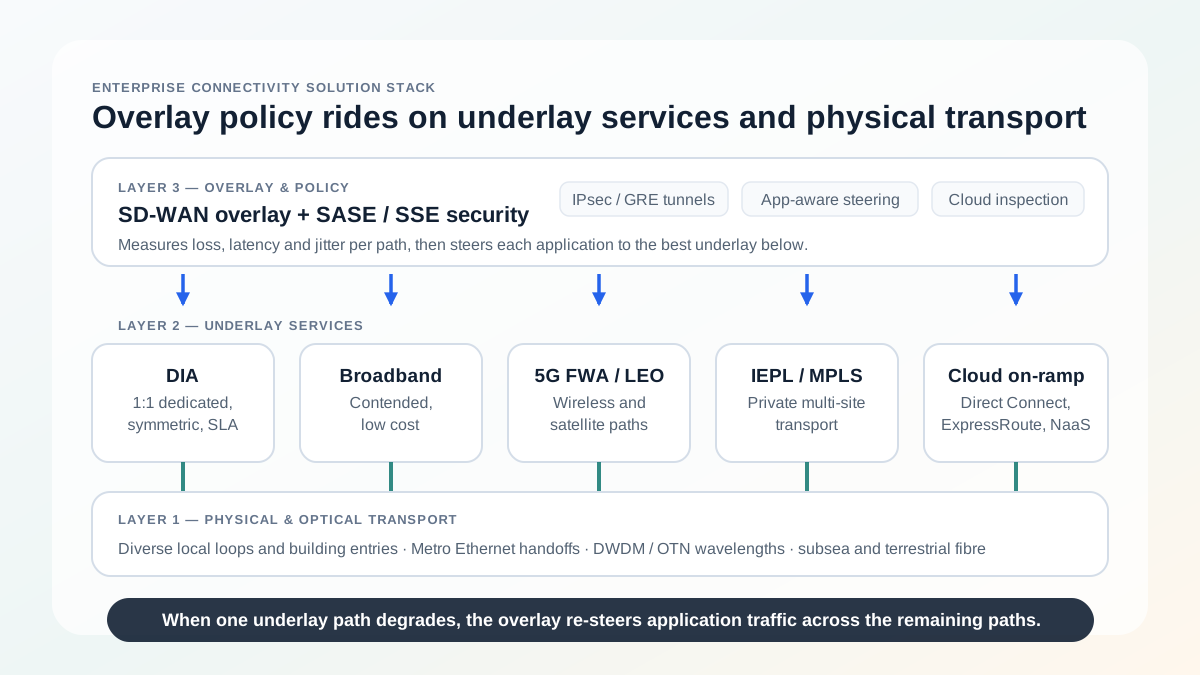
The practical benefit shows up during partial failures, which are far more common than total outages. If a subsea cable carrying a regional IEPL underlay develops a fibre fault or a latency spike, the overlay detects the degradation within seconds and re-steers real-time traffic — video calls, ERP sessions, VoIP — onto a backup DIA or LEO satellite path. Users experience a brief quality dip rather than an outage, and the carrier repairs the underlay without an emergency change window.
Where SASE and SSE fit
SASE (Secure Access Service Edge) converges SD-WAN networking with cloud-delivered security into a single service model; SSE (Security Service Edge) is the security pillar on its own. When a workforce is distributed across a region, maintaining individual branch firewalls stops scaling, so inspection moves from on-premises appliances into regional cloud points of presence. This matches the direction of NIST's zero trust guidance, which holds that no implicit trust should be granted based on network location alone. Our SASE buyer's guide covers the vendor landscape in detail.
Dedicated Internet Access: Contention, CIR and Symmetry
Dedicated internet access is the underlay workhorse of most enterprise connectivity solutions, and three technical terms explain why it costs several times more than business broadband of the same headline speed.
- Contention ratio. Business broadband runs on over-subscribed networks, commonly at ratios from 20:1 up to 100:1, meaning the advertised bandwidth is shared with neighbouring businesses. DIA is 1:1 — the purchased bandwidth maps to a dedicated port on the carrier's edge router.
- CIR versus PIR. A broadband speed is a PIR (Peak Information Rate): a best-effort burst ceiling. DIA is sold with a CIR (Committed Information Rate) equal to the line rate. A 1 Gbps DIA circuit is contractually able to carry 1 Gbps around the clock.
- Symmetry. Broadband plans are usually biased toward downloads. DIA is symmetrical, which matters for video conferencing, cloud backup, replication and AI workloads that push as much data up as they pull down.
These guarantees only have value if the contract states how they are measured and remedied. Before signing, read our explainer on network SLAs — uptime percentages, latency targets and repair clocks are where DIA pricing is actually justified.
Private Lines: IPLC, IEPL and Metro Ethernet
When traffic between two sites must never depend on public internet routing — trading links, payment switching, replication between data centres, cross-border corporate cores — enterprises buy private lines. The two international products are easy to confuse because carriers position them side by side.
IPLC: the Layer 1 circuit
An International Private Leased Circuit is a dedicated point-to-point Layer 1 circuit using time-division multiplexing over subsea and terrestrial fibre. It delivers an absolute bandwidth guarantee with fixed, deterministic latency and minimal jitter, because no other customer's traffic ever queues on the circuit. The trade-offs are hardware and rigidity: IPLCs traditionally interface through specialised customer premises equipment such as a CSU/DSU, and upgrading bandwidth is bound to fixed framing steps (E1/T1, STM-1), often requiring physical re-provisioning.
IEPL: the Layer 2 successor
An International Ethernet Private Line delivers the same isolation as an end-to-end Layer 2 Ethernet connection, carried over an underlying MPLS or OTN transport network. It hands off through standard Ethernet ports straight into enterprise switches, eliminating the CSU/DSU layer, and bandwidth can be adjusted in software — often in 10 Mbps increments — without changing physical interfaces. IEPL also supports point-to-multipoint topologies, mapping to the E-Line and E-LAN service types defined in the MEF Carrier Ethernet standards.
| Dimension | IPLC | IEPL |
|---|---|---|
| OSI layer | Layer 1 (physical, TDM) | Layer 2 (Ethernet) |
| Interface | CSU/DSU or serial router cards | Standard RJ-45 or fibre Ethernet ports |
| Provisioning | Telco-level, hardware-bound | Software-configured at the MAC layer |
| Scalability | Rigid, fixed framing steps (E1/T1, STM-1) | Granular, pay-as-you-grow bandwidth steps |
| Topology | Point-to-point only | Point-to-point or multipoint (E-Line / E-LAN) |
Metro Ethernet and local loop engineering
Within a city, Metro Ethernet plays the same role: Layer 2 connectivity between offices, data centres and carrier hotels. Whatever the product, its weakest point is usually the local loop — the final physical path into the building. Enterprises targeting 99.99%+ availability procure two loops with genuine diversity: a diverse path, entering the building through separate physical conduits so one excavation cannot cut both, and a diverse PoP, terminating at two different carrier exchanges. The demarcation point defines where the carrier's responsibility ends and the enterprise LAN begins; carriers install a managed network interface device (NID, sometimes called a SmartJack) there, which lets them run remote loopback tests and monitor SLA metrics right at the office edge. For the deeper Layer 1 versus Layer 2 distinction, see point-to-point circuits explained.
Optical Transport: DWDM and OTN
When capacity requirements outgrow individual circuits — data-centre interconnect, AI training clusters, storage replication — the buying conversation moves to the optical layer.
DWDM: many channels on one fibre
Dense Wavelength Division Multiplexing transmits many independent data streams down a single fibre pair by assigning each stream its own wavelength of laser light, packed tightly within the C-band spectrum. Typical systems run 40, 80 or 96+ parallel channels per fibre, and optical vendor Ciena notes that modern coherent systems carry 400 Gb/s to 800 Gb/s per wavelength. The enterprise significance is simple: bandwidth scales by lighting new wavelengths instead of laying new fibre. DWDM is also the technology behind dark fibre economics — one leased fibre pair can be multiplied into terabits of private capacity.
OTN: the digital wrapper
Optical Transport Network, standardised as ITU-T G.709, builds on DWDM by adding a standard frame structure across the optical and electrical layers — often called the digital wrapper. Where a plain DWDM wavelength typically carries one service, OTN enables electrical-layer grooming: multiple sub-rate services such as Ethernet, Fibre Channel and IP can be packed efficiently into a single high-capacity wavelength. OTN also contributes built-in forward error correction, hardware-level performance monitoring and fault isolation, and supports Layer 1 wire-speed encryption — securing an entire cross-border flow without the latency and throughput penalty of encrypting at Layer 3 with IPsec. Background on the physics is in our optical fibre communications explainer.
Cloud On-Ramps and NaaS Fabrics
Cloud traffic is now a first-class WAN design input, and routing it over the public internet is a choice, not a default. Dedicated cloud on-ramps such as AWS Direct Connect and Azure ExpressRoute provide private Layer 2/3 connections from enterprise networks into cloud environments: AWS documents Direct Connect as dedicated connectivity using 802.1Q VLANs with private, public and transit virtual interfaces, and Microsoft states that ExpressRoute connections do not traverse the public internet.
The newer pattern is the Network-as-a-Service fabric. Providers such as Megaport, Equinix Fabric and Console Connect let an enterprise provision virtual cross-connects in near real time between its physical points of presence — an IEPL or MPLS headend, a data-centre cage — and multiple cloud regions simultaneously. Instead of ordering a new circuit per cloud per region, the enterprise buys one physical port into the fabric and spins up software-defined connections as architectures change. Our cloud on-ramp explainer covers the routing details.

Benefits and Use Cases: Matching Solutions to Sites
The value of understanding the stack is that different sites justify different mixes. Over-provisioning a small branch with private lines wastes budget; under-provisioning a data-centre interconnect with internet VPNs creates risk.
| Site type | Typical solution mix | Why |
|---|---|---|
| Headquarters | DIA primary, second DIA or broadband backup, SD-WAN edge, SASE breakout. | Committed bandwidth and SLAs where the most users and revenue concentrate. |
| Ordinary branch | Business broadband plus 5G FWA backup under SD-WAN. | Low cost per site; the overlay compensates for best-effort underlays. |
| Data-centre interconnect | DWDM/OTN wavelengths or dark fibre, with Layer 1 encryption. | Terabit-scale, deterministic, low-latency capacity for replication and AI clusters. |
| Cross-border core | IEPL (or legacy IPLC) between regional hubs, DIA local breakout. | Predictable latency and isolation across subsea routes. |
| Cloud edge | Direct Connect / ExpressRoute via a NaaS fabric. | Private, consistent paths into IaaS and SaaS without per-region circuit sprawl. |
| Remote or temporary site | LEO satellite or 5G FWA folded into the overlay. | Fast deployment where fibre is slow, expensive or unavailable. |
Challenges and Limitations of Enterprise Connectivity Solutions
- Lead times and construction risk. Private lines and diverse local loops can take months to deliver, especially where new building entries or subsea capacity are involved. Wireless and satellite bridges are often needed during the wait.
- Diversity claims need verification. Two circuits from two carriers can still share one duct, riser or exchange. Ask for route maps and conduit evidence, not just the word "diverse" in a proposal.
- Private does not mean encrypted. IEPL, MPLS and wavelength services isolate traffic but do not encrypt it by default. Regulated data still needs IPsec, MACsec or OTN Layer 1 encryption, and key ownership should be explicit.
- Demarcation disputes. When performance degrades, the demarc and NID decide whose problem it is. Sites without a managed NID or clear demarcation documentation spend longer in fault triage.
- Operational complexity. An overlay over five underlay types across three providers multiplies telemetry, ticketing and escalation boundaries. One accountable operations owner matters more than any individual SLA.
- Skills scarcity. Optical transport, BGP routing and SD-WAN policy design are distinct specialisations; few in-house teams hold all three, which is why managed service providers anchor most multi-country deployments.
Comparison With Alternatives: Internet-Only, Private-Only or Hybrid
An internet-only WAN — DIA and broadband everywhere, encrypted overlays on top — is the cheapest and fastest to deploy, and for many mid-sized businesses it is enough. Its limits appear on long international paths, where public routing can vary hop by hop, and in workloads that need deterministic latency. A private-only WAN — MPLS or leased lines to every site — offers the opposite profile: predictable but expensive, slow to change and poorly matched to cloud-bound traffic that has to hairpin through a headquarters.
In practice, most enterprises land on a hybrid: internet underlays for the many, private transport for the few paths that earn it, optical capacity where volume demands it, and an overlay unifying policy across all of them. The per-option trade-offs are tabulated in our enterprise internet connectivity guide.
The Future of Enterprise Connectivity Solutions
The commercial direction is well documented. TeleGeography's WAN market forecast projects MPLS revenue falling from $130 billion in 2025 to $57 billion in 2030, while dedicated internet access grows from $99 billion to $142 billion and SD-WAN from $23 billion to $42 billion. The pattern behind those numbers is the architecture described in this guide: internet-first underlays wrapped in software-defined policy, with private and optical transport reserved for the paths that genuinely need them.
Three shifts are worth watching. First, 400G and 800G coherent wavelengths are moving data-centre interconnect buying from managed circuits toward wavelength and dark-fibre economics, driven heavily by AI cluster replication. Second, NaaS fabrics are turning connectivity procurement into an API call, shortening the gap between a cloud architecture decision and the network that supports it. Third, security and networking purchasing continue to converge under SASE, so connectivity contracts increasingly bundle inspection, zero trust access and path policy in one commercial envelope.
Find enterprise connectivity providers in Singapore
Browse directory profiles for telecom carriers, SD-WAN specialists and managed network providers that report work across DIA, private lines, optical transport and cloud on-ramps.
Frequently asked questions
What are enterprise connectivity solutions?
Enterprise connectivity solutions are the layered combination of physical access, internet underlays (DIA, broadband, 5G, satellite), private transport (IPLC, IEPL, Metro Ethernet, MPLS), optical transport (DWDM, OTN), cloud on-ramps and SD-WAN or SASE overlays that connect a company's sites, data centres, clouds and users into one wide area network.
What is the difference between IPLC and IEPL?
An IPLC is a Layer 1 point-to-point circuit using TDM transport; it needs specialised interface hardware such as a CSU/DSU and scales in rigid framing steps. An IEPL is a Layer 2 Ethernet private line delivered over MPLS or OTN; it hands off through standard Ethernet ports, scales bandwidth in software and supports multipoint topologies. Both isolate traffic from the public internet.
What is the difference between DWDM and OTN?
DWDM is the optical technique of carrying many data streams on different laser wavelengths over one fibre pair. OTN (ITU-T G.709) adds a standard digital frame on top of DWDM, enabling several sub-rate services to be groomed into one wavelength, plus forward error correction, hardware performance monitoring and Layer 1 encryption.
What is the underlay and overlay in SD-WAN?
The underlay is the set of physical transport services that move packets — DIA, broadband, 5G, satellite, IEPL or MPLS — judged on latency, loss and cost. The overlay is the virtual network SD-WAN builds on top: encrypted IPsec or GRE tunnels across every underlay path, with application-aware policies that re-steer traffic when a path degrades.
When does a business need DIA instead of broadband?
When the site needs committed rather than best-effort bandwidth. DIA is uncontended (1:1), symmetrical and sold with a committed information rate and SLA, while broadband is contended — commonly 20:1 to 100:1 — and download-biased. Headquarters, cloud-heavy offices and revenue-critical sites usually justify DIA; smaller branches often run broadband under an SD-WAN overlay instead.
What is a cloud on-ramp?
A cloud on-ramp is a private Layer 2/3 connection from an enterprise network into a cloud provider, bypassing the public internet — for example AWS Direct Connect or Azure ExpressRoute. NaaS fabrics such as Megaport, Equinix Fabric and Console Connect let enterprises provision virtual connections to multiple clouds from one physical port.
Sources and further reading
- Mplify/MEF: MEF 70 SD-WAN Service Attributes and Services
- Mplify: Carrier Ethernet service standards (E-Line, E-LAN, E-Tree)
- ITU-T Recommendation G.709: Interfaces for the Optical Transport Network
- Ciena: What is WDM or DWDM?
- AWS: Direct Connect in Amazon VPC Connectivity Options
- Microsoft Learn: What is Azure ExpressRoute?
- TeleGeography: WAN Market Size 2025-2030 Forecast
- NIST SP 800-207: Zero Trust Architecture
- IETF RFC 4364: BGP/MPLS IP Virtual Private Networks
Related resources
Go deeper on this topic
Knowledge base
- Types of Enterprise Internet Connectivity: Access, Transport and Overlay Options Compared
- SD-WAN Explained: Overlay Architecture, Path Selection and What It Does Not Fix
- SASE in WAN Communication Technology: Where SD-WAN Converges With Cloud-Delivered Security
- Layer 1 vs Layer 2 Point-to-Point Circuits: Optical Wavelengths vs Ethernet Private Lines
- Optical Fiber Communications Systems Explained
- Dark Fibre in Singapore: Technical Use Cases, Regulations, and Data Centre Connectivity
- Cloud Connect and On-Ramps Explained
- Network SLAs Explained: Uptime, Latency, Jitter, Packet Loss and Credits
Vendor directories
Research cluster
Related analysis
Recent TechDirectory Insights coverage from the same research cluster.