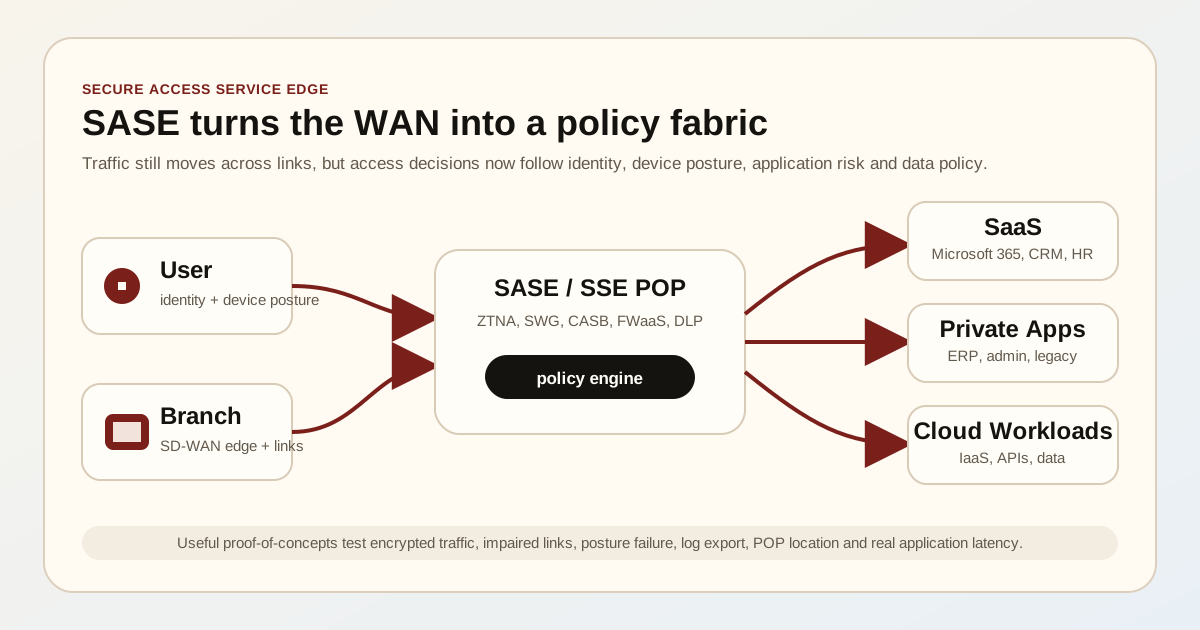
For two decades, many enterprises bought the WAN as a transport problem. Branch traffic moved over MPLS, internet circuits, VPN tunnels, firewalls and proxies. Security sat around the route, not inside it. SASE changes that relationship. It treats the route, the user, the device, the application, the data and the inspection path as parts of the same decision.
That makes SASE in WAN communication technology a control-plane decision disguised as a network-security project. The platform that wins the RFP may decide how traffic is steered, where encrypted sessions are inspected, which device posture signals matter, how SaaS usage is recorded, where logs live and who gets blamed when a branch cannot reach an application.
This guide is written for buyers comparing secure SD-WAN, Security Service Edge, ZTNA, SWG, CASB, firewall-as-a-service, DLP, digital experience monitoring and managed SASE providers. It should be read alongside the broader SD-WAN enterprise guide and VPN and zero trust access explainer.
Why SASE matters now
SASE has become the buying frame for modern WAN refreshes because enterprise traffic no longer has one centre. Users work from offices, homes, hotels and mobile devices. Applications live in SaaS platforms, private data centres, public cloud accounts and third-party APIs. Backhauling every session to a corporate perimeter is slow, brittle and often irrelevant to the risk.
NIST's zero trust architecture explains the security logic: no implicit trust should be granted because an account or asset is on a local network, owned by the enterprise or appears to be in the right place. Authentication and authorization for the subject and device should happen before a session reaches the resource. SASE operationalises that idea across WAN access.
The breach-pressure case is also clear. Verizon's 2026 DBIR top takeaways say 31% of breaches now start with software vulnerabilities, 48% involve ransomware and mobile-targeted lures see 40% higher click rates than traditional email phishing. Those numbers do not prove SASE solves every breach pattern. They explain why buyers want access control, inspection, telemetry and route policy to follow the user instead of staying pinned to an office.
How SASE works
A SASE path usually starts at the endpoint or branch edge, crosses one or more WAN underlays, enters a cloud or regional enforcement point, passes through identity and security controls, and then reaches the application. The important part is not the packet path alone. It is the policy evaluation attached to the path.
The WAN layer: SD-WAN stops being only a routing tool
In a conventional refresh, SD-WAN is often sold for link diversity, application-aware steering, encryption, zero-touch branch deployment and better use of cheap internet links. In a SASE programme, those same functions become security inputs. If a device fails posture checks, if a SaaS application is unsanctioned, if a branch link is impaired or if a user moves from office Wi-Fi to a hotel network, the SD-WAN decision and the access decision should not contradict each other.
The SSE layer: inspection moves closer to the user
Security Service Edge is the security half of SASE. ZTNA narrows private application access. SWG filters web traffic. CASB and DLP watch SaaS usage and sensitive data movement. FWaaS applies firewall controls from the cloud. Cloudflare's SASE learning material lists ZTNA, SWG, CASB and DLP among the typical core technology components of a SASE platform.
For buyers, SSE quality is not proven by a feature list. It is proven by the inspection path under load: TLS inspection on, policy active, users in real regions, SaaS traffic mixed with private apps, logs retained and a broken session traced from endpoint to POP to application.
The policy plane: the buyer is purchasing an adjudicator
A mature SASE policy does not simply say "allow finance". It may evaluate user identity, group, device health, patch state, network location, session risk, application sensitivity, data classification, requested action, country, time and whether the request touches sanctioned or unsanctioned AI tools.
That consistency is valuable. It is also where vendor lock-in begins. Once identity connectors, endpoint agents, firewall rules, DLP dictionaries, SaaS posture checks, route policy and logs settle into one system, the switching cost stops being a licensing line. It becomes an operating model.
Buyer translation table
| Vendor term | What it should mean | Question that finds the gap |
|---|---|---|
| Unified SASE | Common policy, telemetry, agent strategy and management across SD-WAN and SSE. | Which functions share one policy engine, and which are integrated by API or acquisition? |
| Universal ZTNA | Application-level access for users on and off the corporate network. | What happens to an active session when device posture fails mid-session? |
| Full-stack POP | The same inspection capability is available where users actually connect. | Show the services enabled in each POP, not just the total POP count. |
| AI security | Threat detection, GenAI usage control, policy assistance and investigation support with audit trails. | What tenant data feeds the model, and can every AI-generated policy change be reviewed? |
| Data sovereignty | Control over inspection location, log storage, admin access, key handling and support access. | Can traffic inspection and logs be pinned to specific jurisdictions? |
| Lower TCO | Fewer appliances, consoles, endpoint agents, duplicate support contracts and manual troubleshooting steps. | What licences, agents, support tiers and professional services are still required? |
Risks and trade-offs
Unification reduces toil, then concentrates risk
Separate VPN clients, endpoint agents, firewall managers, SD-WAN controllers, CASB consoles, proxy policies, DLP rules and monitoring tools make simple questions slow. Who is this user? Which app was touched? Was the device compliant? Which POP handled the session? Where did the data go? In a fragmented stack, each answer belongs to a different owner.
A unified SASE platform can shorten that hunt. The second-order effect is concentration. A single agent can become a privileged dependency on every endpoint. A single POP fabric can become a shared availability risk. A single management plane can become the place where a mistaken policy blocks revenue. A single vendor can become the only party able to prove what happened.
Dual-vendor SASE is not wrong. It is expensive in coordination.
Dual-vendor designs can be rational. A company may already have a strong SD-WAN estate and want a separate SSE provider. A regulated buyer may split control deliberately. A global enterprise may need one vendor's WAN reach and another vendor's security depth.
The cost is not just integration. It is adjudication. When the video call drops, when a private app is slow, when a DLP rule blocks a file, when SaaS traffic hairpins through the wrong region, the buyer needs one operational owner. Without that owner, dual-vendor SASE becomes a meeting pattern.
VPN replacement is a migration programme, not a switch-off date
A broad VPN can be dangerous because it grants too much network reach. An incomplete ZTNA migration can also be dangerous because it strands the people who fix payroll, plants, stores and production incidents. Start with low-risk web apps. Move internal apps with clean identity and protocol profiles. Leave thick-client, legacy, admin, OT and emergency access paths until they have named owners and test evidence.
TLS inspection is the stress test many demos avoid
Every SASE pitch mentions low latency. The meaningful test is low latency with inspection enabled. SWG, FWaaS, CASB, DLP, sandboxing, IPS, DNS controls and malware scanning all add work. A thin test is easy to pass: one office, one cloud app, a light policy set, a nearby POP. A useful test is uglier: encrypted traffic, file upload, browser and thick-client flows, SaaS and private apps, multiple geographies, an impaired link, a blocked device posture event and a helpdesk ticket opened with only the information a real user would provide.
Data sovereignty is wider than data residency
Many buyers reduce sovereignty to "where are logs stored?" The harder questions are operational. Who can administer the tenant from outside the jurisdiction? Where are support artifacts copied? Are packet captures retained? Are DLP matches stored as full content or hashes? Can the vendor's AI features train on customer telemetry? Can encryption keys be held by the customer?
Proof-of-concept checklist
Where SASE is heading
WAN buying is moving from circuit design toward policy-fabric design. The winning platform will be judged less by the shape of the network diagram and more by whether the business can prove who accessed what, through which path, under which policy, from which device and with what data exposure.
Every WAN RFP is becoming a security RFP. Enterprises refreshing MPLS, firewall, VPN, proxy or branch connectivity contracts will increasingly be asked why those projects are separate. That favours vendors with a credible path across SD-WAN, SSE, endpoint posture, SaaS controls, logging and digital experience monitoring.
The older WAN saw circuits and prefixes. The SASE WAN sees subjects and resources. A finance user's device posture, the sensitivity of a file being uploaded, the SaaS app's risk rating and the user's jurisdiction may all influence the path. That is a different kind of network. It is closer to policy computation than static connectivity.
Shortlist network and security providers in Singapore
Compare telecom providers, SD-WAN specialists, managed security companies and system integrators who can help design, migrate and operate secure WAN access.
Browse network and security providers
Frequently asked questions
What is SASE in WAN communication technology?
SASE, or Secure Access Service Edge, is a cloud-delivered architecture that combines WAN connectivity and security controls. In practice, it brings SD-WAN together with functions such as ZTNA, SWG, CASB, DLP and firewall-as-a-service so access can be decided by identity, device posture, application risk and data policy.
What is the difference between SASE, SSE and SD-WAN?
SD-WAN handles WAN connectivity, path selection and branch routing. SSE is the security service edge, including cloud-delivered security controls such as ZTNA, SWG, CASB and DLP. SASE is the broader architecture that converges SD-WAN and SSE into a unified policy and operations model.
Does SASE replace VPN?
SASE can replace many remote-access VPN use cases with ZTNA, especially for private web apps and SaaS access. Legacy thick-client, admin, OT and emergency access paths may need a staged migration or retained fallback until they have been mapped and tested.
What should buyers test in a SASE proof of concept?
Buyers should test encrypted traffic inspection, device posture failure, impaired WAN links, SaaS and private app performance, POP failover, log export, DLP behaviour, helpdesk visibility and whether policy changes can be reviewed and rolled back.
Is single-vendor SASE better than dual-vendor SASE?
Single-vendor SASE can reduce tool sprawl and policy fragmentation, but it concentrates risk in one platform. Dual-vendor SASE can preserve best-of-breed choices or deliberate control separation, but it increases coordination, troubleshooting and ownership complexity.
How does zero trust fit into SASE?
Zero trust supplies the access principle: do not grant broad trust based on network location. SASE applies that principle to WAN access by checking identity, device posture, application context and risk before allowing a session to reach a resource.
Sources and further reading
- Verizon 2026 Data Breach Investigations Report
- NIST SP 800-207: Zero Trust Architecture
- Cloudflare Learning Center: What is SASE?
Related resources
Go deeper on this topic
Knowledge base
- Firewalls Explained: NGFW vs WAF vs FWaaS
- Identity and Access Management (IAM) Explained
- SD-WAN Explained: Overlay Architecture, Path Selection and What It Does Not Fix
- VPN Explained: Site-to-Site, Remote Access and Zero Trust Trade-Offs
- Network SLAs Explained: Uptime, Latency, Jitter, Packet Loss and Credits
- Managed Security Services Explained: MSS, MDR, SOC and SIEM
- API Security Explained: The OWASP API Top 10 and How to Defend Your APIs
Vendor directories
Research cluster
Related analysis
Recent TechDirectory Insights coverage from the same research cluster.