IT network management best practices are the operational disciplines that keep an enterprise network reliable, secure and fast enough for the business that depends on it. As networks have grown to span campus, branch, data centre, public cloud and remote workers, the distance between a network that is merely built and one that is well managed has widened. A well-run network is quiet; a poorly managed one produces outages, security incidents and slow applications the business feels before anyone opens a monitoring console.
The stakes are measurable. The Uptime Institute's outage research consistently finds that networking has become the single largest cause of IT-service outages, and that most serious incidents trace back to process and configuration failures rather than faulty hardware — problems that disciplined network management is designed to prevent. In its 2024 analysis, IT and networking issues together accounted for 53 per cent of all reported outages.
This guide sets out the practices that close the gap between build and operation: documentation, proactive monitoring, change control, performance, capacity planning, security, resilience, automation and continuous improvement. It is written for network and IT leaders, managed-service providers and technology buyers — including teams in Singapore working under Cyber Security Agency and PDPA requirements — who need a durable operating model rather than a product list.
Table of contents
- What are IT network management best practices?
- Technical breakdown: nine network management best practices
- Key benefits and enterprise use cases
- Network management challenges, risks and limitations
- Network management trends: AIOps, intent and automation
- Comparative analysis: reactive vs proactive network management
- The future of network management
- Frequently asked questions
What are IT network management best practices?
IT network management is the set of activities used to operate, monitor, secure and evolve the network that carries an organisation's traffic. Best practices are the repeatable methods that make those activities reliable rather than ad hoc: they turn firefighting into a managed process with defined ownership, evidence and controls.
The classic reference model is FCAPS — Fault, Configuration, Accounting, Performance and Security management — which originated in the OSI systems-management standards (ISO/IEC 7498-4) and was carried into the ITU-T's Telecommunications Management Network model in Recommendation M.3400. FCAPS is now a foundational lens rather than the operational state of the art — modern practice layers automation, observability and intent on top of it — but it still helps check that an approach covers every functional area, not just the ones a tool makes easy.
Best practices also borrow from service-management frameworks. ITIL 4, now published by PeopleCert after its 2021 acquisition of Axelos, frames two disciplines that sit at the centre of network operations: service configuration management, which maintains accurate records of configuration items in a configuration management database (CMDB), and change enablement (renamed from ITIL v3's change management), which assesses and authorises changes to reduce the risk they introduce. The through-line across every model is the same: management is continuous, evidence-based, and anchored on a single, current source of truth.
Technical breakdown: nine network management best practices
The nine practices below map to the operating loop reliable networks run on. They are ordered deliberately: documentation feeds monitoring, monitoring feeds change and automation, and the results feed back into documentation. No single practice suffices alone; the value is in running them as one connected cycle.
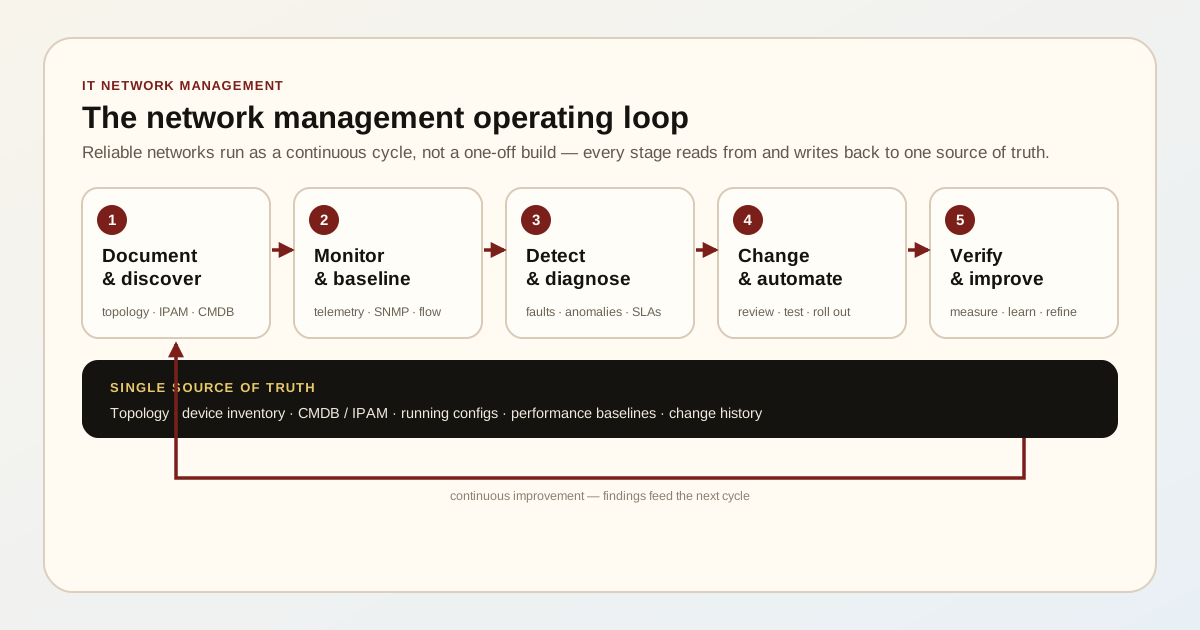
1. Maintain a single source of truth (documentation and discovery)
Effective network management rests on documentation that reflects the network as it actually is. That means a current picture of topology, device inventory, IP addressing (IPAM), interface and connectivity relationships, and the configuration of every router, switch, firewall and load balancer. The most common failure here is drift: the diagram and the CMDB slowly diverge from reality until, during an incident, no one can trust either. Automated discovery and configuration backups counter drift, refreshing the record continuously instead of relying on someone to update a spreadsheet. Treat documentation as an operational asset with an owner, keep device configurations in version control, and require that any change to the network is also a change to its record.
2. Monitor the network proactively — from SNMP polling to streaming telemetry
Proactive network monitoring means detecting and diagnosing problems before users report them. The classic approach polls devices over SNMP for interface counters, errors and device health; modern networks add model-driven streaming telemetry (gNMI) and flow analysis (NetFlow, IPFIX, sFlow) to see who is talking to whom. Track the metrics that predict user experience — bandwidth utilisation, latency, jitter, packet loss and device saturation — and set baselines so that "normal" is defined rather than guessed. Alerting should fire on meaningful deviations from baseline, not every threshold crossing, because alert noise is how real signals get missed. Historical trend analysis then turns monitoring into a planning tool: recurring patterns become capacity and design decisions.
3. Configuration management and change enablement
Change is where network reliability is most often won or lost. Uptime Institute's research identifies configuration and change-management errors as the leading cause of network-related outages — behind 45 per cent of them in its 2024 analysis, ahead of third-party provider failures at 39 per cent. Disciplined change enablement is the countermeasure: standardised procedures, peer review and authorisation before implementation, defined maintenance windows, and pre- and post-change validation. Keep configuration baselines and backups so a change can be rolled back to a known-good state, and run automated compliance checks to catch drift and unauthorised changes. The goal is not bureaucracy but to make every change reviewed, tested, reversible and recorded. NIST's SP 800-128 (2011, updated 2019) covers security-focused configuration management in depth.
4. Performance optimisation and quality of service
Once a network is monitored, the data reveals where it underperforms: congestion points, sub-optimal routing, and latency-sensitive applications competing with bulk traffic. Quality of Service (QoS) is the primary lever. The IETF's Differentiated Services architecture — RFC 2474 and RFC 2475, both from 1998 — lets a network classify and prioritise traffic so that voice and video conferencing are protected from best-effort downloads. Beyond QoS, traffic shaping smooths bursts, load balancing spreads demand, caching cuts repeated transfers, and route and switch tuning reduces latency and loss. On the wide-area network, SD-WAN and SASE add application-aware path selection that steers each flow over the link best suited to it. Performance work is never finished; it responds continuously to what monitoring shows.
5. Capacity planning and scalability
Capacity planning ensures the network can carry current and future demand without degradation or emergency upgrades. The method is simple but often skipped: analyse historical utilisation and growth trends, forecast bandwidth, port and device needs, and set headroom thresholds that trigger an upgrade before a link runs hot rather than after users complain. Scalability is designed in, not bolted on — modular and spine-leaf topologies, virtualisation, cloud elasticity and software-defined networking all allow capacity to be added without redrawing the network. Capacity planning also converts surprise capital spend into predictable, budgeted growth.
6. Network security, segmentation and compliance
Network security is inseparable from network management; the same visibility and control that keep a network fast also keep it defensible. Best practice is defence in depth — firewalls, intrusion detection and prevention, encryption, and disciplined patch and vulnerability management — combined with segmentation that limits how far an intruder or compromised device can move. Micro-segmentation and network access control enforce least privilege by role and device, and the zero trust model, described in NIST's SP 800-207, replaces implicit trust in the internal network with per-request verification — with the NIST Cybersecurity Framework 2.0 (2024) giving the governance structure. In Singapore, critical information infrastructure operators work under the Cyber Security Agency's code of practice, while every organisation must meet the PDPA's requirement for reasonable security arrangements — a legal obligation that maps directly to access control, patching and segmentation. See our cybersecurity basics explainer for the wider control set.
7. Resilience, redundancy and disaster recovery
Networks fail, and the measure of a well-managed one is how gracefully it does so. Resilience starts by identifying the critical services and dependencies the business cannot operate without, then engineering redundancy around them: diverse links and carriers, redundant devices and power, and — for the most critical workloads — geographically separate sites. Failover should be automatic and, importantly, tested. A disaster recovery and business continuity plan is only as good as its last rehearsal; drills and simulated failures turn a document into a capability, exposing the dependency no one mapped and the runbook step that no longer works. This discipline matters even inside the facility: Uptime Institute reports that power remains the largest single cause of significant data-centre outages, at 45 per cent in its 2025 analysis, most often traced to UPS systems.
8. Automation, orchestration and network-as-code
Automation removes the repetitive, error-prone manual work that causes so many incidents. At its simplest, scripts handle provisioning, VLAN changes and software updates. More mature teams adopt network-as-code: configurations are declared in version-controlled files, validated in a pipeline, and deployed through continuous integration and delivery — the same NetDevOps discipline software teams use. Orchestration coordinates changes across domains and enforces policy consistently, and intent-based networking lets operators declare what they want ("these sites can reach that application") and have the system compute and maintain the configuration. Automation is powerful because it scales — which is also its risk, so guardrails, staged rollouts and automated rollback keep a mistaken change from propagating network-wide.
9. Continuous monitoring and improvement
The loop closes with review. Periodic audits check that performance, security posture and configuration compliance still meet the standard, and post-incident reviews convert outages into design changes rather than repeated apologies. Service-level objectives and clear reporting keep the network accountable to the business, while feedback from users surfaces the pain points a dashboard cannot see. Continuous improvement also means keeping people current — network engineering now spans automation, cloud and security, and a team's skills are as much a managed asset as its hardware. NIST's SP 800-137 formalises this ongoing posture for security; the same mindset applies to the network as a whole.
Key benefits and enterprise use cases of network management
The payoff from disciplined network management is concrete: higher availability, faster recovery, a stronger and more demonstrable security posture, lower cost through planned rather than emergency capacity, and faster, safer change. It also produces the evidence — audit trails, configuration history, SLA reporting — that regulated organisations need to show they are in control.
These benefits show up differently across environments. A multi-site enterprise uses centralised monitoring and SD-WAN to run dozens of branches from one console under a single policy. A data centre or colocation footprint leans on redundancy, capacity planning and rigorous change control, where one misconfiguration can cascade. A multi-cloud estate depends on visibility and segmentation across environments the network team does not own. In manufacturing and OT settings, segmentation between operational and corporate networks and reliable wireless roaming are the priorities. And a managed-service provider runs all of this at scale for many clients, where automation and a clean source of truth separate a profitable contract from a loss-making one.
For Singapore enterprises, regulation sharpens the case. Financial institutions manage their networks to standards adjacent to the Monetary Authority of Singapore's technology risk expectations; operators of critical information infrastructure meet the Cyber Security Agency's code of practice; and any organisation handling personal data must satisfy the PDPA's protection obligation. In each case, the practices in this guide are how compliance is achieved and evidenced, not optional hygiene.
Network management challenges, risks and limitations
Adopting these practices is harder than listing them. It is worth being candid about where teams struggle. Tool sprawl and data silos are the most common trap: a monitoring tool here, a config manager there, a separate flow analyser, none sharing a source of truth, producing conflicting data and blind spots. Alert fatigue follows — a system that cries wolf trains operators to ignore it, and the one real alert is lost in the noise. The skills gap is real too: network management now demands automation, cloud and security fluency on top of routing and switching, a combination that is scarce and expensive.
Automation introduces a risk of its own. Because it scales, a flawed automated change scales the mistake with it — the blast radius of a bad push is the whole network, not one device, which is why staged rollouts, guardrails and automated rollback matter more as automation deepens. Documentation drift quietly undermines everything else; a source of truth that is 80 per cent accurate is dangerous precisely because people trust it. Full observability also carries a cost and complexity that must be justified, and heterogeneous, brownfield estates rarely fit a single clean model. Finally, the honest limitation: most of these problems are organisational, not technical. Uptime Institute's data shows human error is a factor in roughly two-thirds of outages but is rarely the root cause — around 85 per cent of human-error incidents trace to staff not following procedures, or to procedures that were flawed to begin with. Better tools do not fix a broken process.
Network management trends: AIOps, intent-based networking and network-as-code
Network management is shifting from human-driven operation toward software-driven, and increasingly AI-assisted, operation. Several developments are converging.
AIOps and observability apply machine learning to the flood of telemetry, correlating events, cutting alert noise and surfacing an incident's probable cause faster than a human sifting dashboards. Intent-based networking moves operators from configuring devices to declaring outcomes and letting the system translate, verify and enforce them. Network-as-code and NetDevOps bring software-engineering discipline — version control, testing, CI/CD — to network changes. And the security and network worlds continue to merge under SASE and zero trust, so connectivity and protection are managed as one system, not two.
The adoption curve is steepening. Gartner projects that 30 per cent of enterprises will automate more than half of their network activities by 2026, up from under 10 per cent in mid-2023, and expects half of enterprises to use AI for day-two network operations over the same period. The direction is clear even where the exact timing is not: the manual, device-by-device network operation of the past decade is giving way to policy-driven, code-managed, machine-assisted operation.
Comparative analysis: reactive vs proactive network management
The clearest way to gauge a network management practice is to place it on a maturity curve. Most organisations can locate themselves on the ladder below and identify the next rung, rather than aiming for full autonomy in one leap.
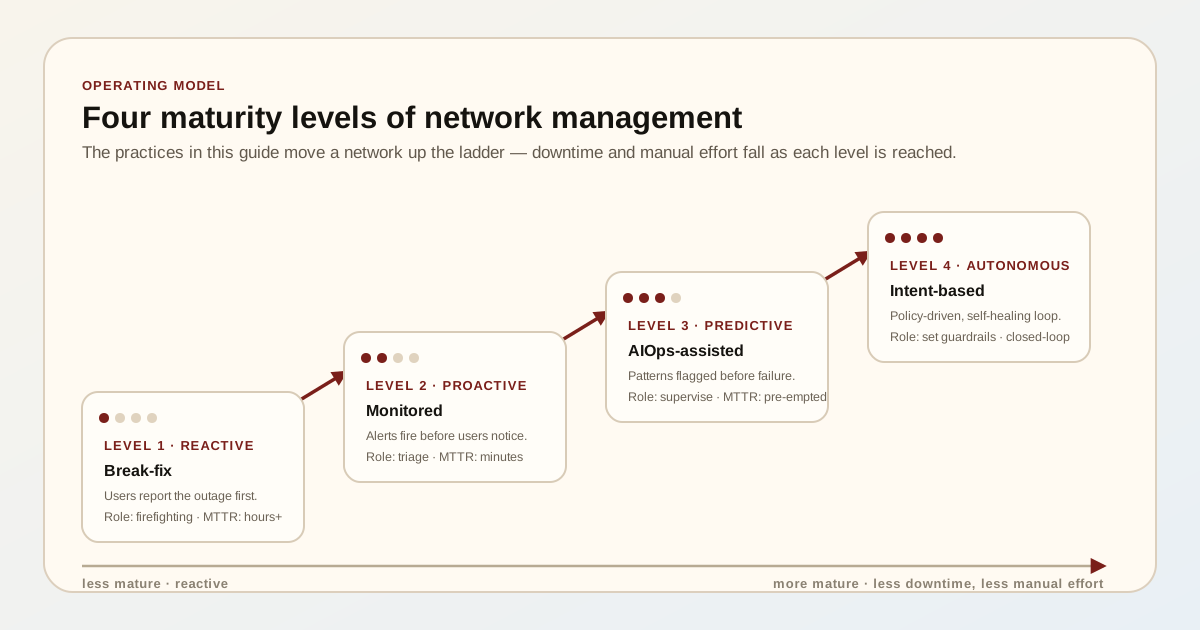
| Dimension | Reactive (Level 1) | Proactive (Level 2) | Predictive / Autonomous (Level 3-4) |
|---|---|---|---|
| Trigger | User reports the outage | Alert fires before users notice | System predicts or prevents the fault |
| Tooling | Basic device access, manual checks | Monitoring, baselines, config backups | AIOps, streaming telemetry, intent engine |
| Change approach | Ad hoc, manual, unrecorded | Standardised change enablement | Network-as-code, automated rollback |
| Typical MTTR | Hours to days | Minutes to hours | Seconds, or pre-empted |
| Human role | Firefighting | Triage and tuning | Setting policy and guardrails |
| Cost profile | Low capex, high outage cost | Balanced | Higher tooling spend, lowest downtime |
Reactive management is not always wrong — for a small, stable network, full automation may not pay for itself. But it scales badly: as a network grows, break-fix operation means more outages, longer recovery and rising firefighting cost. Proactive management is the pragmatic target for most enterprises, and where the return on effort is highest, because monitoring and change control prevent the incidents reactive teams spend their days chasing. Predictive and autonomous operation is where larger, more critical environments are heading — but it extends proactive discipline rather than replacing it. An intent engine layered on a network no one has documented will simply automate the confusion.
The future of network management: toward autonomous networks
The trajectory of network management points toward networks that increasingly run themselves. Self-healing operation — where the system detects a degradation, diagnoses it and remediates within its guardrails before a human is involved — is moving from vendor demonstration to production for well-instrumented environments. Digital twins let changes be tested against a model before they touch production, shrinking the change risk behind so many outages today. And generative AI is beginning to draft configurations and summarise incidents, with Gartner expecting it to generate a meaningful share of initial network configurations within a few years.
None of this removes the need for the fundamentals; it raises their importance. An autonomous system acting on a stale source of truth, or enforcing a flawed policy at machine speed, fails faster and more widely than a human would. The network engineer's role shifts from configuring devices to defining intent, writing the guardrails and validating that the automation does what was asked. Sustainability adds a further dimension, as power and cooling constraints — acute in a dense market like Singapore — make efficient operation a design goal, not an afterthought. The enduring lesson is unchanged by the technology: reliable networks are managed as a continuous, evidence-based discipline, and the tools only amplify the quality of that discipline, in either direction.
Frequently asked questions
What are the most important IT network management best practices?
The foundational practices are: keeping accurate documentation as a single source of truth, monitoring the network proactively against baselines, controlling every change through a review-and-rollback process, securing the network in depth with segmentation and zero-trust principles, and automating repetitive work with guardrails. They are run as a continuous loop and reviewed regularly, so each cycle improves on the last.
What is FCAPS in network management?
FCAPS is the classic network-management functional model covering Fault, Configuration, Accounting, Performance and Security management. It originated in the OSI systems-management standards and was carried into the ITU-T's Telecommunications Management Network model (Recommendation M.3400). It remains a useful checklist for confirming an approach covers every functional area, though modern operations add automation, observability and intent-based control on top.
How does proactive network monitoring differ from reactive management?
Reactive management responds to problems after users report them, so the network team spends its time firefighting and mean time to repair is measured in hours or days. Proactive monitoring detects and diagnoses issues from telemetry and baselines before users are affected, cutting recovery time to minutes and preventing many incidents outright — which is why it is the pragmatic target for most enterprises.
What tools are used for IT network management?
Core categories include network monitoring and observability platforms (SNMP polling and streaming telemetry), flow analysers (NetFlow, IPFIX, sFlow), IP address management and CMDB systems for the source of truth, configuration and compliance managers, and automation and orchestration built on network-as-code and CI/CD pipelines. Mature teams add AIOps for event correlation and intent-based networking for policy-driven operation. The products matter less than whether they share one source of truth.
How does network management relate to network security?
They overlap heavily. The visibility and control that keep a network fast and reliable also keep it defensible: monitoring detects anomalies, configuration control prevents insecure changes, and segmentation limits how far an attacker can move. Security frameworks such as NIST's Zero Trust Architecture (SP 800-207) and Cybersecurity Framework 2.0, and in Singapore the CSA's code of practice and the PDPA's protection obligation, are implemented largely through network management practices.
What are network management best practices for small businesses in Singapore?
Small organisations should right-size the same fundamentals rather than skip them: keep a current record of the network and its configurations, back those up, monitor the handful of links and devices that matter, patch promptly, and segment guest and critical traffic. Many outsource day-to-day management to a managed-service provider, and eligible SMEs can use Singapore's Productivity Solutions Grant to offset the cost of pre-approved tools. The priorities are documentation, backups, monitoring and access control.
SEO Recommendations
Suggested internal links
- Software Defined Networking Explained — Link from the capacity and automation sections, where SDN enables programmable, scalable networks.
- Cybersecurity Basics — Link from the security and segmentation practice for the wider control set.
- SASE in WAN Communication Technology — Link from the performance and trends sections on WAN path selection and security convergence.
- LAN vs WAN Basics — Link from the monitoring section for the underlying performance metrics.
- Layer 2 vs Layer 3 Networks — Link from the capacity and design discussion of routing and segmentation choices.
Image placement suggestions
- Inside the technical breakdown — alt text: The network management operating loop: document, monitor, detect, change and improve, resting on a single source of truth.
- In the comparative analysis section — alt text: Network management maturity ladder from reactive break-fix to autonomous intent-based operations.
Additional long-tail keyword opportunities
- IT network management best practices 2026
- proactive network monitoring vs reactive
- network configuration and change management best practices
- network management maturity model
- network automation and network-as-code
- network segmentation and zero trust best practices
- enterprise network management Singapore
Sources and further reading
- ITU-T Recommendation M.3400 — TMN management functions (FCAPS)
- NIST SP 800-137 — Information Security Continuous Monitoring (ISCM)
- NIST SP 800-128 — Guide for Security-Focused Configuration Management (2011, updated 2019)
- NIST SP 800-207 — Zero Trust Architecture
- NIST Cybersecurity Framework (CSF) 2.0 — CSWP 29 (2024)
- IETF RFC 2474 — Definition of the Differentiated Services Field (DS Field)
- IETF RFC 2475 — An Architecture for Differentiated Services
- Uptime Institute — Annual Outage Analysis 2024
- Uptime Institute — Annual Outage Analysis 2025 (press release)
- Gartner — 30% of enterprises will automate more than half of network activities by 2026 (18 Sept 2024)
- PeopleCert — ITIL 4 (owner of AXELOS best-practice portfolio)
- Cyber Security Agency of Singapore — Cybersecurity Act and Codes of Practice
- PDPC — Data Protection (Protection Obligation, s.24 PDPA)
- Software Defined Networking Explained: Architecture, Controllers and Where SDN Actually Landed
- LAN vs WAN: The Networking Basics Every Business Should Know
- Cybersecurity Basics: Core Concepts, Controls and How They Fit Together
- SASE in WAN Communication Technology: A 2026 Buyer's Guide
- Layer 2 vs Layer 3 Networks: Who Controls the Routing, and Why It Decides What You Buy