Software defined networking (SDN) separates the part of a network that decides where traffic should go from the part that actually forwards it. In a conventional router or switch, both live in the same chassis: the device runs its own routing protocols, builds its own view of the topology, and programs its own forwarding table. SDN lifts that decision-making logic out into software with a view of many devices at once, and leaves the hardware below to do what it is genuinely good at — moving packets at line rate.
The idea is roughly two decades old, and it has aged instructively. The technology most people still associate with software defined networking — OpenFlow, a protocol that lets a controller install match-action rules directly into switches — never became the way enterprises build networks. The underlying principle won anyway. Every hyperscale data centre fabric, every public cloud virtual network, every SD-WAN overlay and every 5G standalone core in production is software defined in the sense that matters: control logic is centralised, programmable and decoupled from forwarding silicon. Understanding SDN means understanding both the original architecture and the compromise the industry settled on.
- SDN separates the control plane (deciding paths and policy) from the data plane (forwarding packets), and exposes the control plane through APIs.
- The reference architecture has three layers — application, control, infrastructure — joined by northbound and southbound interfaces.
- OpenFlow is now largely legacy. Enterprise data centres settled on BGP EVPN-VXLAN fabrics with a centralised intent controller above a distributed routing control plane.
- The clear wins are hyperscale fabrics, cloud virtual networks, SD-WAN/SASE and cloud-native 5G cores — not enterprises programming their own switches.
- The trade-off is unchanged: a network-wide view buys automation and provability at the cost of a concentrated failure and attack domain.
What is software defined networking?
Software defined networking is an architectural approach, not a product. It rests on two commitments. The first is separation: forwarding devices stop making autonomous decisions and instead execute instructions given to them. The second is programmability: whatever makes those decisions exposes an API, so networks can be driven by software rather than by a person typing into a console.
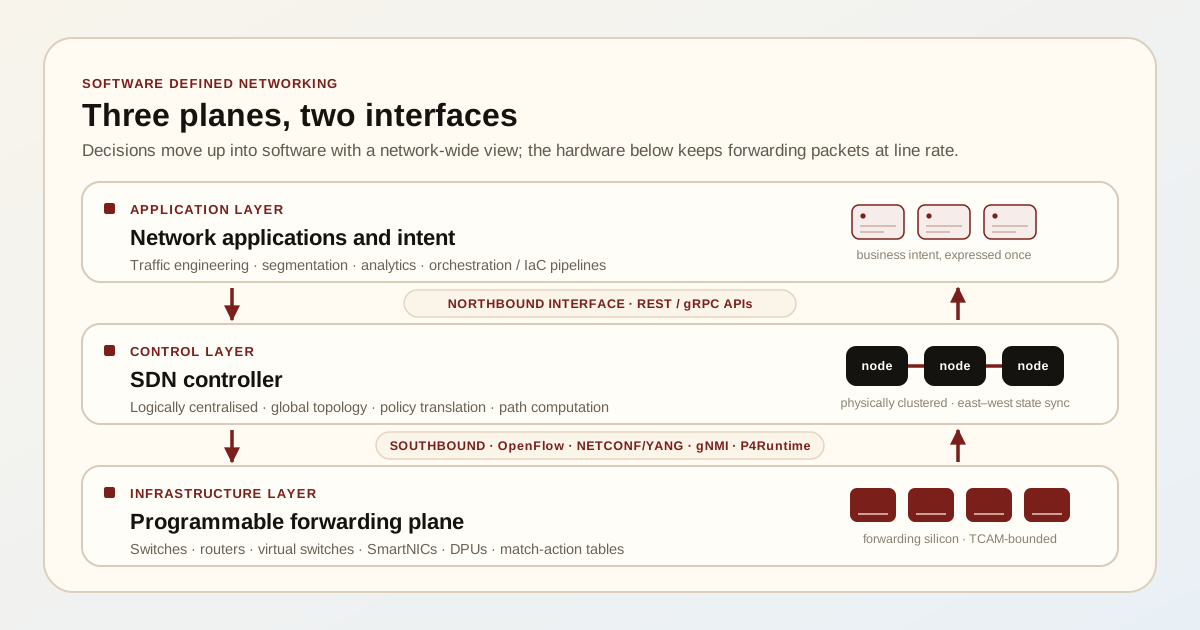
| Layer | What lives there | How it talks downward |
|---|---|---|
| Application | Traffic engineering, segmentation policy, analytics, orchestration and IaC pipelines | Northbound interface — REST or gRPC APIs |
| Control | The SDN controller: topology database, policy translation, path computation, cluster state | Southbound interface — OpenFlow, NETCONF/YANG, gNMI, P4Runtime, OVSDB |
| Infrastructure (data plane) | Physical switches and routers, virtual switches such as Open vSwitch, SmartNICs and DPUs | Match-action flow tables in ASIC memory |
The detail that trips people up is that the control layer is logically centralised, not physically singular. Production controllers run as clusters sharing state, and federate with each other across domains — the point at which "centralised control" quietly becomes a distributed systems problem, with all the consistency and partition questions that implies.
From Ethane to the Linux Foundation: how SDN evolved
The separation idea predates the acronym: the IETF's ForCES working group was formalising Forwarding and Control Element Separation from 2004. The direct ancestor is Ethane, a Stanford project from 2006–2007 that enforced enterprise policy centrally and produced OpenFlow, published in 2008. Momentum built fast. The Open Networking Foundation was founded in 2011 to steward OpenFlow; VMware bought Nicira for about US$1.26 billion in 2012, producing what became NSX; and in 2013 Google published B4, its SDN-controlled inter-datacentre WAN, showing that centralised traffic engineering could drive wide-area links to near-full utilisation.
The institutional endpoint is telling. In December 2023 the ONF folded its portfolio into the Linux Foundation, splitting the projects into three directed funds — LF Broadband, Aether (SD-Core and SD-RAN) and P4, which absorbed the P4 language, Stratum and SD-Fabric. The organisation created to standardise OpenFlow wound down as an independent body without OpenFlow ever becoming the enterprise standard it was built to be. The ideas were absorbed; the protocol was not.
How software defined networking works
At the bottom, a forwarding device holds flow entries. Each is a match condition — some combination of ingress port, MAC and IP addresses, VLAN, protocol and ports — paired with an action: forward, rewrite a header, mirror, meter, drop. A packet arrives, the pipeline finds the highest-priority match, the action executes. This is not exotic; it is what switching silicon has always done. What SDN changes is who writes those entries.
The southbound interface: OpenFlow, and what replaced it
OpenFlow 1.0 arrived in 2009, with 1.3 the version vendors actually implemented. In 2026 it survives mainly inside Open vSwitch and in academic work; almost nobody buys a switch for its OpenFlow support. The southbound role has passed to a family of protocols with different jobs: NETCONF with YANG models and gNMI for configuration and streaming telemetry, OVSDB for virtual switch state, and P4Runtime where the forwarding pipeline itself is programmable.
The northbound interface and intent
Northbound APIs are where the operational value sits. Rather than describing paths, an operator declares a desired state — these workloads may reach that service, this tenant is isolated, that traffic class takes the low-latency path — and the controller renders it into device configuration. Intent-based platforms go further, continuously comparing the running network against the declared design and flagging drift instead of waiting for someone to notice. That closed loop, not flow-rule installation, is what most buyers are purchasing when they buy SDN today.
Proactive, reactive and hybrid rule installation
- Proactive: rules pushed before traffic arrives. Predictable and fast, but consumes table space for flows that may never appear.
- Reactive: the first packet of an unknown flow is punted to the controller, which computes and installs a rule. Flexible, but adds setup latency and makes the control channel both a congestion point and a denial-of-service target.
- Hybrid: common paths pre-installed, exceptions handled on demand — what essentially every production system does.
Table capacity is the constraint absent from most architecture diagrams. Fine-grained matching lives in TCAM, which is expensive, power-hungry and finite. A design assuming per-flow rules for every conversation in a large data centre hits silicon limits long before it hits a conceptual one.
Benefits and use cases of software defined networking
- Automation at scale. A change is expressed once and applied consistently, rather than replicated across dozens of device configurations by hand.
- Provable policy. Segmentation and access rules can be validated against a model before deployment, then monitored for drift.
- Traffic engineering. A global view lets paths follow live conditions and application priority, not shortest-path metrics alone.
- Faster delivery. New tenants, environments and segments become software operations measured in minutes, not change windows.
- Telemetry. The controller is a natural aggregation point for flow-level visibility individual devices cannot provide.
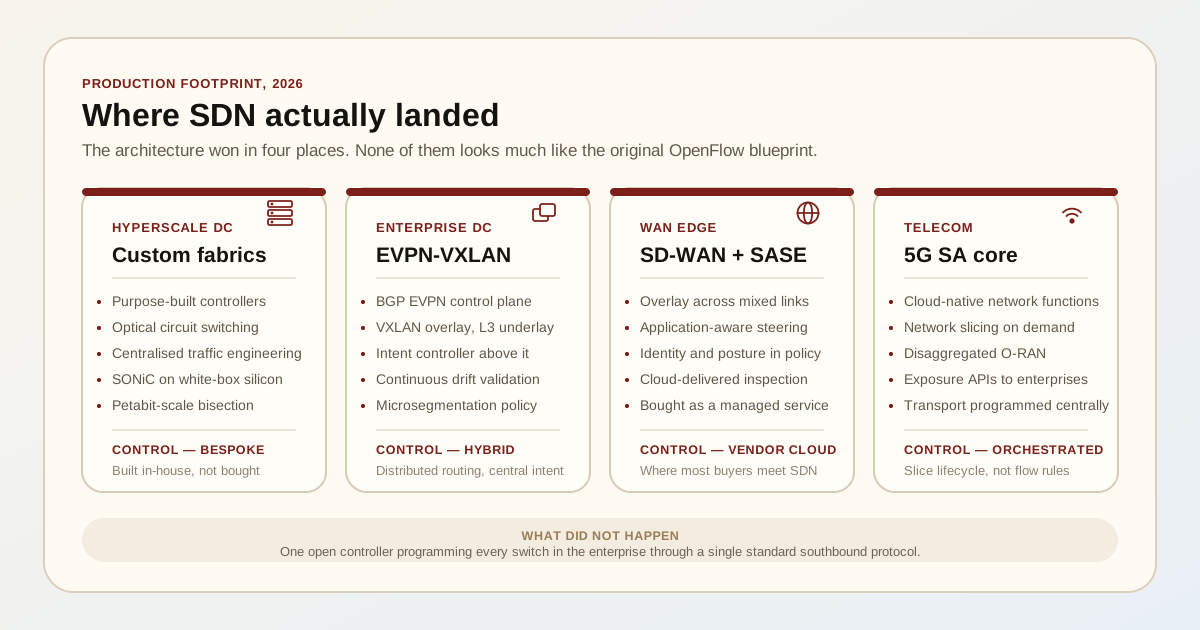
Four deployment patterns account for nearly all of the value being realised today.
| Where | What SDN looks like there | Who operates it |
|---|---|---|
| Hyperscale data centres | Purpose-built controllers driving Clos fabrics with optical circuit switching. Google's Jupiter fabric, built on its Orion controller, now scales past 13 Pb/s of bisection bandwidth. | Built in-house |
| Enterprise data centres | BGP EVPN-VXLAN fabrics with an intent controller above them handling design, deployment, drift detection and microsegmentation. | Enterprise team on a vendor platform |
| WAN and branch edge | SD-WAN overlays selecting paths across fibre, broadband, MPLS and 5G, increasingly bundled with cloud-delivered security as SASE. | Usually a managed service |
| Telecom networks | Cloud-native 5G standalone cores, network slicing, disaggregated radio access and centrally programmed transport. | Operator plus orchestration vendors |
SDN vs traditional networking
| Dimension | Traditional networking | Software defined networking |
|---|---|---|
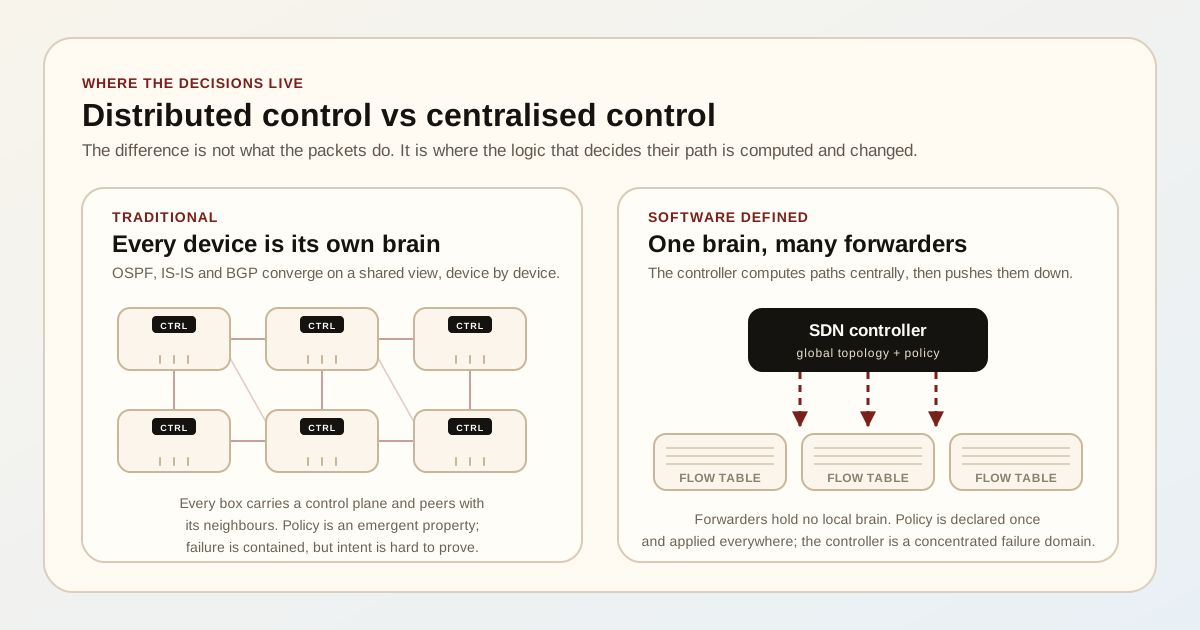
| Control logic | Distributed — each device runs OSPF, IS-IS or BGP and decides independently | Centralised in a controller with a network-wide view |
| Configuration | Per-device, via CLI or templated automation | Declarative policy rendered by the controller |
| Change velocity | Bounded by change windows and manual verification | Bounded by pipeline and validation quality |
| Failure domain | Contained — one bad device affects its neighbours | Concentrated — a controller fault or bad policy can affect the whole domain |
| Hardware coupling | Features tied to a vendor OS and licensing | Looser in principle; in practice tied to the controller platform |
| Troubleshooting | Hop by hop, on the device | Across overlay and underlay, which is harder without good telemetry |
| Skills required | Protocol expertise | Protocol expertise plus APIs, version control and systems thinking |
The honest conclusion is that distributed protocols were never the problem. Modern fabrics deliberately keep BGP EVPN as a distributed control plane — it converges predictably, scales to thousands of switches without spanning tree, and is standardised across Arista, Cisco, Juniper and others — while placing a centralised intent and management layer above it. That hybrid, not one controller programming every flow, is what the industry converged on. For the encapsulation side, see the companion explainer on network virtualisation, VLANs and VXLAN.
SDN, SD-WAN and SASE: how the terms relate
Vendor material uses these interchangeably, which is unhelpful. SDN is the architectural principle. SD-WAN applies it to the wide-area edge: an overlay of encrypted tunnels across whatever underlay links a site has, with a controller pushing application-aware path policy. SASE extends SD-WAN by moving enforcement — secure web gateway, CASB, zero-trust access, firewalling, data-loss prevention — into cloud points of presence, so policy follows the user rather than the circuit.
For most organisations this is where they will actually meet software defined networking, because it is sold as a service rather than built. Worth keeping straight: SD-WAN cannot create capacity the underlay does not have, and cannot make two circuits diverse if they share a duct. The underlying connectivity still has to be designed and bought properly.
Challenges and limitations of software defined networking
SDN's weaknesses are structural rather than incidental, and a serious evaluation should treat them as design inputs.
- Concentrated failure and attack domain. A compromised or overwhelmed controller compromises the network it governs. Academic evaluations of OpenDaylight, ONOS and Ryu consistently identify denial of service — against the controller or via the southbound channel — as the dominant threat. Controller hardening, mutual authentication southbound and a defined behaviour for controller loss are not optional extras.
- Performance overhead. Reactive flow setup adds latency to the first packet of every new flow, the control channel can saturate, and TCAM depth caps how granular matching can be.
- Interoperability and lock-in. The promise was commodity hardware under portable control software. What most buyers get is a vendor's controller managing that vendor's switches; cross-vendor intent platforms exist but remain the minority case.
- Programmable silicon has narrowed. Intel stopped development of its P4-programmable Tofino switch ASICs in 2023, cancelling Tofino 3, and open-sourced the P4 software stack in 2025. P4 remains important in DPUs, IPUs and SmartNICs under Linux Foundation governance, but fully programmable switch pipelines are a smaller market than the 2018 consensus expected.
- Commercial gravity. Broadcom folded standalone VMware NSX into the VMware Cloud Foundation bundle on per-core subscription pricing. Buying software defined networking increasingly means buying an entire stack.
- Operating model. The skill profile shifts toward version control, testing and change pipelines. Organisations that adopt the technology without the practices tend to get faster outages.
- Transition complexity. Almost nobody runs a purely software defined estate. Hybrid coexistence with legacy segments is the normal steady state, and where most operational pain lives.
Where software defined networking stands in 2026
Market sizing for SDN should be read with caution: published figures for the same year differ by more than an order of magnitude depending on whether hardware, controller software, SD-WAN and professional services are counted. MarketsandMarkets, on a relatively broad definition, puts the market at US$35.74 billion in 2025 rising to US$82.59 billion by 2030, a compound annual growth rate of 18.2 per cent. Treat that as directional and weight the segment numbers below more heavily.
AI is now the main driver of network investment
Dell'Oro Group forecasts that data centre switch spending in AI back-end networks will pass US$100 billion by 2030, and reports Ethernet switch revenue in those networks more than doubling to roughly two-thirds of AI-cluster switch sales in the first quarter of 2026. Most AI back-end ports are now 800 Gbps, with 1600 Gbps expected to dominate by 2027. The Ultra Ethernet Consortium published its 1.0 specification in June 2025, with the first public multi-vendor interoperability demonstration at 800GE following in March 2026. This revives SDN's original thesis in a new form: collective operations produce synchronised, bursty traffic that punishes hash-based load balancing, and scheduling-aware central coordination is exactly what centralised control was meant to deliver. Our explainer on how AI data centres are built covers the surrounding infrastructure.
Open network operating systems keep gaining ground
SONiC, now a Linux Foundation project, has become the default disaggregated network operating system. Community figures cited by ONUG put it at more than 4,300 contributors across 520-plus organisations; Alibaba Cloud runs it on over 100,000 white-box devices, Microsoft Azure uses it in AI data centre infrastructure, and Orange has moved it into telco production. A January 2026 SONiC Lite release added MC-LAG support aimed at resource-constrained access and edge switches, extending the addressable footprint below hyperscale.
Sentiment has shifted from controllers to agents
Vendor positioning in 2026 is dominated by autonomous operations rather than control-plane architecture. Cisco announced Cloud Control at Cisco Live in June 2026 — a unified platform designed for both human operators and AI agents, entering controlled availability in the United States first. HPE, following its Juniper acquisition, has pushed agentic capability into Mist and Marvis and added a data centre assistant built on Apstra's graph database. Dell'Oro reported SASE revenue up 21 per cent year on year to over US$3 billion in the first quarter of 2026.
Telecom is finally shipping slices
More than 85 operators across 47 markets had launched commercial 5G standalone networks by the end of 2025, the precondition for slicing. Commercial slice services are now leaving the lab: BT has targeted commercial network slicing before the end of summer 2026 on a dual-mode core with dynamic slice selection and exposure APIs, and Verizon Business has launched dedicated slicing for enterprise customers. Our explainer on private 5G for enterprise covers the enterprise-owned variant of the same architecture.
What this means for Singapore buyers
Singapore is a dense interconnection hub rather than a builder of novel fabrics. IMDA's Digital Connectivity Blueprint sets out an ambition to roughly double submarine cable landing capacity within a decade, and the local data centre market — around US$4.6 billion in 2026 by Mordor Intelligence's estimate — is growing under an explicit sustainability framework. The consequence is that most Singapore enterprises consume software defined networking rather than operate it: through cloud virtual networks, carrier-managed SD-WAN and SASE, colocation fabrics, and integrators running the controller on their behalf.
That shapes what to ask for. Where is the controller hosted, and in which jurisdiction is traffic inspected? What happens to forwarding if the controller is unreachable — does the fabric keep running on last known state? Who holds the API credentials, and is the network's intent in version control you can read? Can the provider show flow-level telemetry across both overlay and underlay, or only the overlay? These questions separate a genuine software defined operating model from a conventional network with a dashboard in front of it.
Sourcing network design or managed SDN in Singapore?
Browse telecom operators, network integrators and managed service providers who design, deploy and run software defined networks, SD-WAN and SASE for Singapore enterprises.
Browse telecommunication providers
Future outlook
Three directions look reasonably safe to project. The control layer becomes agentic: closed loops that ingest streaming telemetry, propose changes and — under human-approved guardrails — apply them, with trust rather than capability as the binding constraint. AI fabrics keep pulling scheduling intelligence back into the network, favouring centralised coordination, open standards such as Ultra Ethernet, and open network operating systems over proprietary stacks. And the SD-WAN and SASE policy planes continue converging into a single enforcement model treating identity, device posture, application risk and data location as one decision.
What is unlikely is a return to the original vision of one controller programming every switch through one open southbound protocol. The federated model — domain controllers for campus, data centre, WAN and cloud, with a policy and observability layer spanning them — is where investment is going. Two newer inputs are also appearing in path selection: energy cost and carbon intensity on one side, data sovereignty constraints on the other. Both are policy questions a centralised control plane is unusually well placed to answer — a fitting outcome for an architecture that began by asking networks to answer to intent rather than to configuration.
Frequently asked questions
What is software defined networking in simple terms?
It is a way of building networks where decisions about how traffic should flow are made by centralised software rather than independently by each switch and router. The hardware still forwards packets, but it is told what to do by a controller that can see the whole network and exposes an API, so the network can be driven programmatically instead of device by device.
What is the difference between SDN and SD-WAN?
SDN is the general architecture: separating control from forwarding and exposing control through software. SD-WAN is one specific application of it at the wide-area edge, where a controller manages an overlay of encrypted tunnels across mixed underlay links and steers each application over the best available path. All SD-WAN is software defined networking; most software defined networking is not SD-WAN.
Is OpenFlow still used in 2026?
Rarely, outside Open vSwitch and academic research. OpenFlow proved the concept and shaped a generation of thinking, but enterprises found that a distributed BGP EVPN control plane with a centralised intent controller above it scaled and converged better than a controller installing flow rules directly. Southbound communication today is mostly NETCONF/YANG, gNMI, OVSDB and P4Runtime.
Does SDN replace routers and switches?
No. It changes what they are responsible for. Physical devices still forward packets and still need adequate capacity, buffering and table space. What moves is the decision-making: instead of each device computing its own view of the network, it receives forwarding state from a controller or participates in a fabric whose design is centrally defined and validated.
What are the main security risks of software defined networking?
The controller is the primary concern, because compromising it compromises the network it governs. Published evaluations of controllers such as OpenDaylight, ONOS and Ryu repeatedly find denial of service — against the controller or through the southbound channel — to be the dominant risk. Mitigations include controller clustering, mutual authentication and encryption southbound, strict role-based access to northbound APIs, rate limiting of control-channel traffic, and a tested fail-safe behaviour if the controller becomes unreachable.
Do we still need to understand SDN if everything runs in the cloud?
Arguably more so. Public cloud virtual networks are software defined networks — the security groups, route tables and VPCs you configure are northbound API calls into a controller you do not operate. Understanding the model explains why cloud networking behaves as it does, where its limits sit, and how to align on-premises segmentation with cloud network design.
Sources and further reading
- Linux Foundation — ONF merges its open source networking portfolio into the Linux Foundation (December 2023)
- Google Cloud — 25 years of data centre networking: Jupiter at 13 Pb/s
- Dell'Oro Group — Data centre switch sales in AI back-end networks to exceed US$100B
- Dell'Oro Group — SASE 1Q 2026 revenue climbs 21 per cent to over US$3B
- Ultra Ethernet Consortium — Specification 1.0 launch
- MarketsandMarkets — Software-Defined Networking market report
- ONUG — State of enterprise SONiC adoption
- MDPI Electronics — Open source SDN controllers: operational and security issues
- Cisco — Cloud Control agentic platform announcement, June 2026
- HPE — AI-native networking portfolio and self-driving network operations
- IETF RFC 7432 — BGP MPLS-Based Ethernet VPN (EVPN)
- IMDA — Digital Connectivity Blueprint
- SASE in WAN Communication Technology: A 2026 Buyer's Guide
- Enterprise Connectivity Solutions: A 2026 Buyer's Guide to Private Lines, Optical Transport and SD-WAN
- Server Virtualization Explained: Hypervisors, Virtual Machines and Enterprise Infrastructure in 2026
- AI Data Centres Explained: Inside the AI Factory, From GPU Racks to Gigawatts
- Private 5G for Enterprise: How Standalone 5G Networks Actually Work
- Global IP Network Traffic Explained: IP Transit, BGP, ASNs and Peering