
Most people experience the internet as a broadband plan, mobile data service, cloud region or SaaS application. Underneath that retail surface is a wholesale routing system: thousands of autonomous systems exchange routes, sell IP transit, peer directly, filter announcements and move packets over terrestrial fibre, subsea cables, data-centre cross-connects and carrier backbones.
This article expands the technical layer behind IP transit and the wider global connectivity stack. It is written for buyers, network engineers and technical founders who need to understand how IP networks, ASNs, BGP, peering and internet backbone providers affect performance, resilience and cloud reachability.
What is global IP transit?
Global IP transit is a wholesale internet service where one autonomous system pays another network to carry traffic to and from the wider internet. An IP network forwards packets using IP addresses, Layer 3 is where routing decisions happen, an ASN identifies a routing domain, and BGP lets those autonomous systems exchange reachability.
| Term | Plain-English meaning | Buyer implication |
|---|---|---|
| IP prefix | A block of IPv4 or IPv6 addresses announced into routing. | Your prefixes must be correctly registered, filtered and originated. |
| ASN | A public routing identity for an autonomous system. | Needed for independent BGP policy and serious multihoming. |
| BGP | The routing protocol used between autonomous systems. | Controls path choice, failover and how your network is reached. |
| IP transit | Paid reachability from one network to the rest of the internet. | Usually required for universal internet reach. |
| Peering | Direct route exchange between networks. | Can shorten paths and reduce transit cost for selected traffic. |
| Tier 1 network | A backbone that can reach the internet without buying full transit. | Useful signal, but not proof of best performance for every route. |
| RPKI | Cryptographic route-origin validation for IP prefixes. | Helps reduce route hijacks and bad origin announcements. |
APNIC defines an autonomous system as a group of IP networks operated under one clearly defined external routing policy. IETF RFC 4271 defines BGP-4 as an inter-autonomous-system routing protocol. Those two ideas explain why internet connectivity is not one giant shared switch: it is a policy graph of independently operated networks.
Why backbone quality matters
A stronger global IP transit network can mean better routes, fewer unnecessary handoffs, broader reach and more predictable reliability. For cloud access, video delivery, gaming platforms, SaaS applications and data-centre traffic, those differences show up as lower latency, fewer packet-loss events and cleaner failover during cable, router or peering incidents.
How global IP network traffic moves
When a network buys global IP transit, it forms one or more BGP sessions with the transit provider. The customer announces its prefixes. The provider applies filters, accepts legitimate routes, advertises those routes to its own peers and customers, and sends the customer routes for reaching the rest of the internet.
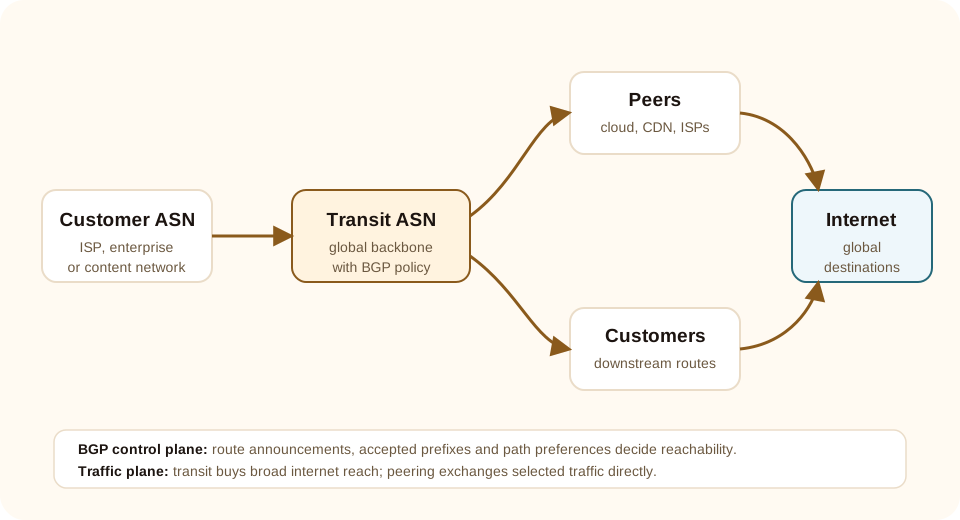
- The customer network announces prefixes. The ASN originating the route says which IP address blocks it can reach.
- The transit provider filters the announcement. Good providers check IRR route objects, RPKI data and customer policy before accepting routes.
- BGP policy selects paths. Local preference, AS path, MED, communities, prepending and route filters influence traffic flow.
- Return traffic may use a different path. Asymmetric routing is normal, which is why troubleshooting needs evidence from both directions.
IP transit versus peering versus private connectivity
Transit, peering and private connectivity solve different problems. They are often combined in the same network design, but they should not be treated as interchangeable products.
| Option | What it gives you | Where it fits |
|---|---|---|
| IP transit | Paid reachability to the global internet through another network. | ISPs, cloud platforms, data centres, content networks and enterprises that operate BGP. |
| Public peering | Traffic exchange at an internet exchange point with selected networks. | High-volume local or regional traffic where both networks agree to peer. |
| Private peering | Direct cross-connect or private interconnection between two networks. | Large traffic volumes, cloud/CDN handoff, predictable paths and tighter operational control. |
| Cloud on-ramp | Private connectivity into a cloud provider edge. | Hybrid cloud, data-heavy workloads and predictable access to VPCs or cloud backbones. |
| Enterprise DIA | Retail dedicated internet access for business sites. | Offices and branches that need SLA-backed internet without operating a full transit network. |
A CDN, cloud provider or regional ISP may use all of these at once: transit for universal reachability, public peering for exchange-based efficiency, private peering for heavy routes, and cloud on-ramps for private application paths. See also cloud connect and on-ramps for the private-cloud side of the architecture.
What a global IP transit provider does
A transit provider is not just selling a port. It is selling reach, routing policy, backbone capacity, peering relationships, congestion management, support discipline, DDoS options, IPv6 maturity, route security and operational transparency.
NTT DATA Global IP Network, also known as NTT GIN, is a useful example because its public material describes a dual-stack Tier 1 Global IP Network spanning the Americas, Asia, Europe and Oceania on AS2914. NTT also publishes routing, routing registry, BGP community and looking-glass resources; it notes that looking glass is for verifying routing information, not measuring SLA performance. Those are exactly the sort of operational artefacts buyers should look for from any provider.
| Evaluation area | What to ask | Why it matters |
|---|---|---|
| Reach and route quality | Which regions, exchange points and peers are strong for my traffic? | A global provider can still be weak for a specific country, cloud or eyeball network. |
| BGP controls | Are communities, prepending, blackholing and local-preference controls documented? | Customers need policy tools for failover, route shaping and incident response. |
| Route hygiene | Does the provider enforce IRR filters, RPKI origin validation and max-prefix controls? | Bad route acceptance can create leaks, hijacks or unstable sessions. |
| Operational evidence | Is there a looking glass, route server, maintenance process and usable NOC escalation? | Troubleshooting depends on visibility, not sales claims. |
| Performance terms | How are latency, packet loss, availability and congestion measured? | An SLA is only useful if measurement and exclusions are clear. |
| Commercial model | What are the commit, burst, port, cross-connect and local-loop terms? | The lowest Mbps price may hide costly operational limits. |
Provider comparison lens for APAC and global backbones
Provider rankings can help shortlist the market, but they should not replace route testing. CAIDA AS Rank is based on customer-cone size inferred from AS relationships; it is not a ranking of traffic volume, revenue, user count or guaranteed route quality for your application.
| Provider group | ASN example | Evaluation lens |
|---|---|---|
| NTT DATA Global IP Network / GIN | AS2914 | Tier 1 backbone, APAC relevance, transpacific reach, published routing resources. |
| Tata Communications | AS6453 | South Asia, Middle East, global enterprise routes and wholesale reach. |
| PCCW Global / Console Connect | AS3491 | Hong Kong-rooted APAC interconnection and cloud connectivity. |
| Telstra International | AS4637 | Australia, Pacific, subsea cable and regional enterprise reach. |
| Singtel STiX | AS7473 | Singapore and ASEAN carrier-grade internet transit context. |
| China Telecom Global, China Mobile International and China Unicom Global | Multiple | China and cross-border APAC routes where local policy, latency and destination testing matter. |
| Bharti Airtel, HGC, KDDI and SoftBank | Multiple | South Asia, Hong Kong, Japan and regional enterprise or content-network reach. |
| KT, SK Broadband, LG U+ and Chunghwa Telecom | Multiple | Northeast Asia eyeball, content and regional interconnection paths. |
| Arelion | AS1299 | Formerly Telia Carrier; major Tier 1 backbone for Europe, North America, content, CDN, cloud and gaming routes. |
| Lumen | AS3356 | Large North American and global backbone, often compared for enterprise, CDN, cloud and wholesale IP transit. |
| GTT | AS3257 | Global Tier 1 IP network used for wholesale, enterprise and multi-region backbone diversity. |
| Cogent Communications | AS174 | Price-competitive high-capacity IP transit with broad data-centre reach and native IPv4/IPv6 options. |
| Hurricane Electric | AS6939 | IPv6-focused global backbone with extensive exchange presence and strong peering visibility. |
| Zayo | AS6461 | Fiber-rich North America and Europe provider where transport, wavelengths and IP transit are often evaluated together. |
| Orange / Open Transit | AS5511 | European, African, wholesale and enterprise reach through Orange's international backbone context. |
| Deutsche Telekom Global Carrier | AS3320 | Strong European eyeball-network and wholesale connectivity, especially for Germany and Central Europe. |
| AT&T | AS7018 | Major U.S. and global business backbone with enterprise, broadband, mobile and interconnection relevance. |
| Verizon Business / UUNET | AS701 / AS702 / AS703 | Major U.S. and international backbone history with enterprise, eyeball and wholesale routing relevance. |
A Singapore or APAC buyer should test routes to the actual destinations that matter: cloud regions, SaaS platforms, payment endpoints, video platforms, gaming networks, partner VPNs, CDN edges and user geographies. A regional carrier can outperform a larger backbone for a local route, while a Tier 1 backbone may be better for international diversity.
Security and operations: route leaks, hijacks, congestion and RPKI
Internet routing is built on trust and policy. Mistakes happen: a network may leak routes, originate a prefix it should not, accept a bad path, saturate an interconnect or hand traffic off too early. These incidents can cause outages, latency spikes, unreachable destinations or traffic detours.
RPKI and route origin validation help networks check whether an ASN is authorised to originate a prefix. IETF RFC 6811 describes BGP prefix origin validation, and regional internet registries such as ARIN provide RPKI services for their resource holders. RPKI does not solve every routing problem, but it is now a baseline route-hygiene question for serious transit procurement.
MANRS frames routing security around practical operator actions: prevent incorrect route propagation, reduce spoofed-source traffic, keep operational contacts current, and publish routing information through IRR or RPKI. For a transit buyer, that becomes a procurement question: can the provider prove how it filters customer routes and coordinates incidents?
Operationally, buyers should ask for route-filter policy, max-prefix limits, RPKI invalid-route handling, BGP community documentation, maintenance notices, DDoS blackholing support, route flap handling and incident reports. The goal is not only a clean design; it is a network that behaves predictably at 3 a.m. when a route or interconnect fails.
Buyer checklist for global IP transit and internet backbone selection
Future outlook for global IP network traffic
Global IP traffic will keep concentrating around cloud regions, AI data centres, streaming platforms, software distribution, gaming, SASE edges, mobile networks and private interconnection fabrics. That does not make transit obsolete. It makes transit selection more application-specific.
The strongest buyers will combine transit, peering, cloud on-ramps, DDoS controls, RPKI hygiene, IPv6 readiness and active path monitoring. They will ask less often, "Which provider is biggest?" and more often, "Which routed path can we prove for our users, applications and failure modes?"
Compare telecom and connectivity providers in Singapore
Shortlist carriers, network integrators, SD-WAN specialists and managed connectivity providers that can design, test and operate resilient internet and WAN paths.
Frequently asked questions
What is global IP transit?
Global IP transit is a service where one network pays another network to carry its traffic to the wider internet. It uses BGP routing, IP prefixes and autonomous system numbers so independent networks can exchange reachability.
What is an ASN in internet routing?
An ASN, or autonomous system number, identifies a network with a defined external routing policy. It is used in BGP so ISPs, cloud providers, enterprises and content networks can exchange routes.
How is IP transit different from peering?
IP transit buys reachability to the wider internet through another network. Peering is direct traffic exchange between selected networks, usually to improve performance or reduce cost for traffic both sides agree to exchange.
Is a Tier 1 IP network always the best choice?
No. Tier 1 status is a useful reach signal, but route quality depends on geography, peering, congestion, cloud adjacency, support and the destinations your users actually need.
How do companies choose a global IP transit provider?
They compare route quality, region coverage, peering, BGP controls, IPv6 support, RPKI or ROA policy, DDoS options, looking-glass visibility, SLA measurement, pricing and operational support.
Sources and further reading
- NTT DATA Global IP Network: Home
- NTT DATA Global IP Network: Routing policies
- NTT DATA Global IP Network: Routing registry
- CAIDA AS Rank: AS2914
- APNIC Help Centre: Autonomous System numbers
- IETF RFC 4271: A Border Gateway Protocol 4 (BGP-4)
- IETF RFC 6811: BGP Prefix Origin Validation
- ARIN: Resource Public Key Infrastructure (RPKI)
- MANRS: Network Operator Actions
- APNIC Academy: Internet Transit, Peering and the Variants