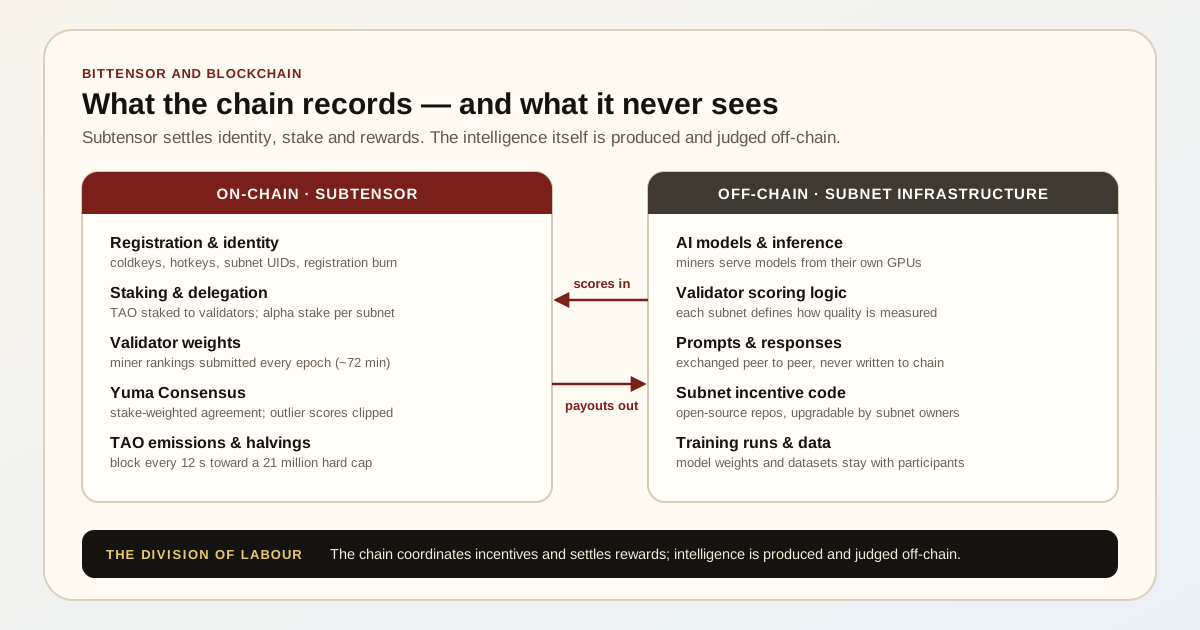
Bittensor is an open-source protocol that uses a purpose-built blockchain to run a market for machine intelligence. Instead of paying for hashes, as Bitcoin does, the network pays for useful AI work: model responses, training runs, data pipelines and compute, produced by anyone with the hardware and skill to compete. The blockchain — a Substrate-based chain called Subtensor — does not run any AI itself. It records who participates, who staked what, how the work was scored, and who gets paid in the network's native token, TAO.
That division of labour is the single most useful thing to understand about Bittensor and blockchain as a pairing. Every model inference, every validator evaluation and every training step happens off-chain on participants' own machines. The chain's job is narrower and harder: turn thousands of subjective quality judgments into one payable number per participant, every block, without a central operator deciding who deserves what.
This article explains how the pieces fit together — subnets, miners, validators, Yuma Consensus and dynamic TAO — what the December 2025 halving changed, where the credible enterprise uses are, and the risks the incentive design has not yet solved. It reflects network data as of August 2026.
Table of contents
- What is Bittensor, and why does it need a blockchain?
- Technical breakdown: how the Bittensor blockchain works
- Key benefits and enterprise use cases for Bittensor
- Challenges, risks and limitations of Bittensor
- Market trends: Bittensor in 2026
- Comparative analysis: Bittensor against other decentralised AI networks
- Future outlook for Bittensor and decentralised AI
- Frequently asked questions
What is Bittensor, and why does it need a blockchain?
Bittensor was founded around 2019 by Jacob Steeves, a former Google engineer, and Ala Shaabana, with the Opentensor Foundation stewarding development. Its whitepaper, published under the pseudonym Yuma Rao, frames machine intelligence as a commodity that markets can price the way they price electricity or storage — provided there is a trustworthy way to measure who produced value. The network went through three chains to get there: Kusanagi in January 2021, Nakamoto later that year, and the current Finney chain in March 2023. The Revolution upgrade of October 2023 opened subnet creation to outsiders, which is when Bittensor became a platform rather than a single experiment.
The reason it needs a blockchain is incentive accounting, not computation. A decentralised AI network has to answer three questions continuously: who is participating, whose work was better, and who gets paid. Answering them through a company reintroduces the gatekeeper the design is trying to remove. Answering them on a public ledger makes participation permissionless — anyone can register a miner or validator by paying a registration cost in TAO — and makes the reward history auditable by anyone.
The token economics borrow deliberately from Bitcoin. TAO has a hard cap of 21 million, emissions halve as issuance milestones are reached, and there was no premine, initial coin offering or insider allocation — early participants earned tokens by mining, the same way later ones do. One TAO was emitted per 12-second block until December 2025; the first halving cut that to 0.5 TAO per block, or roughly 3,600 TAO a day. Because registration fees are recycled back into the unissued pool, halvings arrive when cumulative issuance crosses the threshold rather than on a fixed date.
The participants: miners, validators, stakers and subnet owners
- Miners run AI models or services on their own hardware and respond to the tasks a subnet defines — answering prompts, training models, detecting deepfakes, renting out GPU capacity. They compete against every other miner in their subnet for a share of emissions.
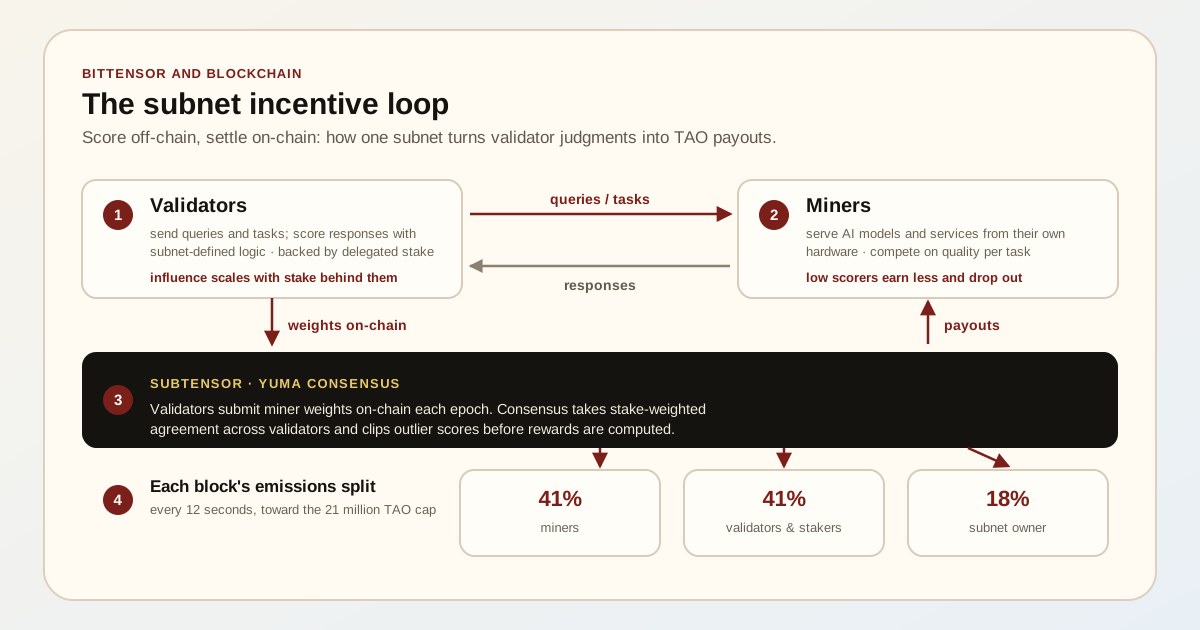
- Validators send miners work, score the responses using the subnet's evaluation logic, and submit those scores to the chain as weights. Their influence over rewards scales with the stake behind them.
- Stakers delegate TAO to validators (or, since 2025, into a specific subnet's pool) and share in the validator's emissions — economically similar to delegated staking on proof-of-stake chains.
- Subnet owners register a subnet, define its digital commodity and write the incentive mechanism that scores it. They receive 18% of their subnet's emissions for doing so.
The same structure repeats in every subnet, but each subnet is its own market with its own rules. That is the architectural bet Bittensor makes: rather than one global scoreboard for intelligence, it runs many narrow competitions and lets capital decide which ones matter.
Technical breakdown: how the Bittensor blockchain works
Subtensor is a standalone layer-1 built with Substrate, the framework behind the Polkadot SDK, producing blocks every 12 seconds. Block production is handled by a permissioned authority set operated and vetted by the Opentensor Foundation — a pragmatic choice that keeps the chain fast, and a genuine centralisation trade-off discussed below. What makes the chain unusual is not how blocks are made but what they settle: registrations, stake movements, validator weights and emissions.
Subnets: 129 markets for digital commodities
A subnet is an independent incentive market focused on one commodity. As of August 2026 there are 129 active subnets, with published plans to scale the slot count further. Text inference, image generation, model fine-tuning, sports prediction, deepfake detection and raw GPU rental all run as separate subnets, each with an owner-written scoring mechanism that defines what miners must produce and how quality is measured. Registering a new subnet is permissionless but priced: the lock cost doubles with each recent registration and decays over about two weeks toward a floor of 1,000 TAO, and under dynamic TAO the locked amount seeds the new subnet's liquidity pool rather than being refunded.
Yuma Consensus: how Bittensor scores work it cannot see
The chain cannot evaluate an essay or a training run. Yuma Consensus is the mechanism that converts validators' off-chain judgments into on-chain rewards while limiting how much any one validator can distort the result. Each epoch — 360 blocks, roughly 72 minutes — validators submit a weight vector ranking the miners they queried. The chain computes a stake-weighted aggregate for each miner and clips weights that sit far above the consensus view, so an outlier score, honest or malicious, moves the outcome very little. Validators earn bonds in miners they weight consistently with consensus over time, which rewards accurate, steady scoring rather than lobbying.
The whitepaper's design goal was a market that stays honest as long as no colluding group controls about half the network's weight. Practice has added two hardening layers: commit-reveal, which delays the publication of weights so lazy validators cannot simply copy others' scores in the same epoch, and the third-generation consensus rules (Yuma 3), live in 2026, which track validator-miner bonds individually for finer-grained fairness. Weight-copying and validation subjectivity remain the system's open research problems rather than solved ones.
Dynamic TAO: pricing subnets with alpha tokens
Until 2025, a small root network of 64 large validators voted on how emissions were divided between subnets — a committee deciding capital allocation. The dynamic TAO (dTAO) upgrade of 13 February 2025 replaced the committee with a price signal. Every subnet now issues its own alpha token, paired with TAO in an on-chain automated market maker. Staking TAO into a subnet buys its alpha; the relative price of alpha tokens steers each subnet's share of network emissions. The mechanism has been tuned since launch — emissions briefly followed measured TAO inflows during late 2025 before reverting to a price-based model in June 2026 — but the principle held: subnet funding is set by an open market rather than a vote. The root network's emission-steering role was removed, though root staking itself persists at a discounted weight.
The chain also gained an EVM layer, live on mainnet since the end of 2024. Solidity contracts deploy unchanged against standard Ethereum JSON-RPC endpoints, with precompiles exposing Bittensor-native operations such as staking. The practical effect is a DeFi surface for the TAO economy — liquid staking, lending and structured products — without bridging to Ethereum itself.
Key benefits and enterprise use cases for Bittensor
Enterprises touch Bittensor in two distinct ways, and conflating them causes most of the confusion. The first is consuming services that happen to be produced on the network. The second is participating in the network itself — running miners or validators, launching a subnet, or holding TAO on a balance sheet. The risk profiles are entirely different.
- Low-cost open-model inference. Chutes (subnet 64, built by Rayon Labs) serves open-weight models through a standard API, with OpenRouter-verified throughput that peaked around 42 billion tokens a day in February 2026 and ran at 8–12 billion daily in August 2026. Emissions subsidise the serving cost, which is why its pricing undercuts centralised endpoints — and why the subsidy's durability belongs in any procurement assessment.
- Specialised digital commodities. Subnets exist for tasks that lack a clean commercial market: continuous deepfake detection (BitMind), sports-video prediction, model fine-tuning (Gradients), and confidential GPU compute (Targon, whose operator Manifold Labs raised a $10.5 million Series A and self-reports eight-figure annualised revenue, unaudited).
- Monetising idle GPU capacity. Compute-rental subnets such as Celium let hardware owners earn TAO from capacity that would otherwise sit dark — relevant to any operator with stranded accelerators between projects.
- Distributed training as proof of capability. The Templar subnet's successor project pre-trained Covenant-72B, a 72-billion-parameter model, across more than 70 permissionless nodes by March 2026 — evidence that incentive-coordinated training at scale is possible, whatever one concludes about its economics.
- Structured exposure without operations. Listed vehicles — the Grayscale Bittensor Trust, and treasury companies such as xTAO and TAO Synergies — exist for organisations that want economic exposure without running infrastructure. These are volatile instruments tied to a volatile token, not cash substitutes.
The honest caveat: most Bittensor demand is still crypto-native. Independently verifiable external revenue across all subnets was in the single-digit millions annually as of August 2026 — a rounding error beside centralised AI platforms. What the network demonstrably provides today is a permissionless funding and distribution channel for AI teams, and cheap open-model inference for cost-tolerant workloads. Enterprise-grade contracts, data-processing agreements and service credits are the exception, not the rule.
Challenges, risks and limitations of Bittensor
- Central points in a decentralised design. Block production sits with an authority set run by the Opentensor Foundation, and the foundation demonstrated its reach in July 2024, when a malicious package uploaded to PyPI (masquerading as Bittensor client version 6.12.2) drained about 32,000 TAO — roughly $8 million — from users who had installed it. The foundation firewalled validators and placed the chain in safe mode within minutes, stopping transactions network-wide. Effective incident response, and simultaneously proof that a single party could halt the chain.
- Governance concentration. The sharpest test came in April 2026, when Covenant AI — the team behind the network's flagship distributed-training work — exited Bittensor entirely, describing it as "decentralisation theatre" and alleging unilateral emission suspensions. TAO fell roughly 27% in a day. Whatever the merits of each claim, the episode showed that subnet businesses carry platform risk concentrated in a small leadership group.
- Validation quality and gaming. Peer-reviewed analysis of the protocol (arXiv, 2025) found reward outcomes driven more by stake than by output quality, with the top five validators holding over half of voting power. Weight-copying is mitigated by commit-reveal, not eliminated, and every subnet's scoring code is an attack surface its owner must maintain.
- Emission economics. Around $300 million a year in emissions (at mid-2026 prices) flows to participants regardless of external demand, creating structural sell pressure, while most subnet alpha tokens trade in thin liquidity pools that amplify drawdowns. Verified external revenue covered roughly 6% of that emission budget at best. The gap is the network's core economic question.
- Regulatory standing. TAO's classification remains unresolved in the United States, with the pending spot-ETF applications acting as a de facto test. In Singapore, dealing in or facilitating the exchange of digital payment tokens is licensable activity under the Payment Services Act, and since 30 June 2025 the FSM Act's digital token service provider regime has closed the loophole for Singapore-based firms serving only overseas customers. Consuming inference from a subnet is not a regulated activity; operating token infrastructure from Singapore very likely is.
Market trends: Bittensor in 2026
TAO traded around $234–242 in late August 2026, a market capitalisation of roughly $2.2–2.7 billion depending on the supply methodology used — aggregators disagree on circulating supply (about 9.6 million versus 11.3 million) because they treat recycled registration fees differently. That placed TAO between roughly 32nd and 42nd among crypto assets, well below its 2024 peak. Three structural developments matter more than the price.
The supply schedule proved itself. The first halving executed in mid-December 2025, cutting emissions to 0.5 TAO per block on schedule with the issuance threshold. Grayscale Research framed the event as the first real test of whether Bitcoin-style scarcity mechanics translate to a productive network — one where emissions are not just security spend but the working subsidy for AI services. Post-halving, every subnet business operates on half the subsidy, which is quietly accelerating the shift toward external revenue as the metric that matters.
Institutional structure arrived. The Grayscale Bittensor Trust began OTC trading as GTAO in December 2025, with an S-1 filed the same month to convert it into a spot ETF on NYSE Arca; Bitwise filed a parallel application in April 2026, and both remained pending as of late August 2026. Digital Currency Group's Yuma subsidiary, launched in November 2024 under Barry Silbert, incubates subnet ventures and added an asset-management arm in late 2025. Public treasury vehicles — xTAO on the TSX Venture Exchange, TAO Synergies on Nasdaq, and TaoWeave — together hold six-figure TAO positions. None of this changes the protocol; all of it changes who can hold the asset and how closely the network is scrutinised.
Attention concentrated on real workloads. NVIDIA chief executive Jensen Huang's favourable reference to the Covenant-72B training run in March 2026 briefly lifted combined subnet-token value to about $1.5 billion — followed within weeks by the same team's acrimonious exit, and a drawdown. The whipsaw captures the 2026 market accurately: genuine technical milestones, reflexive token pricing, and an ecosystem where the leading revenue subnets (Rayon Labs' three subnets alone drew almost a quarter of all emissions in August 2026) are consolidating while the long tail fights for relevance.
Where Singapore sits in the Bittensor ecosystem
Singapore's most visible contribution is Tensorplex Labs, a Singapore-based team backed by Yzi Labs that operates the Dojo data-collection subnet and built stTAO, an early liquid-staking product for the ecosystem. For everyone else, the city-state's relevance is regulatory clarity: MAS licenses digital payment token services under the Payment Services Act, the FSM Act's DTSP regime removed the offshore-only carve-out from mid-2025, and retail speculation remains actively discouraged. A Singapore enterprise consuming subnet inference through a fiat-invoiced gateway faces ordinary outsourcing diligence; one holding TAO, staking, or operating subnet infrastructure should assume licensing analysis before launch. The broader signal is consistent with Singapore's institutional blockchain posture — Project Guardian's tokenisation pilots with DBS, JPMorgan and UBS welcome the settlement rails while holding token speculation at arm's length.
Comparative analysis: Bittensor against other decentralised AI networks
Decentralised AI projects split into three families: networks that sell raw compute, platforms built around AI agents, and incentive markets that score outputs. Bittensor is the largest of the third family, and the only one running many independent scored markets on one chain.
| Network | What it prices | Coordination model | Position in 2026 |
|---|---|---|---|
| Bittensor | Scored AI outputs and services across 129 subnets | Own Substrate L1; Yuma Consensus; TAO plus per-subnet alpha tokens | ~$2.2–2.7B market cap; deepest incentive design; thin verified external revenue |
| Render Network | GPU rendering and inference cycles | Burn-and-mint credits on Solana | Reported >$1.5B market cap and ~5,600 nodes; work is metered, not quality-scored |
| Akash Network | Leased cloud compute via reverse auction | Cosmos-SDK chain; migration plans announced | Building GB200-class superclusters; generic compute, no model scoring |
| ASI Alliance (Fetch.ai) | Agent services under a merged token | Token merger of Fetch.ai, SingularityNET and Ocean (2024) | Agent framework focus; one mega-token versus Bittensor's many subnet economies |
| Gensyn | Verifiable ML training compute | Cryptographic verification of training work | Testnet since March 2025, pre-token; proofs where Bittensor uses game theory |
| Prime Intellect | Company-orchestrated distributed training | Open infrastructure, no token incentive layer | Trained INTELLECT-2 (32B) via permissionless RL; raised a $130M Series A |
The deeper comparison is with the centralised default. Analyst estimates put OpenAI's annualised revenue around $40 billion by mid-2026, and AWS was projecting a ten-figure run rate for Bedrock — against low single-digit millions of independently verifiable external revenue across all Bittensor subnets. Decentralised AI is not competing on volume, reliability or enterprise contracts today. Its differentiated claims are structural: permissionless entry for producers, censorship-resistant funding for niche models, transparent reward accounting, and open pricing of intelligence as a commodity. Whether those properties compound into commercial weight is the open question the next halving cycle will answer.
Future outlook for Bittensor and decentralised AI
Three trajectories are reasonably well supported by what is already in motion. First, the regulatory track matures regardless of sentiment: the pending Grayscale and Bitwise ETF applications will settle how US markets classify TAO, and each treasury vehicle adds conventional reporting around the asset. Second, subnet economics keep tightening — the December 2025 halving cut the subsidy in half, dTAO exposes every subnet to continuous market repricing, and the teams that survived 2026's drawdowns are the ones reporting external customers rather than emission share. Third, the EVM layer pulls standard DeFi tooling into the TAO economy, making stake more liquid and subnet tokens easier to build against.
The claim that is not yet supported is that token incentives alone produce frontier-quality intelligence. The network's strongest technical result to date — a 72-billion-parameter model trained across permissionless nodes — was followed by its builder leaving the platform over governance, and academic analysis still finds stake, not quality, driving much of the reward distribution. A defensible reading of Bittensor in 2026: the most complete experiment yet run in pricing machine intelligence on a blockchain, with mechanism design ahead of its market fit, and a governance model still earning the decentralisation its architecture promises. For technology buyers, it is a capability to monitor and price-check against — and for AI teams, a funding rail that did not exist five years ago.
Frequently asked questions
What is Bittensor in simple terms?
Bittensor is a network where anyone can earn cryptocurrency by doing useful AI work. It is organised into subnets — competitive markets for specific tasks such as answering prompts, training models or detecting deepfakes. Miners produce the work, validators score it, and the network's blockchain (Subtensor) pays out its native token, TAO, in proportion to those scores. The blockchain never runs AI itself; it keeps the books — identity, stake, scores and payouts.
Is Bittensor a blockchain or an AI project?
Both, with a strict division of labour. The AI work — inference, training, evaluation — happens off-chain on participants' own hardware. The blockchain layer, Subtensor, is a purpose-built Substrate chain that records registrations, staking, validator weights and TAO emissions every 12-second block, and since late 2024 also runs an EVM layer for Solidity contracts. Yuma Consensus is the bridge: it converts validators' subjective quality scores into on-chain reward weights.
What is the TAO token used for?
TAO is the network's unit of payment, stake and access. Miners and validators earn it from block emissions; stakers delegate it to validators or into subnet pools to share rewards; registering a miner, validator or new subnet requires spending or locking it; and under dynamic TAO, staking it into a subnet's pool buys that subnet's alpha token, which is how the market steers emissions between subnets. Supply is hard-capped at 21 million with no premine.
What happened at the first TAO halving?
The first halving executed in mid-December 2025, cutting emissions from 1 TAO to 0.5 TAO per 12-second block — from about 7,200 to about 3,600 TAO a day. Bittensor halvings trigger on cumulative issuance thresholds rather than dates, and recycled registration fees push the trigger later. The practical effect was to halve the subsidy every subnet business runs on, which sharpened the network's focus on external, non-emission revenue through 2026.
How is Bittensor different from Bitcoin?
The monetary design is a deliberate homage — 21 million cap, halvings, a fair launch with no premine. The consensus purpose is entirely different. Bitcoin miners compete on hashes, and the work securing the chain has no other use. Bittensor pays for AI outputs scored by validators through Yuma Consensus, while block production itself is handled by a permissioned authority set operated by the Opentensor Foundation — so Bittensor's decentralisation lives in who can participate in its markets, not in who produces blocks.
Can a business use Bittensor without holding TAO?
Yes. Gateways built on subnets — Chutes for open-model inference is the clearest example — sell API access with conventional billing, so consuming the output is ordinary vendor procurement plus diligence on where data travels. Holding TAO, staking, or operating miners, validators or a subnet is a different posture: it puts a volatile token on the balance sheet and, in Singapore, likely brings Payment Services Act and DTSP licensing analysis into scope before launch.
SEO Recommendations
Suggested internal links
- Inside Large Language Models — Link from the inference-subnet discussion, since subnet miners serve the model families this article explains.
- Open Source LLMs Explained — Link from the Chutes use case — open-weight models are what emission-subsidised inference actually serves.
- GPU Architecture Explained — Link from the compute-rental subnet discussion for the underlying accelerator economics.
- Singapore Crypto and Web3 Regulations — Link from the Singapore section — the licensing gates summarised here are covered in depth there.
- Introduction to Artificial Intelligence — Link from the opening definition for readers who need the AI fundamentals first.
Image placement suggestions
- Opening the technical breakdown — alt text: Diagram of what the Bittensor blockchain records on-chain — identity, stake, weights, consensus and emissions — versus the AI inference, scoring logic and data that stay off-chain.
- Beside the Yuma Consensus explanation — alt text: Bittensor subnet incentive loop showing validators querying miners, scores submitted on-chain, and TAO emissions split 41 percent to miners, 41 percent to validators and stakers, 18 percent to subnet owners.
- In the market trends section — alt text: Timeline of Bittensor institutional milestones from the Grayscale trust and DCG's Yuma in 2024 to the December 2025 halving and pending spot ETF applications in 2026.
Additional long-tail keyword opportunities
- bittensor and blockchain explained
- how does bittensor work
- bittensor subnets explained 2026
- TAO token halving December 2025
- yuma consensus explained
- dynamic TAO alpha tokens
- bittensor vs render vs akash
- decentralised AI marketplace blockchain
- bittensor subtensor EVM compatibility
- bittensor enterprise use cases
Sources and further reading
- Bittensor whitepaper — A Peer-to-Peer Intelligence Market (Yuma Rao)
- Bittensor docs — Emissions and the 41/41/18 split
- Bittensor docs — The halving mechanism
- Bittensor docs — Dynamic TAO FAQ
- Bittensor docs — Yuma Consensus 3 migration guide
- Opentensor — EVM on Bittensor (GitHub)
- Taostats — Bittensor network explorer and subnet data
- Grayscale Research — Bittensor on the Eve of the First Halving
- SEC EDGAR — Grayscale Bittensor Trust S-1 (December 2025)
- CoinDesk — DCG's Barry Silbert bets on Bittensor with Yuma
- Halborn — The Bittensor hack, July 2024 (post-mortem)
- arXiv 2507.02951 — Bittensor Protocol: A Critical and Empirical Analysis
- Pine Analytics — The bear case for Bittensor (subnet revenue analysis)
- CoinDesk — xTAO to debut on Canada's TSX Venture Exchange
- Tensorplex Labs — Dojo subnet documentation
- CMS Law — Singapore's 30 June 2025 DTSP deadline under the FSM Act
- Inside Large Language Models: How the Engines Behind ChatGPT, Claude, and Gemini Actually Work
- Open Source LLMs Explained: Open-Weight Models, Uses, Benefits and Limits
- GPU Architecture Explained: How Graphics Cards Work
- Singapore Crypto and Web3 Regulations: A Practical 2026 Guide
- Introduction to Artificial Intelligence: How AI Works and Where It Is Used