
Artificial intelligence has moved from a research field to a budget line. Stanford HAI's 2026 AI Index reports that 88 per cent of organisations now use AI in at least one business function, yet fewer than one in ten have fully scaled it anywhere. That gap is why an introduction to artificial intelligence is still worth the time: the hard part is rarely getting a model to produce output, it is knowing what the technology does, what it costs, and where it fails. This is a working overview rather than a glossary — how the terms nest, how models are trained, what they are genuinely good at, and the market, energy and policy picture as of mid-2026.
- AI is the broad field; machine learning is the part that learns from data; deep learning is the part of machine learning that uses large neural networks.
- Modern systems do not follow written rules. They learn statistical patterns from examples, so their behaviour is probabilistic rather than deterministic.
- Every AI system shipping today is narrow. General-purpose human-level AI remains a research goal, not a product.
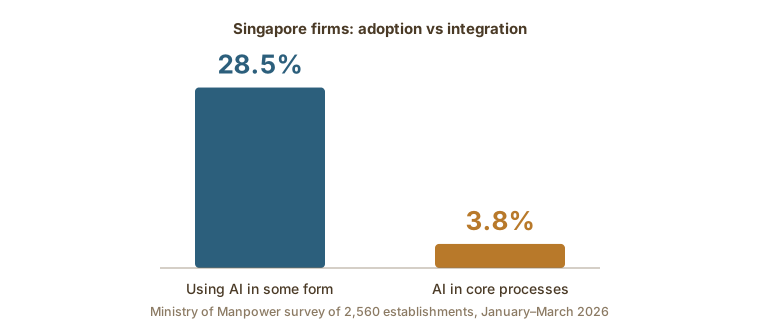
- Adoption is broad but shallow: Singapore's Ministry of Manpower found 28.5 per cent of firms had adopted AI in early 2026, and only 3.8 per cent had integrated it into core processes.
- The binding constraints are data quality, evaluation, integration and governance — not model capability.
What is artificial intelligence?
Artificial intelligence is the branch of computer science concerned with building systems that perform tasks normally associated with human cognition: understanding language, interpreting images, planning, reasoning over evidence and producing new content. A working definition is narrower and more honest than the marketing one — an AI system is software whose behaviour is derived from data rather than specified by a programmer.
The field is older than the current wave. The term was coined at the 1956 Dartmouth workshop, and for four decades the dominant approach was symbolic: encode human knowledge as explicit rules. Expert systems worked in narrow domains and collapsed under the weight of exceptions elsewhere. The statistical alternative — learn the rules from examples — won once two conditions arrived together in the 2010s: enough labelled data, and enough parallel compute.
Narrow AI, general AI and the terms that get confused
Every AI system in commercial use is narrow AI: competent inside a task domain and useless outside it. A model that drafts contracts cannot drive a car. Artificial general intelligence — a system matching human breadth across arbitrary tasks — has no agreed definition, no agreed test and no shipping example; treat claims about it as forecasts, not specifications. The rest of the vocabulary is layered rather than parallel, which is where most confusion starts. The terms nest:
| Term | What it means | Example |
|---|---|---|
| Artificial intelligence | The whole field, including rule-based systems that do not learn. | Chess engines, fraud rules engines, chatbots. |
| Machine learning | The subset where behaviour is learned from data, not programmed. | Spam filtering, credit scoring, forecasting. |
| Deep learning | Machine learning using many-layered neural networks that learn their own features. | Face recognition, speech transcription, medical imaging. |
| Generative AI | Deep learning models trained to produce new content, not classify existing content. | Text, image, code and audio generation. |
| Large language models | Generative models trained on text at very large scale. | ChatGPT, Claude, Gemini, Llama, DeepSeek. |
| AI agents | Models wrapped in a loop that can plan, call tools and act over several steps. | An assistant that searches, reads and drafts unattended. |
Two further terms describe capability areas rather than techniques. Natural language processing covers anything involving human language; computer vision covers images and video. Both were separate disciplines with their own methods, and both are now dominated by the same underlying architecture. For the language side in depth, see our explainer on how large language models work.
How artificial intelligence works: from data to decisions
Conventional software is a set of instructions: if this, then that. A machine learning system is a mathematical function with millions to trillions of adjustable numbers, called parameters or weights, and training tunes those numbers so outputs match known examples. The trained model is then a fixed artefact mapping inputs to outputs — with a consequence that catches teams out: you cannot patch a model the way you patch code. Changing behaviour means changing the data, the training, or the instructions wrapped around it.
Machine learning: learning from examples
There are three broad ways a model can learn, and the choice determines what data you need:
- Supervised learning — the model sees inputs paired with correct answers and learns the mapping. The workhorse of commercial machine learning, and the reason labelled data is expensive.
- Unsupervised learning — no labels; the model finds structure on its own, typically by clustering similar items. Customer segmentation and anomaly detection sit here.
- Reinforcement learning — the model learns by acting, receiving rewards or penalties, and adjusting over many trials. It underpins game-playing systems, robotic control, and the alignment stage that turns a raw language model into a usable assistant.
Data quality dominates outcomes whichever paradigm applies. Models learn the patterns present in their training data, including its errors, gaps and historical biases — a model trained on hiring decisions that favoured one group will reproduce that preference, with the appearance of objectivity. Data governance is not preparation for an AI project; it is most of the project.
Neural networks and deep learning
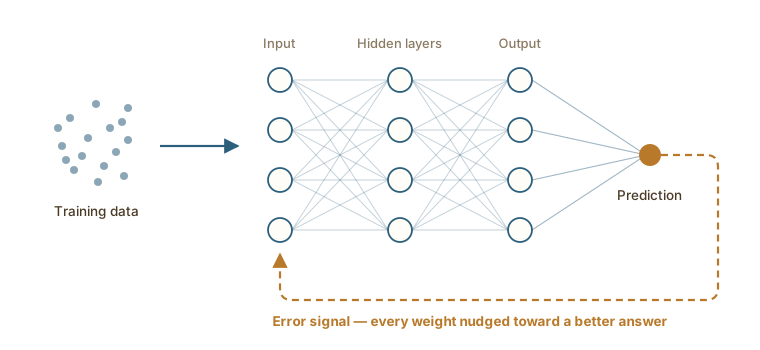
A neural network is a stack of layers, each containing simple units that take weighted sums of their inputs and apply a non-linear function. The biological analogy is decorative; what matters is that stacking non-linear layers lets the network approximate very complicated relationships. Training uses backpropagation: run an example forward, measure the error, push it backwards through the layers, nudge every weight in the direction that reduces it, and repeat billions of times. Depth is the point — where classical machine learning needed an engineer to choose which features mattered, a deep network learns its own.
Transformers, tokens and the generative turn
The architecture behind the current generation arrived in 2017 with the transformer, whose central mechanism — self-attention — lets a model weigh the relevance of every part of an input against every other part. Text is broken into tokens, roughly word fragments, and the model is trained to predict the next one. At sufficient scale, capabilities emerge that were never explicitly taught. Pretraining produces a general text predictor; post-training then makes it useful through supervised fine-tuning on curated examples and preference methods such as RLHF and DPO. The same backbone now handles images, audio and video, which is what multimodal means in practice: one model, several input types.
Two techniques matter for business use because they address the same weakness — a model only knows what was in its training data. Retrieval-augmented generation (RAG) searches your own documents first and passes the relevant passages to the model as context, grounding answers in current, private information. Tool use lets the model call external systems and build on the results. Chain tool calls together with a planning loop and you have an agent, which carries its own security profile; see our deep dive on AI agents and security.
What artificial intelligence is used for
Underneath the product names, a manageable number of capability families do the actual work. Recognising which family a vendor is selling tells you more about fit and risk than any demonstration:
| Capability | What it does | Typical business application |
|---|---|---|
| Prediction and classification | Assigns a label or number to structured data. | Credit risk, churn scoring, predictive maintenance. |
| Natural language processing | Interprets and generates human language. | Support automation, contract review, search, summarisation. |
| Computer vision | Interprets images and video. | Quality inspection, medical imaging, retail analytics. |
| Speech AI | Transcribes speech and synthesises natural voice. | Contact centre transcription, voice interfaces, translation. |
| Content generation | Produces text, images, code, audio or video. | Marketing production, software development, design iteration. |
| Recommendation and ranking | Orders items by predicted relevance. | E-commerce merchandising, feeds, internal knowledge search. |
| Autonomous agents | Plans and executes multi-step tasks using tools. | Research workflows, ticket triage, back-office automation. |
Sector adoption follows task structure rather than industry glamour. Healthcare uses vision models for diagnostic support and language models for clinical documentation; financial services runs classification for fraud and language models for compliance review; manufacturing pairs vision inspection with predictive maintenance. The winning applications share a profile: high volume, tolerant of a reviewable error rate, and expensive to staff with humans at the same scale. Most are also invisible — spam filtering, map routing, phone camera processing and machine translation are all mature deployments, and that is the realistic template. AI works best as an embedded component of a product, not as a product.
The limits of artificial intelligence
Honest limitations are more useful than capability lists, because they determine which projects are viable. The recurring ones:
- Confident errors. Generative models produce fluent output whether or not they have grounds for it. Fabricated citations and plausible-but-wrong reasoning are structural to next-token prediction, not bugs to be patched. Stanford's 2026 AI Index found inaccuracy is now the top-cited organisational AI risk at 74 per cent, up 14 points in a year.
- Data quality and bias. Models inherit the distribution they were trained on. Where historical data encodes discrimination or under-represents a group, outputs will too — and automation gives that bias scale and a veneer of neutrality.
- Evaluation is genuinely hard. A classifier has a right answer you can score against; a drafted email has a range of acceptable answers and several ways to be subtly wrong. Benchmark scores rise faster than real-world validation.
- Cost, latency and opacity. Reasoning-heavy and agentic workloads consume far more tokens per task than a single response, so unit economics need modelling on realistic traffic. And a deep network's decision cannot be read off its weights — a problem wherever an explanation is legally required.
- A new security surface. Prompt injection, training-data poisoning and inadvertent disclosure of sensitive context are distinct from conventional application risks; our cybersecurity basics primer covers the baseline these sit on top of.
- Provenance, copyright and energy. Training-data rights and ownership of generated output remain contested, and serving at scale consumes enough power to constrain where capacity can be built.
The largest limitation is organisational. MIT's Project NANDA study of enterprise generative AI put the share of pilots delivering no measurable profit-and-loss impact at roughly 95 per cent, attributing failure not to model quality but to brittle workflow integration and weak organisational learning. Stanford's finding that fewer than 10 per cent of adopters have scaled AI anywhere points the same way: the technology is usually not the bottleneck.
Artificial intelligence in 2026: capability, cost and market sentiment
Capability has continued to compound. Stanford HAI's 2026 AI Index records top models meeting or exceeding human performance on PhD-level science questions and competition mathematics, with coding performance on SWE-bench Verified rising from around 60 per cent to near saturation within a single year. Industry, not academia, produced more than 90 per cent of notable frontier models in 2025 — a structural shift, given that frontier training runs require capital only a handful of organisations command. The competitive picture has also flattened: the US–China frontier gap has effectively closed, and open-weight models trail closed frontier models by a shrinking margin.
For buyers that matters less as geopolitics than as pricing pressure. Inference costs have fallen roughly an order of magnitude per year for a given level of capability, driven by algorithmic efficiency such as mixture-of-experts routing and quantisation, faster accelerator generations, and competition. Capability that cost tens of dollars per million tokens in 2023 is available for cents in 2026 — so anything rejected on cost grounds eighteen months ago deserves a fresh calculation.
Market sentiment is the genuinely contested part. The largest hyperscalers are expected to spend more than US$600 billion on infrastructure in 2026, roughly three-quarters of it on AI capacity. Bulls point to operating cash flows that still cover the spend; bears point to off-balance-sheet lease commitments, depreciation schedules that assume long accelerator lifetimes, and circular arrangements in which suppliers finance their own customers. Both readings are defensible from public filings, so the implication for buyers is contractual: avoid commitments that only make sense if today's pricing and supply conditions persist. Underneath sits a physical constraint — the IEA estimates data centres consumed about 415 TWh in 2024, roughly 1.5 per cent of global electricity, and projects that to roughly double to around 945 TWh by 2030, with accelerated AI servers accounting for almost half the net increase. Power availability, not chip supply, now gates most markets; see our AI data centre explainer and the underlying NVIDIA AI infrastructure stack.
Artificial intelligence in Singapore: adoption, policy and infrastructure
Singapore is an instructive case because usage and integration have diverged sharply. The Ministry of Manpower's first dedicated study of AI adoption among firms, surveying 2,560 private-sector establishments between January and March 2026, found 28.5 per cent had adopted AI in some form — but only 3.8 per cent had fully integrated it into core processes. Adoption scales steeply with size, from 23.9 per cent among firms under 25 employees to 76.4 per cent among those above 500. By sector, information and communications leads at 74.1 per cent, ahead of professional services at 57.5 per cent and financial and insurance services at 56.4 per cent.
Policy has moved in step. The National AI Strategy 2.0, launched in December 2023, was refreshed in 2026, and Budget 2026 established a National AI Council chaired by the Prime Minister with a mandate to deploy AI at speed and scale across advanced manufacturing, connectivity, finance and healthcare rather than through isolated pilots. On governance, IMDA and the AI Verify Foundation maintain the Model AI Governance Framework — extended to generative AI and, in January 2026, to agentic systems — alongside AI Verify, an open-source toolkit that tests systems against internationally recognised principles. The posture is deliberately pro-innovation and framework-led rather than statutory, a meaningful contrast with the EU AI Act's risk-tier obligations; our guide to Singapore AI regulations sets out what applies to whom. Compute is available through hyperscaler regions, GPU-as-a-service and national research systems, and for most organisations renting is the practical route — start with the AI computing companies directory and our AI computing buyer's guide.
Artificial intelligence compared with traditional automation
A recurring and expensive mistake is applying AI to problems a deterministic system solves better. The choice is not ideological — it follows from whether the task has stable rules, and how tolerable a wrong answer is.
| Approach | How it decides | Best suited to | Main failure mode |
|---|---|---|---|
| Rules engine | Explicit conditions written by people. | Stable, auditable logic: tax calculation, eligibility checks. | Unmaintainable as exceptions multiply. |
| Robotic process automation | Scripted UI and API steps. | Repetitive transfers between systems that lack integration. | Breaks when an underlying interface changes. |
| Classical machine learning | Learned statistical patterns over structured data. | Scoring and forecasting where you have labelled history. | Silent degradation as data drifts. |
| Generative AI | Next-token prediction over learned language patterns. | Unstructured content: drafting, summarising, extracting. | Fluent, confident errors that pass casual review. |
| Agentic AI | A model planning and calling tools in a loop. | Multi-step tasks spanning several systems. | Compounding errors and a wide security surface. |
The sound default is the simplest approach that meets the requirement, reserving AI for the parts genuinely characterised by ambiguity or unstructured input. Hybrid designs usually win: a language model extracts fields from a document, and a rules engine — deterministic, testable, auditable — makes the actual decision.
Future outlook
Three directions are visible enough to plan around. Multimodality becomes the default, removing the pipeline of specialised components most systems still stitch together. Capability is moving down the size curve — small models running on a laptop, a phone or a factory device now match flagship models from two years ago, shifting inference to the edge for latency, cost and data-residency reasons. And agentic systems are the current frontier of both value and risk: McKinsey's 2026 research found roughly 23 per cent of organisations scaling an agentic system in at least one function but no more than about 10 per cent within any given function, while Gartner forecasts that more than 40 per cent of agentic projects will be cancelled by 2027 on unclear ROI and weak controls.
Governance, meanwhile, is becoming a procurement question rather than an ethics discussion, as EU AI Act obligations phase in and frameworks such as AI Verify give buyers something concrete to ask for. What is unlikely to change is the shape of the problem. Models will keep improving and keep getting cheaper; the organisations that benefit will be those that did the unglamorous work — defining tasks precisely, fixing their data, building evaluation harnesses, and integrating output into processes people actually follow. That work is portable across model generations, which is why it is the safest place to invest.
Find AI and machine learning providers in Singapore
Browse directory profiles for AI computing, data and machine learning companies operating in Singapore, with recorded capability fields where available.
Frequently asked questions
What is artificial intelligence in simple terms?
Artificial intelligence is software whose behaviour is learned from data rather than written as explicit rules. Instead of a programmer specifying every step, the system is shown large numbers of examples and adjusts internal parameters until its outputs match them. That is why AI can handle messy inputs such as language and images that conventional programming struggles with — and also why its answers are probabilistic rather than guaranteed.
What is the difference between AI, machine learning and deep learning?
They are nested, not parallel. Artificial intelligence is the whole field, including rule-based systems that do not learn. Machine learning is the subset where behaviour is learned from data. Deep learning is the subset of machine learning that uses neural networks with many layers, which discover their own features instead of relying on human-engineered ones. Generative AI and large language models are applications of deep learning.
How does an AI model actually learn?
A model is a mathematical function with a very large number of adjustable parameters. During training it makes a prediction on an example, the error against the known answer is measured, and that error is propagated backwards to nudge every parameter slightly in the direction that reduces it. Repeated across enormous datasets, this converges on parameters that capture useful patterns. After training the model is fixed until it is retrained or fine-tuned.
Why do AI systems produce confident but wrong answers?
Generative models are trained to produce statistically plausible continuations, not to verify truth. Fluency and accuracy are separate properties, so a model can generate a well-formed citation or figure that does not exist. Retrieval-augmented generation, tool use and human review reduce the frequency of these errors but do not eliminate them, which is why any process using generative AI needs a defined acceptable error rate and a review step.
What is the difference between generative AI and AI agents?
Generative AI responds to a request with content — text, an image, code. An AI agent wraps a model in a loop that can plan a sequence of steps, call external tools such as search or internal APIs, observe the results and continue until a goal is met. Agents extend what AI can automate, but they compound errors across steps and widen the security surface, so they need tighter permissions and monitoring than a single-turn assistant.
How widely have businesses in Singapore actually adopted AI?
Broadly, but not deeply. The Ministry of Manpower's study of 2,560 private-sector establishments in early 2026 found 28.5 per cent had adopted AI, while only 3.8 per cent had integrated it into core processes. Adoption rises sharply with firm size — 23.9 per cent below 25 employees against 76.4 per cent above 500 — and is concentrated in information and communications, professional services and financial services.
Sources and further reading
- Stanford HAI — The 2026 AI Index Report
- Ministry of Manpower Singapore — Adoption of AI Among Firms (April 2026)
- IEA — Energy and AI: Energy demand from AI
- McKinsey — The state of AI trust in 2026: shifting to the agentic era
- Smart Nation Singapore — National AI Strategy
- AI Verify Foundation — AI Verify testing framework
- European Commission — AI Act regulatory framework
- Epoch AI — LLM inference price trends
Related resources
Go deeper on this topic
Knowledge base
- Retrieval-Augmented Generation (RAG) Explained
- Inside Large Language Models: How the Engines Behind ChatGPT, Claude, and Gemini Actually Work
- Fine-Tuning, LoRA and RAG: How to Customise an LLM
- AI Agents and Cybersecurity: Agentic AI Risks and Controls
- NVIDIA Technologies Explained: CUDA, GPUs and the AI Infrastructure Stack
- GPU Architecture Explained: How Graphics Cards Work
- AI Data Centres Explained: Inside the AI Factory, From GPU Racks to Gigawatts
- Cybersecurity Basics: Core Concepts, Controls and How They Fit Together
Vendor directories
Research cluster
Related analysis
Recent TechDirectory Insights coverage from the same research cluster.
- Enterprise AI Deployment — a 5-article path