Meta description: Open source LLMs explained: open-weight vs fully open models, how they work, deployment choices, benefits, risks, licences, use cases and 2026 trends.
Title suggestions:
- Open Source LLMs Explained: Open-Weight Models, Uses, Benefits and Limits
- Introduction to Open Source LLMs: How They Work and Which Model to Choose
- Open Source vs Closed LLMs: Licensing, Deployment and Trade-Offs
An open source LLM gives developers access to more of the model than a hosted chat interface or API normally does. That may mean downloadable weights, source code, documentation, training data information, or the entire training recipe. The phrase is used broadly, however, and a model described as open source is often open-weight: the trained parameters are available, while the data and training process remain partly undisclosed. This guide explains the difference, how these models work, where they are useful, and what a technical or procurement team should check before deploying one. For the underlying architecture, see our guide to how large language models work; for the wider AI landscape, see our introduction to artificial intelligence.
The practical question is not whether openness is good in the abstract. It is whether a model gives an organisation the control, privacy, customisation and cost profile its workload requires. A small local model may suit classification or an offline assistant, while a managed closed model may suit a high-stakes workflow that needs an SLA and minimal infrastructure work.
What Is an Open Source LLM?
A large language model is a neural network trained to predict tokens, or pieces of text, from preceding context. An open source LLM is a language model whose components are released under terms that permit meaningful use, inspection, modification and redistribution. The exact scope of those components determines how open the model really is.
The Open Source Initiative's Open Source AI Definition 1.0 sets a demanding reference point: model parameters, complete training and inference code, and sufficient information about data provenance, selection, labelling, processing and filtering. The aim is to let a skilled person study and build a substantially equivalent system, not merely download a working model.
This is why the term open-weight LLM is useful. Weights are the learned numerical parameters that make a trained model behave as it does. Releasing them makes local inference and fine-tuning possible, but it does not automatically disclose the data, filtering decisions, hyperparameters, intermediate checkpoints or training code needed to reproduce the model. Open-weight models are often very useful. They are not automatically fully open-source models.
Open Source vs Open Weight vs Closed Source
| Model type | What is usually available | What it enables | What to check |
|---|---|---|---|
| Closed or proprietary | API or application access; weights and training process are private. | Fast adoption with provider-managed hosting, safety and updates. | Data handling, retention, pricing, availability, lock-in and usage limits. |
| Open weight | Trained weights, model card and often inference code; the training data and full recipe may be limited. | Self-hosting, local inference, fine-tuning and model-level customisation. | Model licence, acceptable-use policy, data provenance and supported runtimes. |
| Fully open-source aligned | Weights, training and inference code, data information, recipes and often intermediate checkpoints. | Reproduction, research, deeper audit and modification of the full pipeline. | Whether the release is complete, the licences for each component and any unavailable data. |
| Open tooling around a model | Runtimes, libraries or evaluation tools are open even when the model weights are not. | Portable serving, quantisation, orchestration and easier model switching. | The tool licence and the separate licence of every model it serves. |
The distinction is visible in current releases. Ai2 describes OLMo 2 as fully open, with training data, code, recipes, evaluations and intermediate checkpoints. Meta's Llama 4 releases make weights and supporting material available, but the Llama 4 Community License is a custom licence with attribution, use-policy and other conditions. That makes Llama 4 an open-weight family rather than an OSI-compliant open-source AI system.
How Open Source LLMs Work: The Technical Breakdown
Open source LLMs use the same mathematics as closed models. The difference is access to the artefacts and control over where the model runs. Most general-purpose models are decoder-only Transformers; encoder-only and encoder-decoder architectures remain useful for classification, retrieval, translation and sequence-to-sequence tasks.
From text corpus to model weights
- Tokenisation. Text is split into tokens, which may be whole words, word fragments, punctuation or spaces. A tokenizer maps each token to an integer ID that the model can process.
- Embeddings and position. Token IDs become vectors. Positional information, commonly through Rotary Positional Embeddings or a related method, helps the model distinguish sequence order.
- Transformer computation. Self-attention lets each token weigh other tokens in the context. Feed-forward layers transform the resulting representations, while residual connections and normalisation help stabilise a deep network. The original Transformer design is described in Attention Is All You Need.
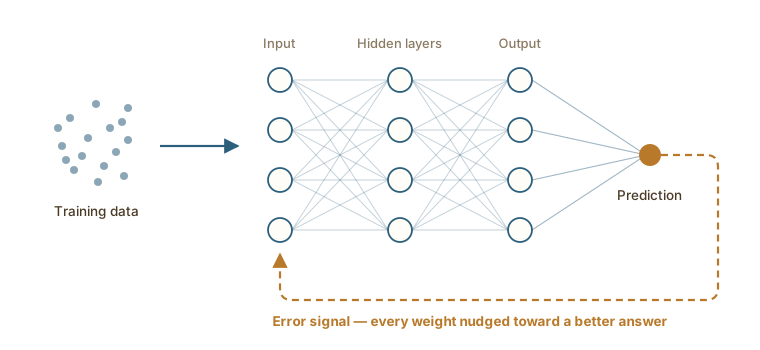
- Pretraining. The model predicts the next token across a large text and code corpus. The prediction error is used to update billions of parameters. This stage produces a base model that can continue text but does not necessarily follow instructions reliably.
- Post-training. Supervised fine-tuning teaches a conversational or task-specific format. Preference optimisation methods such as DPO, reinforcement learning from human feedback and reinforcement learning with verifiable rewards can change how the model follows instructions, reasons and uses tools.
- Inference. At run time, the system first processes the prompt, called prefill, and then generates output one token at a time. A key-value cache stores attention information from earlier tokens so the server does not recompute the full prompt for every new token.
The release format affects inference. A model in 16-bit precision needs roughly two bytes per parameter before runtime overhead, so a 70-billion-parameter model is not a desktop application. Quantisation stores weights in lower precision, commonly 8-bit or 4-bit, to reduce memory. The Hugging Face bitsandbytes documentation describes 8-bit inference and 4-bit QLoRA, where a small trainable adapter is added to a quantised base. Quantisation saves memory but can change quality or latency.

Why mixture-of-experts models matter
Many current open-weight models use a mixture-of-experts, or MoE, design. Instead of activating every feed-forward sub-network for every token, a router selects a small group of experts. The total parameter count can therefore be much larger than the active parameter count used for one token. In its official technical summary, DeepSeek-V3 reports 671 billion total parameters and 37 billion activated per token, alongside 14.8 trillion pretraining tokens. That architecture can improve quality per unit of computation, but the full model still consumes substantial storage and distributed-memory capacity.
Serving software is another layer. vLLM provides high-throughput serving features such as PagedAttention, continuous batching, quantisation, distributed parallelism and an OpenAI-compatible API. Local tools such as Ollama and llama.cpp target simpler developer workflows and smaller or quantised models. Choosing the runtime is an engineering decision: the best option depends on hardware, concurrency, context length, latency targets and the need for tool calling or structured output.
Open Source LLM Benefits and Use Cases
The strongest case for an open source LLM is control. A team can choose where it runs, inspect the licence, adapt the model and keep a stable version. That matters most when a workload handles sensitive information, needs a domain vocabulary or has enough traffic for infrastructure economics to matter.
- Privacy and data residency. A self-hosted model can process internal documents, source code or customer records inside a controlled environment. This does not remove privacy obligations; it changes who operates the processing environment and where the data flows.
- Customisation. Teams can fine-tune an instruct model, add a LoRA adapter, adjust the system prompt, or combine the model with retrieval and tools. Fine-tuning changes model behaviour; retrieval-augmented generation adds current or private evidence at request time.
- Cost control. Self-hosting can reduce per-token charges for steady, high-volume workloads. It can also cost more when traffic is intermittent, capacity is underused, or the organisation lacks GPU, MLOps and reliability skills. The correct comparison includes hardware, power, storage, engineering time and support.
- Offline and edge operation. Smaller quantised models can run on a workstation, laptop, phone or an isolated network. That can reduce latency and keep a workflow available when a cloud connection is unsuitable.
- Research and audit. Fully open releases make it easier to inspect training choices, reproduce results, study failure modes and compare modifications. Open-weight releases still support substantial experimentation, but the audit trail is narrower.
- Resilience and portability. A local model reduces dependence on a single API. Standard runtimes and model formats can make it easier to change providers, although compatibility is not automatic and model-specific prompt templates still matter.
Common open source LLM use cases
Practical deployments usually use a model inside a larger system. Examples include private document assistants, code completion, document extraction, multilingual support, classification, search reranking, summarisation, customer-service triage and tool-using internal agents. For regulated or high-impact decisions, the model should prepare evidence or recommendations while a defined process retains review and accountability.
| Model family or example | What the release illustrates | Good fit to investigate | Licensing or operational note |
|---|---|---|---|
| OLMo 2 | Fully open data, code, recipes, evaluations and checkpoints. | Reproducibility and research. | Check each data and software licence. |
| Qwen3 | Open-weight dense and MoE family; the project states Apache 2.0 licensing. | Multilingual work, tools, coding and varied hardware. | Verify the exact version and model card. |
| Llama 4 | Open-weight multimodal MoE family with long-context variants. | Multimodal experiments and its ecosystem. | Custom Community License and use policy; not OSI-aligned. |
| DeepSeek-V3 | Large MoE model with documented training scale and local serving paths. | High-capability distributed experiments. | Code and weights have separate terms. |
| gpt-oss-20b and 120b | Apache 2.0 open-weight reasoning models for operator-controlled infrastructure. | Tool use, reasoning and self-hosting. | Not served through ChatGPT or the OpenAI API. |
Challenges and Limitations of Open Source LLMs
Open source LLMs shift responsibility toward the deployer. A downloadable model is not a production service: the organisation still has to select hardware, secure the endpoint, manage model files, monitor failures, test outputs, handle upgrades and define what happens when the model is wrong.
- Infrastructure and skills. GPUs, storage, networking and cooling can dominate the budget. A smaller model may need retrieval, routing or guardrails to meet the task target.
- Licensing is not one checkbox. Review the model, code, tokenizer, data terms, acceptable-use policy and restrictions on redistribution, derivatives or commercial scale.
- Evaluation does not transfer automatically. Public scores may not predict performance on Singapore English, internal abbreviations, scanned documents or production tools. Build a task-specific test set.
- Safety controls remain necessary. Open weights may lack a provider's moderation layer. Add access limits, prompt-injection defences, logging, escalation and abuse monitoring where needed.
- Hallucination and stale knowledge. An open model predicts plausible text rather than guaranteeing truth. Retrieval and validation reduce error but do not create a verified database.
- Operational drift. A pinned model avoids unexpected provider updates but leaves the team responsible for runtime patches, vulnerabilities, data refreshes and reevaluation.
The cost of self-hosting is more than GPU rental
A fair cost model includes instances, storage, power, cooling, networking, observability, security reviews, data preparation and engineering time. Self-hosting tends to fit predictable demand where privacy or customisation has material value. Managed inference tends to fit variable usage, small teams or workloads where an integrated service reduces operational work.
Open Source LLM Developments and Market Sentiment in 2026
The open-model market is competitive, but the gap with closed models has not disappeared. Stanford HAI's 2026 AI Index technical-performance chapter reports that, as of March 2026, the top closed model led the top open model by 3.3%, compared with 0.5% in August 2024. It also cautions that common benchmarks have reliability and gaming problems. Open models are serious production candidates in many tasks, but benchmark rank alone is not a procurement decision.
Several release patterns are shaping the market. Qwen3 spans small dense and larger MoE models with multilingual and tool-use support. Meta's Llama 4 illustrates multimodal open weights and sparse activation. OpenAI's gpt-oss adds Apache 2.0 open-weight reasoning models, while Ai2's OLMo 2 shows what fuller transparency looks like when data, code, recipes and checkpoints are released together.
The market sentiment is becoming more practical. The discussion is moving from principle toward deployment questions: can the model meet the task quality target, can the organisation operate it, is the licence compatible, must data stay controlled, and does self-hosting beat the total cost of service? This is an inference from release patterns, vendor documentation and performance tracking, not a single survey.

The technology trend: more capability per unit of hardware
Model releases are becoming more hardware-aware. MoE reduces active computation, quantisation lowers memory requirements, and serving systems use batching and cache management to increase throughput. This creates options from small local models to distributed MoE clusters. Long context and multimodal inputs add memory, evaluation and latency costs that buyers should measure.
Open Source LLMs Compared with Alternatives
| Approach | Strengths | Limitations | Typical fit |
|---|---|---|---|
| Closed managed API | Fastest start, managed infrastructure, integrated tools, service-level options and provider-led updates. | Less control over weights and model lifecycle; data, pricing and availability depend on the provider. | Teams that value speed to production and have moderate or variable volume. |
| Hosted open-weight API | Open model choice without owning all serving infrastructure; easier switching between model families. | Still depends on a hosting provider; licence and data handling remain important. | Teams testing models or seeking open-model economics without full self-hosting. |
| Self-hosted open-weight LLM | Control over data path, version, latency, fine-tuning and serving policy. | Requires GPU capacity, MLOps, security, monitoring and model evaluation. | Privacy-sensitive, steady-volume or highly customised workloads. |
| Fully open-source model | The strongest basis for reproduction, research and inspection of training choices. | Fewer releases at the largest scales; data and infrastructure can still be difficult to reproduce. | Research, transparency work and teams that need to study the entire pipeline. |
| Hybrid routing | Sends routine tasks to small or open models and difficult or specialised tasks to a managed frontier model. | Adds routing logic, multiple evaluation surfaces and more than one operational relationship. | Organisations balancing cost, privacy, quality and resilience across workloads. |
For many organisations, hybrid routing is the practical middle ground. A small open model can classify, redact or retrieve documents locally, while a hosted model handles occasional complex requests. The design should be based on measured quality, latency, risk and total cost rather than a blanket preference for one model category.
Future Outlook for Open Source LLMs
Open source LLMs are likely to remain important, but openness will continue to be a spectrum. Some capable releases may publish weights and inference code without all training details, while research projects push toward fuller transparency. Buyers will need to read release documentation rather than treat an open-source label as a complete description.
- Smaller specialised models. Domain-specific, multilingual and task-specific models will make local inference more attractive where a general model is unnecessarily large.
- Model and tool systems. The practical unit of deployment will increasingly be a model plus retrieval, tools, policy checks, evaluation and observability, not a set of weights in isolation.
- Provenance and licensing evidence. Organisations will ask for clearer training-data information, model cards, evaluation methods and obligations for derivatives and redistribution.
- More hybrid infrastructure. Private inference, hosted open-weight services and closed APIs will coexist behind routing and policy layers, with workload placement based on sensitivity, cost and required quality.
- Evaluation as a durable capability. Teams that maintain representative test sets and review workflows will be better able to compare model releases than teams relying on public leaderboards alone.
Find AI computing and deployment partners in Singapore
Browse Singapore AI computing providers, cloud specialists and system integrators that can help with GPU capacity, private inference, fine-tuning and production deployment.
Frequently asked questions
What is an open source LLM?
An open source LLM is a language model released with terms and artefacts that allow meaningful use, inspection, modification and redistribution. In strict usage, that includes the weights, complete training and inference code, and sufficiently detailed training-data information. Many models called open source are more precisely open-weight because only the trained parameters and selected tools are public.
What is the difference between open source and open-weight LLMs?
An open-weight LLM makes its trained parameters available for download and local use, but it may not disclose the full training data, filtering process, training code or intermediate checkpoints. A fully open-source AI release aims to provide those additional artefacts under compatible terms so the system can be studied and reproduced more completely.
Can I run an open source LLM locally?
Yes. Small and quantised models can run on some laptops, workstations and edge devices, while larger models need high-memory GPUs or distributed servers. Runtimes such as vLLM, Ollama, llama.cpp and Transformers support different model families and hardware. Check the model card, licence, memory requirement, context length and runtime support before downloading.
Are open source LLMs free to use?
The weights may be free to download, but running a model still has costs for GPUs, storage, power, cooling, hosting, engineering, monitoring and security. Some models use permissive licences; others have custom terms or acceptable-use policies. Commercial use should be reviewed against the exact licence for the weights, code, tokenizer and data.
Are open source LLMs better than ChatGPT, Claude or Gemini?
Not in every task. Closed services often provide a higher quality ceiling, managed infrastructure, integrated tools and less operational work. Open-weight models can be better for privacy, customisation, offline use, stable versioning or high-volume workloads. The right comparison uses a representative evaluation set, total cost, latency, data requirements and risk controls.
Which open source LLM should a business choose?
Start with the workload rather than the model name. Define the required language coverage, context length, latency, tool use, accuracy, privacy and budget. Then shortlist models with compatible licences, run them on representative tasks, test the safety and failure modes, and compare self-hosted, hosted open-weight and closed API options using total cost of ownership.
SEO Recommendations
Suggested internal links
- How large language models work — Links the reader to the Transformer, attention and post-training fundamentals.
- AI compute infrastructure explained — Supports the deployment and GPU-capacity discussion.
- AI agents and cybersecurity — Connects open-model tool use with permissions, monitoring and prompt-injection controls.
- GPU architecture explained — Provides technical context for memory, accelerators and inference cost.
- AI computing companies in Singapore — Creates a commercial-intent path for readers evaluating deployment partners.
Image placement suggestions
- After the open source vs open-weight table — alt text: Training loop showing how data, model weights and error feedback interact in an open LLM project.
- After the inference and quantisation section — alt text: GPU servers and cooling equipment supporting self-hosted large language model inference.
- Before the 2026 market sentiment section — alt text: Professionals reviewing an AI-assisted workflow with human oversight and evaluation controls.
Additional long-tail keyword opportunities
- what is an open source LLM
- open source vs open weight LLM
- best open source LLM for business
- how to run an open source LLM locally
- open source LLM licensing for commercial use
- self-hosted LLM infrastructure requirements
- open source LLM fine-tuning and RAG
- open source LLM vs ChatGPT Claude Gemini
Sources and further reading
- Open Source Initiative - The Open Source AI Definition 1.0
- Open Source Initiative - Open Weights: not quite what you've been told
- Ai2 - OLMo 2 fully-open language models
- Team OLMo - 2 OLMo 2 Furious technical report
- Meta AI - The Llama 4 herd
- Meta Llama - Llama 4 Community License
- DeepSeek-AI - DeepSeek-V3 repository and technical summary
- Qwen Team - Qwen3 repository and model documentation
- Google AI for Developers - Gemma 3 model card
- OpenAI - Introducing gpt-oss
- Stanford HAI - 2026 AI Index technical performance
- vLLM documentation
- Hugging Face Transformers - bitsandbytes quantisation
- Vaswani et al. - Attention Is All You Need
- Hu et al. - LoRA: Low-Rank Adaptation of Large Language Models
- Rafailov et al. - Direct Preference Optimization
- Inside Large Language Models: How the Engines Behind ChatGPT, Claude, and Gemini Actually Work
- Introduction to Artificial Intelligence: How AI Works and Where It Is Used
- ai compute infrastructure explained
- AI Agents and Cybersecurity: Agentic AI Risks and Controls
- GPU Architecture Explained: How Graphics Cards Work
- cloud computing enterprise guide