
Rank the world's startup hubs and you find a small island near the top. Singapore has no oil, no farmland and roughly six million people. It sits fourth in the world — behind the United States, the United Kingdom and Israel, and ahead of every country in continental Europe. That ranking comes from StartupBlink's 2026 index, which scores startup activity country by country.
The number a board should care about is not the rank. It is the speed. Singapore grew 24.4% in a year — faster than anywhere else in the world's top ten.
Investors agree. In the first six months of 2026, companies registered in Singapore took in US$6.9 billion of the US$7.4 billion raised across all of Southeast Asia. That is 94 cents of every dollar, up from 91 cents six months earlier. But read that figure carefully. It says less about a thousand thriving young companies and more about where the region's money chooses to be based — a gap Singapore has spent twenty years creating deliberately.
Nothing that follows is an accident of geography. The rankings, the grants, the tax rules, the visa schemes and the country's careful political neutrality are all deliberate tools, built to do one job: make Singapore the easiest place in Asia to register a company, raise money, hire people and protect an idea. The tools are worth understanding. So are their limits.
Singapore is small. Its startup scene is not.
The pull is measurable. Fourth in the world overall. First in the world for how active its startup community is. Second in the world for financial technology. More than 4,500 technology companies, backed by over 500 investment funds.
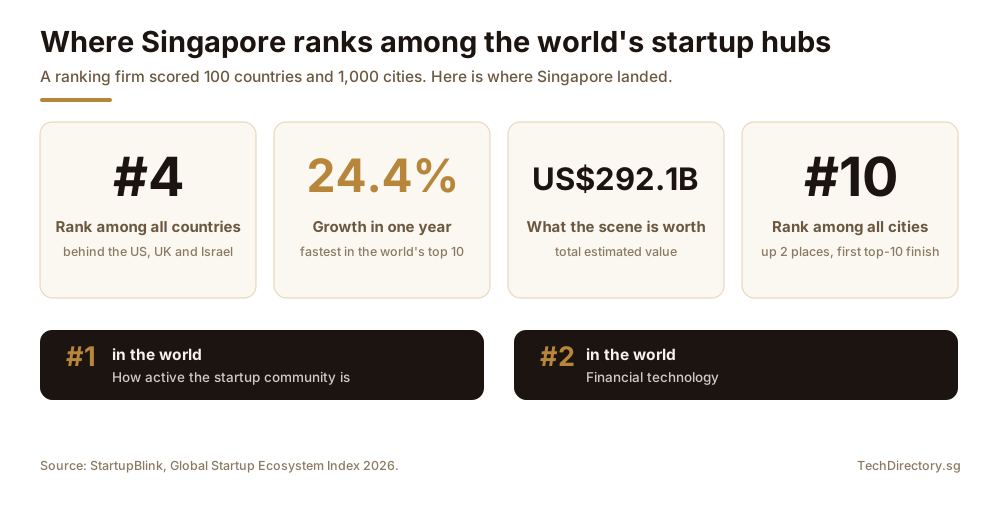
Behind the headline rank sits a thick support layer. More than 4,500 technology startups. More than 220 organisations that help young companies get going. More than 500 active investment funds, ranging from vehicles linked to the state investors Temasek and GIC through to family offices and global funds. Singapore the city entered the world's top ten for the first time in 2026, climbing two places to tenth on 26.7% growth — the fastest of any city in the top twenty. The whole scene is valued at close to US$292 billion.
Read the 94% figure twice
Here is the part most summaries skip. The total amount invested across Southeast Asia more than doubled compared with a year earlier — but the number of deals actually fell, from 153 down to 127.
So the growth did not come from more companies raising money. It came from a handful of very large cheques. The biggest by far was US$4.5 billion raised by DayOne, a Singapore company that builds and runs data centres, across two funding rounds. In other words: concentration, not breadth.
Money is pooling in Singapore, and inside Singapore it is pooling in a shrinking number of very large infrastructure bets. Anyone reading the ranking as proof of a broad, healthy market should hold that fact next to it.
What it actually costs to run a company here
Singapore is one of the most expensive places in Asia to operate. But its tax rules are designed so that a new company pays almost nothing on its first few years of profit.
The standard company tax rate is a flat 17%, unchanged since 2010 and low compared with most developed countries. For a new company, the real rate is far lower. A scheme called the Start-Up Tax Exemption cancels 75% of the tax on the first S$100,000 of taxable profit, and 50% on the next S$100,000, for the first three tax years. In practice that pulls most qualifying young companies down to an effective rate of 2% to 5% while they are still small. The 2026 Budget added a one-off 40% discount on the tax owed, capped at S$30,000.
There is also no tax on the profit you make from selling shares, and share sales sit under rules that give sellers extra certainty. That matters a great deal on the day founders and early investors finally cash out.
Two more schemes target exactly what a science-and-engineering founder spends money on. One lets companies claim up to four times their actual spending on research, patent registration and innovation as a tax deduction. Another can cut the tax on income earned from your own patents and protected ideas to somewhere between 5% and 10%. Registering the company itself is close to effortless: foreigners can own 100% of it, you need almost no starting capital, and it takes days rather than months. Setting up the company is the easy part.
| Support scheme | What you get | Who it suits | The catch |
|---|---|---|---|
| Startup SG Tech | Up to S$400,000 to prove an idea works, or up to S$800,000 to prove it sells | Companies with their own technology they can turn into a product | Paid in stages as you hit targets. You must put in 10–20% of the money yourself, and the government takes a small stake. |
| Startup SG Equity | The government invests its own money alongside private investors. Topped up by another S$1 billion in the 2026 Budget. | New and growing companies built on hard science and engineering | A private investor has to lead the round first. |
| Enterprise Development Grant | Pays 50–70% of the cost of projects that build new company capabilities | Companies scaling up their operations | Conditions on how much of the company is locally owned, and on what the project covers. |
| Enterprise Compute Initiative | Computing power, cloud credits and engineering help, from a S$150 million pot | Companies running heavy artificial-intelligence work | You have to go through approved suppliers. Aimed at using AI, not inventing it. |
| Start-Up Tax Exemption | 75% off the tax on your first S$100,000 of profit, 50% off the next S$100,000, for three years | Almost any qualifying new company | No more than 20 shareholders, and one person must hold at least 10%. |
The offset to all of this is cost, and it builds up. Prime office space, senior engineering salaries and housing are among the most expensive in Asia. The gap against Jakarta, Kuala Lumpur or Ho Chi Minh City is wide enough to change how fast a young company burns through its first serious funding round.
Singapore's answer is not to compete on price. It competes on near-certainty — that the money, the contracts and the eventual sale of the business will all behave the way you expect. And it charges for that.
The government is the biggest investor in the room
Singapore's largest startup backer is the state itself. It has committed billions to artificial-intelligence research, to computing power, and to investing alongside private funds through the second half of this decade.
The country's National AI Strategy 2.0, launched in December 2023 and updated through 2026 under the banner of "AI for the public good", reads less like a mission statement and more like a shopping list. Underneath it sits real money.
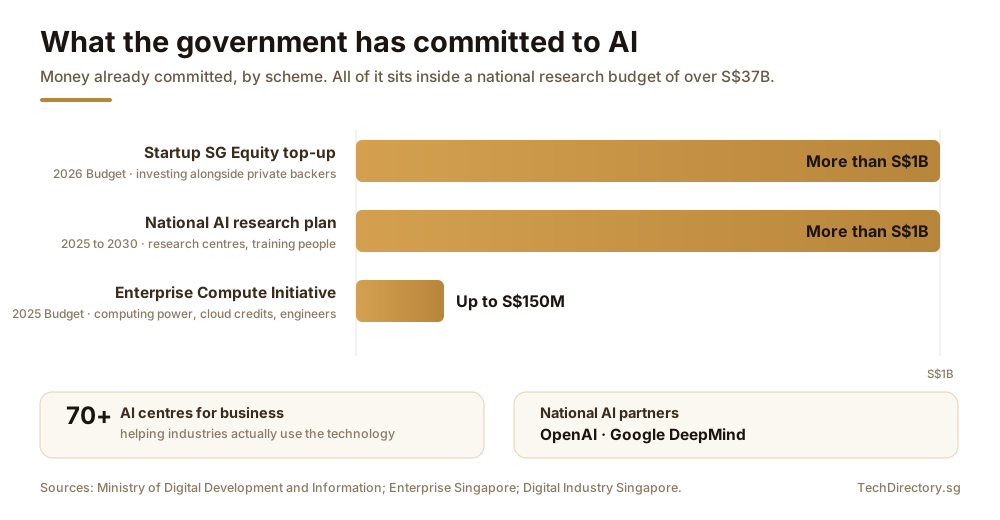
The national AI research plan commits more than S$1 billion between 2025 and 2030 to research centres, to both basic and applied work, and to training people. The Enterprise Compute Initiative set aside up to S$150 million in the 2025 Budget to put computing power, cloud credits and engineers within reach of companies that could never afford to build their own. The 2026 Budget added another S$1 billion to the government's co-investment scheme, extending it to larger, more established companies.
All of it sits inside a national research and innovation budget worth more than S$37 billion. On top of that, national partnerships with OpenAI and Google DeepMind — working labs, training programmes, national accelerators — bolt private, frontier-grade capability onto the public framework. This is a country buying its way to large-scale use of the technology rather than waiting for it to arrive.
For a founder, the maths is blunt. A government that invests alongside you, subsidises your computing bill and helps fund your research lowers the amount of private money you need to reach your next milestone. But it also steers you. The money flows toward the industries the strategy names — manufacturing, finance, healthcare and communications — and toward practical uses of artificial intelligence rather than speculative research. Cheap fuel, with a direction attached.
Where the people and the machines are
The supply of skilled people and the physical infrastructure are built to the same plan as the tax breaks — deliberately, and at national scale.
The universities do real work here. The National University of Singapore's computing school ranked fourth in the world for computer science in the 2026 QS university tables. It and Nanyang Technological University are the only Southeast Asian institutions in the global top tier, and the government research agency A*STAR pushes practical talent out into industry. Between 2015 and 2020 the government put more than S$700 million into education and mid-career retraining through a national scheme called SkillsFuture, creating a pool of workers that large multinationals then deepened.
Bringing in talent from abroad has its own dedicated routes. One visa scheme admits established technology leaders and founders. A second fast-tracks work permits for a young company's core team. A five-year pass targets very high earners.
On the physical side, Singapore has the region's best communications infrastructure, dense mobile coverage, and a growing — though power-limited — base of very large data centres, now supported by the government computing scheme for AI work. The computing power, the people and the money all sit inside a two-hour taxi ride.
Why American and Chinese firms both pick Singapore
Singapore's political neutrality lets companies from rival power blocs run their regional operations from the same island without inheriting either side's political risk.
The draw is not the tax. It is trust — the boring, enforceable kind. English-style commercial law. Judges whose rulings you can predict. A currency you can freely move in and out. And strong protection for ideas: software is automatically copyrighted, AI inventions can be patented if they do something genuinely new, and trade secrets can be enforced in court. For a company whose only real asset is its software, that is worth more than a tax rebate.
The rules are written to be usable rather than punishing. The country's AI governance framework offers voluntary, testable principles on fairness and explaining decisions, rather than outright bans. Singapore's personal data law is lighter than Europe's privacy rules in ways product teams actually notice. The financial regulator runs live test environments where companies can try AI and finance products under supervision — and it has taken a clearer position on digital assets than most countries have managed.
Neutrality is the quiet multiplier. An American AI company and a Chinese one can both put their regional headquarters here, and neither government reads it as a bet against them.
The catch in being the base
The weaknesses are the mirror image of the strengths: high cost, tightening borders, and dependence on growth that happens somewhere else.
Cost is the obvious one. Every time the government tightens the rules on work permits — a recurring response to local unease about competition from foreigners — it adds back exactly the friction the whole system exists to remove. And each adjustment lands on precisely the founders the visa schemes were built to attract.
The subtler risk is structural. A large share of what happens in Singapore is middleman work: money, holding companies and regional finance chiefs based on an island whose own home market is small. When budgets tighten, middlemen are the easiest layer to cut out.
The 94% funding figure flatters this. Strip out the giant infrastructure deals and what remains is a hub booking the region's transactions, not one generating the region's demand. Indonesia, Malaysia and Vietnam have noticed. They court the same companies with cheaper land and far larger home markets.
Singapore's response has been to climb rather than defend — to sell itself as the audited, well-regulated, trusted place for work that cannot tolerate uncertainty, and to leave cheap-and-large to its neighbours. That is a defensible position. It is also a narrow one, and it rests on a bet: that founders will keep paying a premium for certainty in a region that is steadily building its own.
What this means for your business
Four things follow from the picture above, whether you are founding a company, funding one, or deciding where to put a regional office.
- The rank is real, but it is not evidence of a broad market. Fourth in the world is genuine. So is the fact that deal numbers fell from 153 to 127 while the money doubled. If you are raising a normal-sized round, the headline figure is not describing your market.
- The cheapest capital in Singapore is government capital — with strings. Co-investment, subsidised computing and research deductions genuinely lower the private money you need. But the money flows toward named industries and toward practical uses of AI. If your business does not sit in one of those lanes, the support is thinner than the headlines suggest.
- You are buying certainty, not cost savings. Offices, salaries and housing are among the most expensive in Asia, and the gap against regional neighbours is wide. What you get in return is predictable law, protected ideas and a currency you can move. Decide whether your business actually needs that. Many do not.
- Neutrality is a genuine and unusual asset. Very few places let an American and a Chinese company both run regional operations without political consequence. If your customers or investors sit on both sides of that divide, this is hard to replicate elsewhere.
What to do next
Practical steps, in the order they usually matter.
- Work out your real tax bill for years one to three. Between the 75% exemption on your first S$100,000 of profit, the 50% exemption on the next S$100,000, and the one-off 40% rebate, most new companies land at an effective rate of 2% to 5%. Model that against the cost of offices and salaries before you decide the country is expensive.
- Check which grants you actually qualify for before you plan around them. Each has a real condition attached: a minimum 10–20% of your own money, a private investor who has to lead first, local ownership rules, or a limit of 20 shareholders. Read the catch column of the table above.
- If you run heavy AI workloads, apply for computing support early. The S$150 million scheme routes through approved suppliers, so the paperwork sits between you and the machines.
- Pick your visa route before you plan your hiring. There are separate schemes for established founders, for a young company's core team, and for very high earners. The rules tighten periodically, so treat current criteria as a snapshot rather than a guarantee.
- Pressure-test the concentration risk in your own plan. If your funding assumptions rest on the 94% figure, strip out the single US$4.5 billion data-centre deal and check whether the picture still supports your case.
The bet is holding for now. Of the US$7.4 billion that flowed into Southeast Asian technology in the first half of 2026, US$6.9 billion was booked in Singapore — and US$4.5 billion of that went to one data-centre company. Fourth in the world, first for community activity, and increasingly a place where a few very large bets set the headline. Whether that reads as a deep market or a concentrated one is the question the next funding cycle will answer.
Frequently asked questions
Is Singapore a good place to start a tech startup in 2026?
On the measurable numbers, yes. Singapore ranks fourth in the world in the StartupBlink 2026 index, first in the world for how active its startup community is, and second for financial technology. It has more than 4,500 technology startups and over 500 investment funds, and it grew 24.4% in a year — the fastest in the global top ten. The main trade-off is cost. Offices, salaries and housing are among the most expensive in Asia.
What government grants can a Singapore tech startup apply for?
The main ones are Startup SG Tech, which gives up to S$400,000 to prove an idea works or up to S$800,000 to prove it sells; Startup SG Equity, where the government invests alongside private backers and which received an extra S$1 billion in the 2026 Budget; the Enterprise Development Grant and the Productivity Solutions Grant, which help pay for adopting technology and building new capabilities; and the S$150 million Enterprise Compute Initiative, which provides computing power and cloud credits for artificial-intelligence work.
How much corporate tax does a Singapore startup pay?
The headline rate is a flat 17%, but new companies pay far less. The Start-Up Tax Exemption cancels 75% of the tax on the first S$100,000 of taxable profit and 50% on the next S$100,000, for the first three tax years. That puts most early-stage companies at an effective rate of 2% to 5%. Singapore also charges no tax on the profit from selling shares.
Do founders need to be Singaporean to incorporate a company?
No. Foreigners can own 100% of a private limited company, you need almost no starting capital, and registration usually takes days. Some grant schemes, including Startup SG Tech and Startup SG Equity, do have local ownership conditions. Founders who want to move here can apply through the Tech.Pass, Tech@SG or ONE Pass schemes.
Why do global AI companies base their Asian operations in Singapore?
Political neutrality, English-style commercial law, strong protection for ideas, and rules that are usable rather than punishing. American and Chinese AI companies can both run regional operations from Singapore without political entanglement. They are supported by a voluntary AI governance framework, a business-friendly personal data law, and a financial regulator that runs live supervised test environments.
Sources and further reading
- StartupBlink — Singapore Startup Ecosystem, Global Startup Ecosystem Index 2026
- The Independent SG — Singapore breaks into global top 10 startup ecosystems index for the first time
- The Independent SG — Singapore captures 94% share of Southeast Asia tech funding
- Tech Wire Asia — Southeast Asia tech funding H1 2026
- MDDI — Singapore invests over S$1 billion in the National AI R&D Plan
- Digital Industry Singapore — Enterprise Compute Initiative
- Enterprise Singapore — Startup SG Equity (Budget 2026 top-up)
- EDB — Why Singapore is a hub in Asia for AI and tech innovation
Related resources
Go deeper on this topic
Reader notes
Questions, corrections, and field notes
Curated notes from verified readers. Submissions are reviewed before publication.
Loading reader notes...


