The CCNA occupies a strange position in 2026. It is old enough to be treated as a default hiring keyword, but new enough in its current form to keep absorbing cloud, automation and AI topics. Cisco retired the old multi-track associate system in 2020 and consolidated the entry network-engineering signal into one general CCNA exam. Six years later, the credential is being reshaped again.
For candidates, the practical question is timing. Anyone sitting before the 2027 transition should study the current 200-301 CCNA v1.1 blueprint. Anyone planning for February 2027 or later should watch the v2.0 blueprint closely, because Cisco is moving the exam toward troubleshooting, security-first thinking and the role of AI in network management and operations.
For buyers and hiring managers, CCNA sits beside broader security and infrastructure credentials. Compare it with the CompTIA Security+ guide for security-role screening, then use the networking cluster to test whether candidates can reason through LAN, WAN, VPN, SD-WAN and switching fundamentals.
What CCNA validates
Cisco describes CCNA as a certification for validating knowledge and skills in network fundamentals, network access, IP connectivity, IP services, security fundamentals and automation. There are no formal prerequisites, although Cisco says learners often benefit from one or more years of experience implementing and administering Cisco solutions.
That scope explains why CCNA continues to matter. A junior network engineer or administrator needs to understand VLANs, trunks, routing tables, OSPF, DHCP, NAT, ACLs, wireless security, device access, APIs and controller-based networking before specialising. CCNA is not proof that a person can design a national carrier network. It is proof that they have worked through the common vocabulary and operating mechanics of enterprise networking.
200-301 v1.1 exam domains
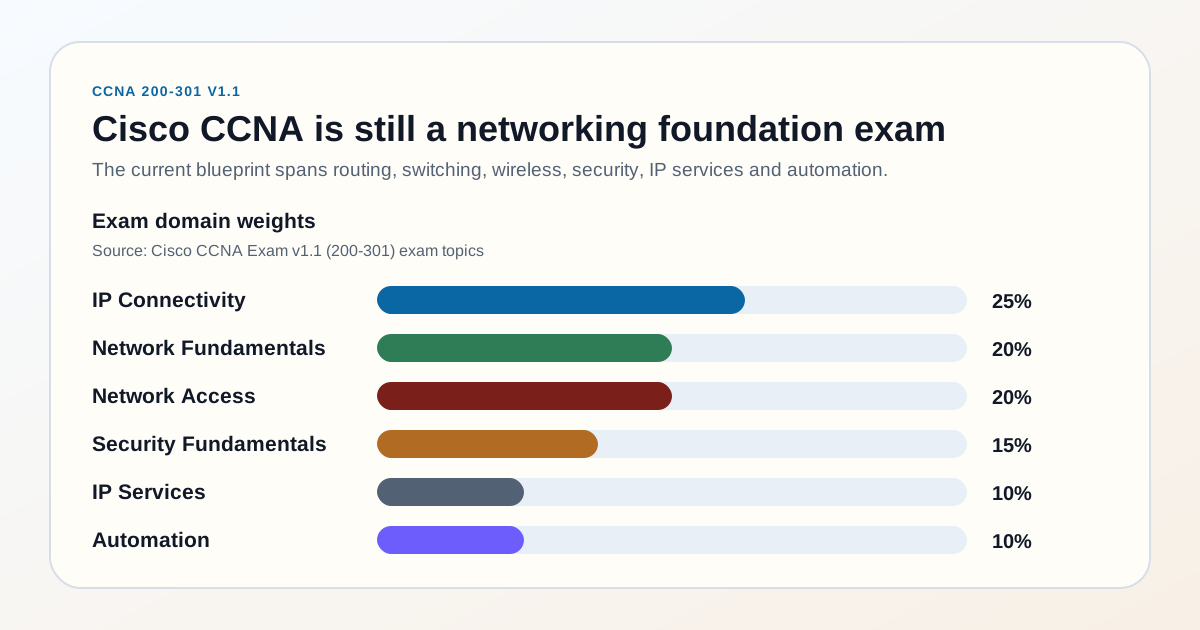
Cisco's official 200-301 v1.1 exam topics list six weighted domains. The largest is IP Connectivity at 25%, followed by Network Fundamentals and Network Access at 20% each. Security Fundamentals carries 15%, while IP Services and Automation and Programmability carry 10% each.
| Domain | Weight | What candidates should be able to do |
|---|---|---|
| Network Fundamentals | 20% | Explain network components, topologies, cabling, TCP/UDP, IPv4 and IPv6 addressing, wireless basics, virtualization and switching concepts. |
| Network Access | 20% | Configure and verify VLANs, trunks, EtherChannel, Layer 2 discovery, Rapid PVST+, wireless architectures and device management access. |
| IP Connectivity | 25% | Interpret routing tables, understand forwarding decisions, configure static routing and single-area OSPFv2, and describe first-hop redundancy. |
| IP Services | 10% | Configure NAT, NTP, DHCP client and relay, SSH access, and explain DNS, DHCP, SNMP, syslog, QoS and file-transfer functions. |
| Security Fundamentals | 15% | Define threats and mitigations, configure device access control and ACLs, understand IPsec VPNs, Layer 2 security, AAA and wireless security. |
| Automation and Programmability | 10% | Explain automation, controller-based networking, APIs, JSON data, Ansible and Terraform, plus AI and machine learning in network operations. |
The v1.1 update went live on August 20, 2024. Cisco's release notes say the update reflected cloud, automation and AI shifts, adding AI and machine learning, Terraform, cloud-managed access language and more precise security and API wording.
Why the current automation domain matters
The Automation and Programmability domain is only 10%, but it tells candidates where the job is going. The exam now expects recognition of Ansible and Terraform, REST APIs, JSON, controller-based networking, and AI or machine learning in network operations. That does not make CCNA a DevOps certification. It does mean an entry-level network engineer should understand how network operations are being abstracted.
Cost, scoring and recertification
Cisco does not publish every operational detail in the same place. The official exam topics confirm the 120-minute duration and the six-domain scope. Cisco's CCNA certification page confirms that the certification has no formal prerequisites and is valid for three years. Candidates can renew with Continuing Education credits or by retaking exams before expiry.
For cost, candidates should verify the final amount in Pearson VUE checkout for their country, tax treatment and delivery mode. The original draft used the commonly cited figure of USD 300 before local taxes, but exam pricing is a purchase-time fact, not a static editorial fact. Do not budget from a blog post alone.
Cisco also does not publish a universal passing score, question count or pass rate. The often-repeated 825/1000 number should be treated as community folklore, not an official threshold. Scaled scoring and question pools can change. The safer preparation rule is simple: know the blueprint, lab the commands, and do not rely on memorised question banks.
Study resources that actually help
The draft named three resources that appear constantly in CCNA preparation discussions: a structured video course, Wendell Odom's Cisco Press Official Cert Guide Library, and Boson ExSim-Max for practice exams. Cisco's own CCNA page points candidates toward Cisco U, the CCNA certification guide, CCNA Prep and community resources.
- Start with the official blueprint. Download the Cisco 200-301 v1.1 exam topics and map every lesson, lab and practice test to those domains.
- Use Packet Tracer or equivalent labs. CCNA is not a reading-only exam. VLANs, trunks, OSPF, ACLs, NAT, DHCP, SSH and troubleshooting need hands-on repetition.
- Practise subnetting until it is automatic. Slow subnetting steals time from every other question.
- Use practice exams diagnostically. Good practice exams expose weak domains. Braindumps train recognition without competence and can breach exam rules.
- Watch the v2.0 transition date. If you book for February 2027 or later, confirm which blueprint is active on your test date.
Career value and hiring reality
CCNA is strongest as a screening and foundation signal. It helps candidates entering network support, NOC, network administrator, help desk and junior network engineer roles. It is also useful for cybersecurity, cloud and systems roles where networking literacy is a daily requirement.
The credential does not guarantee a salary. Salary aggregators blend junior administrators, experienced engineers and people who merely list the certification. The more honest view is that CCNA can help a candidate pass an early filter, but interviews, labs, troubleshooting judgement and production experience decide whether the signal holds up.
For employers, CCNA should be treated like a baseline, not a finish line. A candidate who can explain OSPF but cannot reason through a failed trunk, duplicate IP, broken DHCP relay or misordered ACL is not production-ready. A candidate who has labbed, documented and troubleshot those problems is much closer.
CCNA v2.0 roadmap
Cisco announced the next major CCNA blueprint change on May 20, 2026 and described it as the first major CCNA blueprint change since 2019. The new blueprint is built around four pillars: network infrastructure, troubleshooting and problem-solving, a security-first mindset, and the role of AI in network management and operations.
Cisco says the updated exam will be available on February 3, 2027. It also says learners currently studying for the current CCNA do not need to change gears because the current exam remains live until the new exam goes into effect.
The important shift is not the phrase "AI" by itself. It is the direction of travel. Cisco is trying to validate network engineers who can configure, secure, troubleshoot and supervise modern networks where automation and AI tools are part of the operating environment. The future CCNA candidate will need enough fundamentals to judge the tool, not just use it.
What employers should verify
Need network engineering or managed WAN support?
Browse Singapore telecom providers, system integrators and managed IT companies that can support routing, switching, SD-WAN, Wi-Fi and network operations.
Frequently asked questions
What is the current Cisco CCNA exam?
The current production exam is Cisco CCNA 200-301 v1.1, a 120-minute exam covering Network Fundamentals, Network Access, IP Connectivity, IP Services, Security Fundamentals, and Automation and Programmability.
When does the new CCNA v2.0 exam go live?
Cisco announced on May 20, 2026 that the refreshed CCNA exam will be available on February 3, 2027. Cisco says the current exam remains live until the new exam goes into effect.
Does CCNA have prerequisites?
Cisco lists no formal prerequisites for CCNA. Learners often benefit from one or more years of experience implementing and administering Cisco solutions, but it is not a hard entry requirement.
How long is CCNA valid?
Cisco says CCNA certification is valid for three years. It can be renewed with Continuing Education credits or by retaking qualifying exams before expiry.
How much does the CCNA exam cost?
Candidates should verify the final price in Pearson VUE checkout for their country and tax treatment. The commonly cited U.S. figure is around USD 300 before local taxes, but exam pricing should be treated as a booking-time fact.
Is CCNA still worth it in 2026?
CCNA is still useful as a recognised foundation signal for network support, NOC, network administrator and junior network engineer roles. It is strongest when paired with hands-on labs, troubleshooting practice and real operational experience.
Sources and further reading
- Cisco: CCNA certification
- Cisco: CCNA Exam v1.1 (200-301) exam topics PDF
- Cisco: CCNA Minor Update v1.1 release notes PDF
- Cisco Blogs: AI-led updates across Cisco certification portfolio
- Cisco Blogs: Learn with Cisco certification changes