What changed in this guide
- — Added an original diagram
- — Added the grant support estimator
- — Corrected the EDG 70% sustainability tier: extended, not lapsed
- — Published
Executive Summary
Grant value in Singapore is captured by sequencing, not by applying. Enterprises leave money unclaimed not because they are ineligible, but because they treat a technology refresh as one purchase and push it at one scheme. Catalogued licences belong to PSG; the integration and process redesign around them belong to EDG; the training that makes either land is offset again by the SkillsFuture Enterprise Credit (SFEC).
Timing decides the outcome. Both schemes disqualify a project the moment a payment, deposit or signed contract precedes the application, and both reimburse only after deployment is evidenced. Grant planning is therefore a procurement-calendar exercise: the approval clock, the 1 April–31 March cap year, SFEC's 30 November 2026 expiry and the EDGE cut-over, all sequenced before a purchase order is raised.
Key Takeaways
- Split the project; do not pick a grant. One cost line cannot be claimed twice, but adjacent lines can draw on both schemes.
- The PSG cap is annual and company-wide. S$30,000 across every EnterpriseSG-supported solution per financial year, with no carry-forward — so January–March submissions are risky.
- Never pay, deposit or sign first. Any payment to the vendor before submission disqualifies the application outright, whatever the amount.
- Your vendor cannot apply for you. EnterpriseSG states vendors are strictly not allowed to submit on an applicant's behalf; the CorpPass submission must come from the company.
- SFEC's current credit expires 30 November 2026. The S$10,000 offsets up to 90% of remaining out-of-pocket costs; unused balance is forfeited, and the redesigned SFEC from 1 December 2026 is a separate credit.
- EDG demands evidence, not intent. Projections, milestones, measurable worker outcomes and — for consultancy costs — a consultant certified to SS 680:2021, which superseded TR 43:2015 in 2025.
- A grant is not a compliance discharge. Co-funded AI, security and data tooling stays bound by the PDPA, MAS Technology Risk Management expectations and Cybersecurity Act licensing.
Quick Facts
| Dimension | Productivity Solutions Grant (PSG) | Enterprise Development Grant (EDG) |
|---|---|---|
| Support level | Up to 50% of eligible costs for local SMEs | Up to 50% for SMEs; up to 30% for non-SMEs |
| Cap | S$30,000 per company per financial year (1 April – 31 March) | No published cap; assessed project by project |
| Funds | Pre-approved software, SaaS, equipment and scoped consultancy from the catalogue | Consultancy, project software and equipment, incremental internal manpower |
| Scope freedom | None — the quotation must match the approved package | High — you define the scope and defend it |
| Decision time | ~4–6 weeks | ~8–12 weeks per complete application |
| Eligibility | Operating in Singapore; ≥30% local equity; group turnover ≤S$100m or ≤200 staff | Operating in Singapore; ≥30% local equity; financially ready to complete |
| Disbursement | Reimbursement after deployment and proof of use | Reimbursement after deliverables; claims within six months of period end |
| Consultant rule | Not applicable — the vendor is pre-approved | Management consultancy requires SAC-accredited SS 680:2021 certification |
| Portal | Business Grants Portal (BGP) via CorpPass; PSG catalogue on GoBusiness | |
| 2026 change | PSG, EDG and MRA consolidate into EDGE in 2H2026 — one application, all Singapore-registered businesses including non-SMEs, around S$100,000 a year | |
What PSG and EDG Fund for IT Infrastructure — and Why It Matters
PSG buys down the price of something already on a government-vetted shelf; EDG buys down the cost of building something that is not. The distinction is procedural, not technological, and it decides which parts of a programme can be subsidised.
PSG: the catalogue route
PSG works only against solutions pre-approved by EnterpriseSG and, in the digital categories, pre-scoped by IMDA under SMEs Go Digital — accounting and ERP software, CRM, HR systems, cybersecurity tooling, e-commerce platforms and, following the Budget 2026 expansion, more AI-enabled tools. The trade-off is rigidity: the quotation must mirror the approved package line for line, so a varied scope fails on a technicality rather than on merit.
EDG: the project route
EDG funds project-based transformation under three pillars — Core Capabilities, Innovation & Productivity, and Market Access. Infrastructure work usually sits in Innovation & Productivity: automation, process redesign, systems integration and bespoke development. There is no catalogue and no fixed ceiling, but the burden of proof shifts to the applicant, who must evidence measurable business outcomes and worker commitments such as wage increments, job creation, job redesign or training. Correct sequencing routinely moves net programme cost by a quarter or more without changing a line of the technical design.
Singapore Market Landscape
Singapore's grant architecture is unusually centralised: one portal, one digital identity, one catalogue — and from 2H2026, one grant. That centralisation makes the process navigable, and makes procedural errors fatal.
The administrative spine
Both schemes run through the Business Grants Portal via CorpPass, with the PSG catalogue on GoBusiness. EnterpriseSG owns the schemes; IMDA owns pre-approval of digital solutions and the Industry Digital Plans. Public-sector selling runs on a separate track through GovTech's GeBIZ platform — vendors sometimes conflate pre-approval with government procurement standing.
The EDGE transition
From 2H2026, PSG, EDG and MRA consolidate into EDGE: one application, all Singapore-registered businesses including non-SMEs, around S$100,000 a year. EnterpriseSG has confirmed existing schemes remain fully open and their claims will be honoured. The implication is the opposite of what most firms assume — a ready project should be filed now, because a scheme in transition carries launch risk and a queue.
What grants do not change
Co-funding alters price, not obligation. Grant-funded personal-data processing stays bound by the PDPA and the PDPC's breach-notification duty; grant-funded systems in a financial institution stay within MAS Technology Risk Management expectations; grant-funded security services stay licensable under the Cybersecurity Act. Subsidised AI sits under the same governance stack as unsubsidised AI — IMDA's Model AI Governance Framework and AI Verify, ISO/IEC 42001, ISO/IEC 27001 and the NIST AI Risk Management Framework. See IT compliance and Singapore AI regulations.
Evaluation Framework for Enterprise Buyers
Decide the grant per cost line, not per project. Build the bill of materials first, then assign each line to the scheme whose rules it satisfies.
| Cost line | Route | Why |
|---|---|---|
| Catalogued SaaS or software licence | PSG | Pre-approved package; fastest approval |
| Systems integration, custom development, automation | EDG | Bespoke by definition; no catalogue equivalent |
| Process redesign and change management | EDG | Consultancy needing an SS 680 certified consultant |
| Internal engineering time | EDG | Incremental Singaporean and PR manpower, time-costed |
| End-user and admin training | SFEC | Offsets remaining out-of-pocket cost; expires 30 November 2026 |
| Hardware refresh with no productivity case | Neither | Like-for-like replacement is not a supported outcome |
Vendor evaluation questions
Common mistakes
- Paying a deposit to secure a discount before submission — automatic disqualification.
- Letting the vendor drive the submission. Vendors may not apply on your behalf.
- Quoting a customised package. Any deviation breaks the match test.
- Claiming one cost line twice. Double-funding risks rejection and clawback.
- Treating approval as funding. Both schemes reimburse; you pay in full first.
Provider Landscape Compared
No ranking of grant providers is worth trusting, because the parties play structurally different roles. Evaluate by role and by what each can prove.
| Party | Role | Verify | Trade-off |
|---|---|---|---|
| IMDA pre-approved ICM vendor | Supplies the catalogued PSG solution | Current GoBusiness listing; category match | Fast and certain; no scope flexibility |
| System integrator | Delivers custom EDG scope | Comparable projects; named team; references | Flexible; the business case rests on you |
| SS 680:2021 consultant | Required for EDG consultancy cost lines | Named individuals, not the firm | Mandatory; adds cost and lead time |
| Grant advisory firm | Prepares proposals and projections | Fee basis; who signs the submission | Success fees can bias scope toward the fundable |
| In-house finance and operations | Owns the submission and evidence trail | Internal capacity for an 8–12 week EDG process | Cheapest and most controllable |
The supply-side check that materially reduces risk is verifying pre-approval yourself, on the GoBusiness catalogue, at the moment of quotation — not from a badge on a vendor's website. Appointments are time-limited and renewable: IMDA's pre-approval route is a structured evaluation spanning four to five months, with terms of about a year and an option to extend, so a listing that lapses mid-project is a real failure mode.
Funding Rates, Co-Payment and Total Cost of Ownership
The headline percentage is not the number that reaches your budget. Support applies to eligible costs, is capped, is paid in arrears, and covers only a slice of a multi-year subscription.
| Cost element | Illustrative gross | Treatment | Net effect |
|---|---|---|---|
| Catalogued ERP subscription, year 1 | S$48,000 | PSG at 50%, within the S$30,000 annual cap | Up to S$24,000 reimbursed |
| Integration to legacy systems | S$120,000 | EDG at up to 50% (SME) on qualifying costs | Up to S$60,000, subject to assessment |
| Subscription years 2–3 | S$96,000 | Typically outside the funded period | Fully borne by the buyer |
| User training | S$15,000 | SFEC offsets up to 90% of remaining cost | Materially reduced if claimed before 30 November 2026 |
Three effects are routinely missed. Subscription horizon: PSG supports a bounded initial period, so a three-year SaaS commitment is largely unsubsidised from year two. Cash flow: the full invoice is paid before any grant arrives, and an EDG programme can run a year between outlay and disbursement. Cap arithmetic: the PSG ceiling is company-wide, so a department claiming early consumes headroom another was counting on. See also GPU procurement and cloud migration costs.
Estimate a published grant support ceiling
Use a stated project cost to see an indicative upper-bound estimate under currently published PSG or EDG rates. This planning aid does not collect contact details or send your figures to TechDirectory.
Source checked 3 Sep 2026. Rates and caps are linked to EnterpriseSG Productivity Solutions Grant. Verify current terms with EnterpriseSG before applying or committing funds.
This planning tool applies EnterpriseSG's published standard rates only: PSG up to 50% for local SMEs within the S$30,000 annual cap, and EDG up to 50% for local SMEs or 30% for local non-SMEs. Enhanced tiers, such as EDG support of up to 70% for sustainability-related projects, are not modelled.
Compliance, Eligibility and Risk Management
Grant risk here is administrative rather than legal — but the consequences are financial, and land after you have spent the money.
Maintaining eligibility. Both schemes require eligibility at application and at claim. A shareholding change dropping local equity below 30%, an acquisition pushing group turnover past S$100 million, or a restructuring offshore can invalidate approval before disbursement.
Evidence and audit. Claims are evidence-led: proof of payment, deployment and usage, with EDG claims commonly auditor-verified and due within six months of the qualifying period ending. Open the claim file on day one — quotations, Letter of Offer, invoices, bank records, deployment screenshots, timesheets. Reconstructing this at claim time is where delays originate.
What funding does not touch. Personal data in a co-funded system remains subject to the PDPA and the PDPC's three-day breach-notification duty; financial institutions remain accountable under MAS Technology Risk Management and outsourcing obligations. Specify compliance requirements before the quotation: retrofitting them after approval is a scope change the grant will not follow.
Implementation Roadmap and Pitfalls
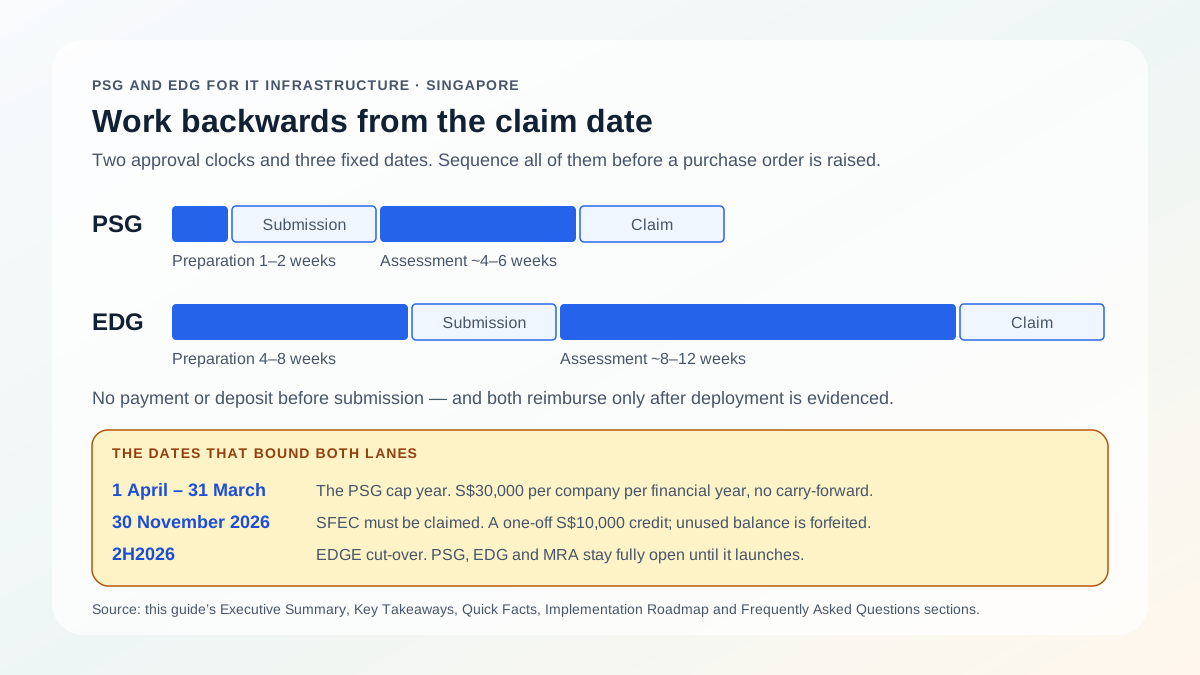
Work backwards from the claim date, not forwards from the idea.
| Stage | PSG | EDG |
|---|---|---|
| Preparation | 1–2 weeks: shortlist catalogue solutions, obtain a matching quotation | 4–8 weeks: scope, build the case, secure a certified consultant |
| Submission | BGP via CorpPass with quotation and financials | BGP with proposal, milestones, KPIs, projections, ACRA profile, financial statements |
| Assessment | ~4–6 weeks | ~8–12 weeks; clarification rounds common |
| Letter of Offer | Accept, then purchase and deploy within the qualifying period | Accept, then start work; milestones drive claims |
| Claim | Payment, deployment and usage proof before the due date | Deliverable evidence, often auditor-verified |
| Disbursement | Corporate PayNow or GIRO, after verification | |
Failure modes worth designing around
- The vendor's timeline ignores the approval window. If a quotation expires or pricing moves during assessment, the matched-quotation test breaks.
- Financial-year boundary risk. A February submission disbursing in April draws on a different cap year than planned.
- Unmeasurable outcomes. EDG rejections cluster around unquantified productivity claims and absent worker outcomes.
- Change management treated as optional. A deployed but unused system fails the usage-evidence test — the grant rewards adoption, not installation.
Future Outlook (3–5 Years)
Expect consolidation, broader eligibility, and a shift from catalogue-based to activity-based support. EDGE's design signals the direction: one application surface, eligibility beyond SMEs, and support organised around what a firm is trying to do rather than which pre-approved product it buys. For larger enterprises previously locked out of PSG that is a real expansion of access; for SMEs it will likely mean more documentation for the same money.
Two second-order effects follow. Pre-approval becomes less of a moat as activity-based assessment displaces catalogue listing. And as AI-enabled tools absorb more supported spend, assessors will expect governance evidence alongside the productivity case — AI Verify testing, ISO/IEC 42001 alignment or NIST AI RMF mapping.
Frequently Asked Questions
Can I use PSG and EDG for the same project?
Yes, provided they fund different cost items — typically PSG for the pre-approved package and EDG for the integration around it. You cannot claim the same cost line under both: double-funding is a rejection cause and a clawback risk.
Is the PSG S$30,000 cap per application or per year?
Per company per financial year, 1 April to 31 March, across every solution EnterpriseSG supports. It is not a per-application cap, and unused headroom does not carry forward.
What happens if I pay the vendor before applying?
The application is disqualified. EnterpriseSG requires that no payment or deposit reaches the supplier before submission, regardless of amount. An early-payment discount is almost always worth less than the grant it forfeits.
Can my IT vendor apply for the grant on my behalf?
No. EnterpriseSG states that vendors are strictly not allowed to apply on behalf of applicants; the submission must come from your own CorpPass account. A vendor can supply a compliant quotation and documentation, but the accountability stays yours.
Is the 70% EDG rate still available in 2026?
Not for IT infrastructure. EnterpriseSG's EDG page states that support for sustainability-related projects has been extended at up to 70%, with no end date published as at 3 September 2026 — but that tier is for sustainability projects under the Enterprise Sustainability Programme, not IT infrastructure. The 70% rate running to 31 March 2029 applies to Market Readiness Assistance (MRA) internationalisation. Standard EDG support is up to 50% for SMEs and 30% for non-SMEs (the non-SME rate is published in the EDG FAQ).
Should I wait for the EDGE grant?
Generally no. EnterpriseSG has confirmed PSG, EDG and MRA stay fully open until EDGE launches in 2H2026, and their claims will be honoured. File a ready project now. Larger multi-activity projects, and non-SMEs previously excluded from PSG, have a better case for waiting.
How does SFEC stack with PSG and EDG?
SFEC applies after other grants, offsetting up to 90% of the remaining out-of-pocket cost from a one-off S$10,000 credit. It must be claimed by 30 November 2026 and unused balance is forfeited; the redesigned SFEC from 1 December 2026 is a separate credit.
Do I need a certified consultant for an EDG project?
For management consultancy cost lines, yes — certified under SAC-accredited SS 680:2021, which superseded TR 43:2015 after it expired on 28 February 2025. Team members in dedicated non-consultancy roles such as market research, audit or installation are generally exempt.
Does a grant reduce my compliance obligations?
No. Co-funding changes the price of a system, not the duties attached to it. Personal data in a grant-funded platform stays subject to the PDPA and the PDPC's breach-notification requirements.
Final Recommendations
Treat grant planning as a procurement-calendar problem: build the bill of materials, assign each line to the scheme that fits it, and file before anyone signs anything. The sequence is PSG first for catalogued components, EDG in parallel for the bespoke work around them, and SFEC last against what remains — with the 30 November 2026 SFEC deadline and the 1 April cap reset in the finance calendar.
Primary Sources and Further Reading
Source links last checked 6 September 2026. This records that each link resolved, not that its content was re-read.
Grant rates and dates were re-checked against EnterpriseSG's PSG, EDG, EDG FAQ, MRA and Budget 2026 pages on 3 September 2026; the remaining sources were reviewed on 19 August 2026. Rates, caps and scheme timing change, and the EDGE transition will supersede parts of this guide during 2H2026. Verify current terms on the Business Grants Portal. This guide is educational, not financial, tax or legal advice.
- EnterpriseSG — PSG and the PSG FAQ (annual cap; vendors may not apply for you).
- EnterpriseSG — EDG and the EDG FAQ (support levels, pillars, certification).
- EnterpriseSG — Budget 2026 (EDGE consolidation; expanded PSG AI support).
- IMDA — SMEs Go Digital pre-approval and the Industry Digital Plans.
- SkillsFuture Enterprise Credit — the S$10,000 credit, expiring 30 November 2026.
- PDPC — PDPA, MAS TRM Guidelines, CSA Cybersecurity Act, AI Verify, ISO/IEC 42001, ISO/IEC 27001 and the NIST AI RMF.
Browse Grant-Ready IT Providers in Singapore
TechDirectory lists records for IT solution providers, system integrators and consultancies serving Singapore. Profiles may show recorded capabilities, certifications and approved reviews where available. Pre-approval status and consultant certification should be verified in the primary source — the GoBusiness catalogue — before you contract.
Browse IT Providers →- IT & Digital Grants in Singapore — the full scheme landscape
- Enterprise Development Grant (EDG) — pillars, eligibility and claims in depth
- CRM and ERP Implementation Partners — who delivers the funded scope
- IT Compliance in Singapore — PDPA, the Cybersecurity Act and MAS TRM
- Selling to Government via GeBIZ — the public-sector track