What Is the Enterprise Development Grant?
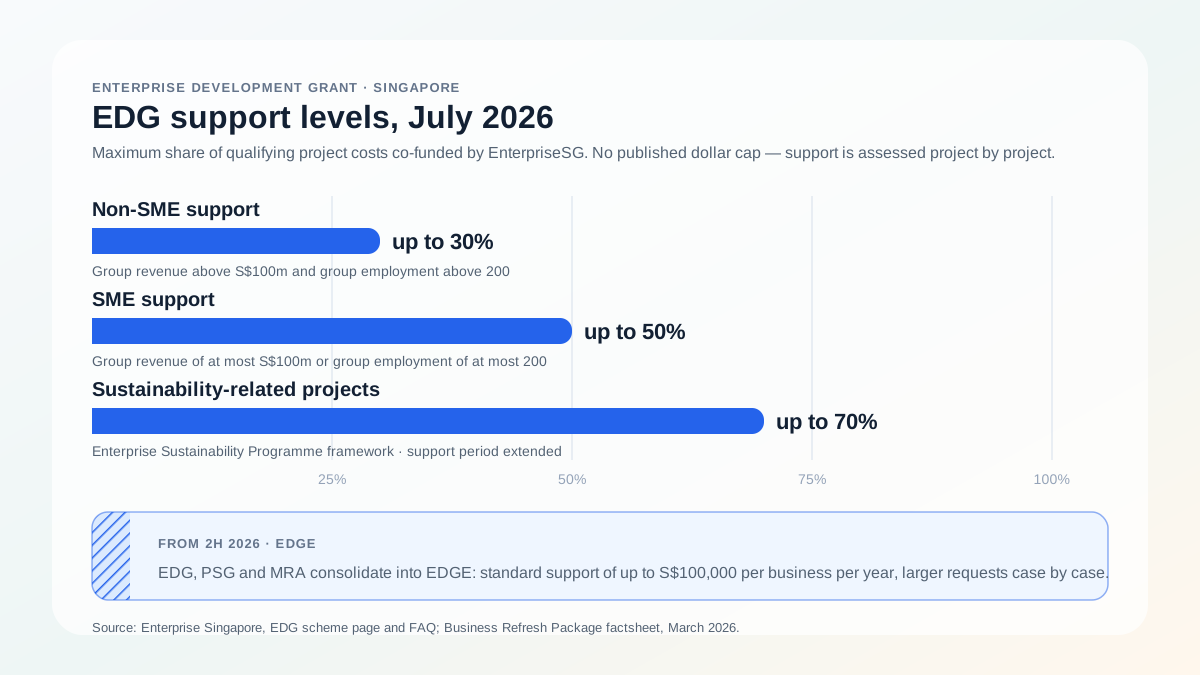
The Enterprise Development Grant (EDG) is Enterprise Singapore's project-based grant for companies undertaking capability-building, innovation, productivity, and internationalisation work. Unlike catalogue schemes with pre-approved solutions, the EDG funds custom projects: a company submits its own proposal and, if approved, receives up to 50% of qualifying costs as an SME or up to 30% as a non-SME — covering third-party consultancy fees, software and equipment, and internal manpower — across three pillars: Core Capabilities, Innovation & Productivity, and Market Access. Sustainability-related projects attract enhanced support of up to 70%.
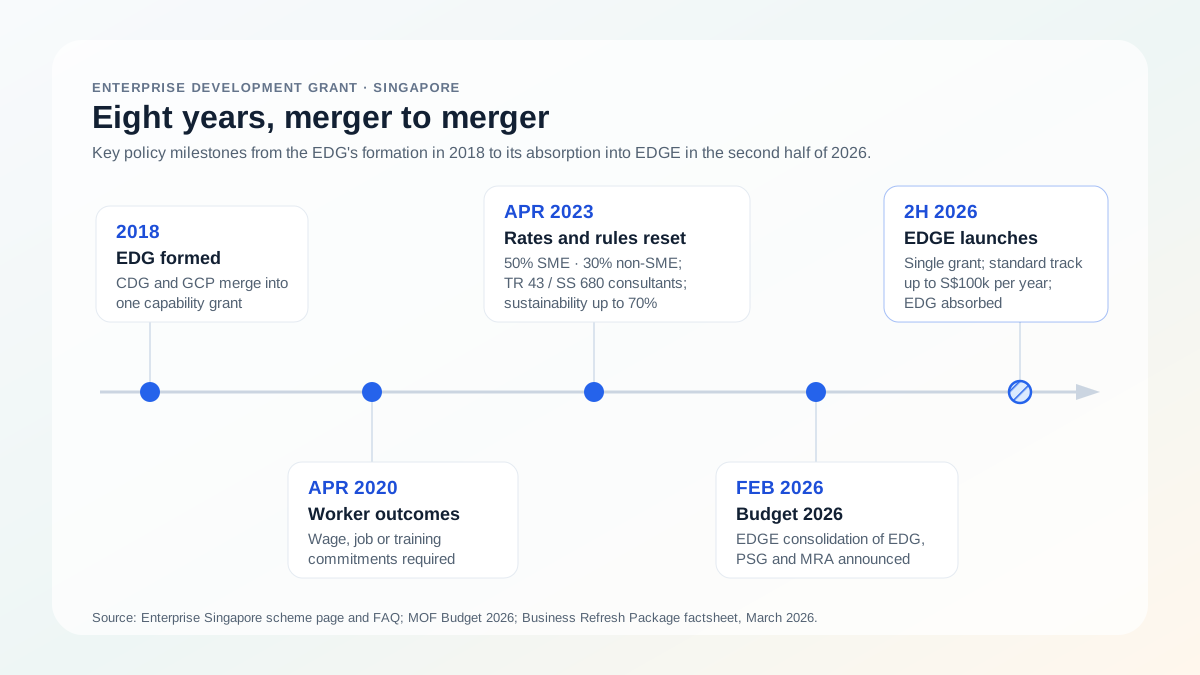
The EDG was formed in 2018 when Enterprise Singapore merged two predecessor schemes — the Capability Development Grant and the Global Company Partnership grant — into a single instrument for firm-level upgrading. Its design premise is that the highest-value interventions are bespoke: a process-automation programme, a regional brand strategy, a financial-management overhaul, or a market pilot cannot be bought off a shelf, so the grant evaluates each proposal on scope, projected outcomes, and the competency of the service provider.
That premise is what separates the EDG from its siblings. The Productivity Solutions Grant (PSG) subsidises pre-approved IT solutions and equipment from a published catalogue — low friction, fixed scope. The Market Readiness Assistance (MRA) grant defrays overseas market-entry costs, capped at S$100,000 per company per new market. The EDG sits above both: full proposal, open scope, no published ceiling, and correspondingly heavier scrutiny. A related variant, the EDG-Industry (EDG-I), supports group projects in which a lead company works with a cohort of SMEs to drive industry-level transformation.
Why the EDG Matters in 2026
Grant schemes rarely get rigorous public evaluation; the EDG has one. A Ministry of Trade and Industry (MTI) feature article in the Economic Survey of Singapore, published 25 May 2026, used firm-level administrative data to compare recipients against similar non-recipients. A typical grant was associated with a 1.9% per annum increase in revenue and a 1.6% per annum increase in value-added over 2019–2022, statistically significant at the 10% level, with larger effects for smaller firms. These are modest annual numbers, honestly reported — not the transformational multiples grant marketing implies — but they compound, and they survive controls for other grants the same firms received.
The near-term significance, though, is the transition. At Budget 2026, delivered on 12 February, the Government announced that the EDG will be consolidated with the PSG and the MRA into a single scheme called EDGE, launching in the second half of 2026. Enterprise Singapore's March 2026 factsheet confirms EDGE's standard track will support all Singapore businesses at up to S$100,000 per year, with larger requests assessed case by case. The EDG — which today carries no published funding cap — remains open until EDGE launches. For companies planning a S$400,000 automation programme or a multi-market expansion, the sequencing question is now real: the EDG's uncapped, project-based structure disappears as a default entitlement once EDGE arrives.
Quick Facts
| Attribute | Detail (as at July 2026) |
|---|---|
| Administering agency | Enterprise Singapore (EnterpriseSG), a statutory board under MTI |
| Support level — SME | Up to 50% of qualifying project costs |
| Support level — non-SME | Up to 30% of qualifying project costs |
| Sustainability-related projects | Up to 70%; support period extended, current end date not published on the scheme page |
| Funding cap | None published; assessed project by project |
| Qualifying costs | Third-party consultancy, software and equipment, internal incremental manpower |
| Project pillars | Core Capabilities; Innovation & Productivity; Market Access |
| Processing time | Approximately 8–12 weeks per complete application |
| Typical project duration | 12–18 months |
| Disbursement | Reimbursement after audited claim; PayNow Corporate within ~14 working days of claim approval |
| Application channel | Business Grants Portal (BGP), via CorpPass |
| Application fee | None — EnterpriseSG charges no fees, and third parties cannot apply on a company's behalf |
| Scheme status | Open; consolidates into EDGE in 2H 2026 |
The Three Pillars: What the EDG Actually Funds
Every EDG project must sit under one of three pillars. The pillar determines the proposal template, the acceptable deliverables, and — critically — the exclusions. Most rejected or descoped applications fail on exclusions the applicant never read.
Core Capabilities
Foundation-strengthening projects across five areas: business strategy development, financial management, human capital development, service excellence, and strategic brand and marketing development. Typical deliverables are diagnostics and gap analyses, strategic roadmaps, governance frameworks, and implementation plans. The exclusions are pointed: no standalone IP registration, no regulatory compliance work such as tax filing or consolidated statements, no standalone training courses, and — the one that surprises marketing teams — no production of collateral and no execution of campaigns. Brand strategy is fundable; the website build, media buys, influencer engagements, SEO and SEM that follow are not.
Innovation & Productivity
Three areas: automation, process redesign, and product development. Automation projects cover sophisticated hardware and software adoption with system integration and staff training — but not laptops, tablets, off-the-shelf appliances, solutions already covered by the PSG catalogue, or like-for-like equipment replacement. Product development requires demonstrable innovation against industry norms and excludes a company's first product. Resource-optimisation projects qualify when they specify quantified efficiency targets — carbon, energy, waste, or water. For large-scale automation deployments, eligible businesses could also apply for a 100% Investment Allowance on approved capital expenditure of up to S$10 million per project, a Budget 2023 measure announced as running until 31 March 2026; confirm current availability with EnterpriseSG when applying.
Market Access
Two areas: pilot projects and test-bedding in new markets, and first-time standards adoption. Pilots require the product to be new and pre-revenue at application. Standards adoption covers consultancy, training and first-time certification for voluntary management-system and product standards — but excludes recertification, annual surveillance, standards mandated by regulation, and baseline certifications such as ISO 9001, SS 506, SS 444 and ISO 45001, which EnterpriseSG treats as table stakes rather than differentiators. First-time adoption of standards such as ISO 27001 or ISO 42001, where genuinely new to the company and market-relevant, is the kind of project this pillar was built for.
Funding Rates, Qualifying Costs and Exclusions
The headline rate is a percentage of qualifying costs, not of total project spend — and the gap between the two is where budgets go wrong. Costs qualify only if incurred after application, and support applies only to the approved scope in the Letter of Offer.
| Cost category | Supported | Notes |
|---|---|---|
| Third-party consultancy fees | Yes | Management consultants must hold SAC-accredited TR 43 or SS 680 certification; fee breakdown by phase and man-day required |
| Project-specific software and equipment | Yes | Quotations by unit and unit cost; must be integral to the project, not a general IT refresh |
| Internal incremental manpower | Yes | Salaries of Singaporean/PR employees allocated to the project, evidenced by employment letters |
| Marketing execution and collateral | No | Websites, campaigns, SEO/SEM, media buys and brochures are excluded across pillars |
| Off-the-shelf solutions in the PSG catalogue | No | Redirected to PSG; the EDG will not double-fund catalogue items |
| Standalone training courses | No | Training qualifies only as part of a wider project (e.g. deploying an automation solution) |
| Regulatory compliance and filings | No | Accounting, tax filing, mandatory certifications and legal drafting are excluded |
| General business setup costs | No | Incorporation, office fit-out and similar costs are not project costs |
Employers eligible for the SkillsFuture Enterprise Credit can stack it against out-of-pocket expenses on supportable schemes, which in practice lifts the effective support rate for smaller firms. On sustainability: strategy formulation, resource optimisation with quantified targets, first-time adoption of sustainability standards, and green product development are supported at up to 70% under the Enterprise Sustainability Programme framework. EnterpriseSG's page states the enhanced-support period has been extended but no longer publishes an end date — worth confirming at application, since the difference between 50% and 70% is material on a large project.
Eligibility: Who Qualifies — and Who Should Not Apply
- Registered and operating in Singapore — private limited companies, sole proprietorships, partnerships and LLPs all qualify.
- At least 30% local equity held directly or indirectly by Singapore citizens or permanent residents, traced through corporate layers to ultimate individual owners.
- Financially ready to start and complete the project. EnterpriseSG assesses indicators such as the current ratio from your latest financial statements — a company that cannot evidence the liquidity to carry the full project cost will not be approved, because the grant only reimburses.
- Worker outcomes committed — projected wage increases, job creation, job redesign or training for local staff, quantified in the application.
- Project not commenced. Three triggers each disqualify: work has started, any payment has been made to a project vendor, or a contract has been signed with a project vendor before the application date.
Equally useful is knowing who should not apply. Companies below 30% local shareholding are structurally ineligible. Early-stage startups building their first product fall outside the product-development scope. Businesses whose real need is marketing execution, standard equipment, or an off-the-shelf system will be rejected or redirected to the PSG. Financially stretched companies face a double barrier: the current-ratio screen at assessment, and the cashflow reality of financing the entire project before any reimbursement arrives. And a project that has already quietly started — a signed statement of work is enough — is unfundable regardless of merit.
EDG vs PSG vs MRA vs EDGE
The EDG is one instrument in a family. Choosing the wrong one is the most expensive mistake a buyer can make, because it usually surfaces only at rejection. Use this table to place your project before you invest in a proposal.
| Aspect | EDG | PSG | MRA | EDGE (from 2H 2026) |
|---|---|---|---|---|
| Best for | Custom transformation and capability-building projects | Pre-approved IT solutions and equipment | First steps into a new overseas market | Single entry point for all three activity types |
| Support level | Up to 50% SME / 30% non-SME / 70% sustainability | Up to 50% | Up to 70% SME (from 1 Apr 2026, until 31 Mar 2029) | Up to S$100,000 per business per year; more by case-by-case assessment |
| Cap | None published; project-based | Solution-specific caps | S$100,000 per company per new market | S$100,000 per year standard track |
| Who can apply | SMEs and non-SMEs with 30% local equity | SME-focused | SME-focused (non-SMEs added under EDGE at up to 50%) | All Singapore-registered businesses, including non-SMEs |
| Application complexity | High — full proposal, projections, worker outcomes | Low — catalogue purchase | Medium | Announced intent: simplified, activity-based |
| Processing time | About 8–12 weeks | Weeks | Weeks | Not yet published |
| Status | Open until EDGE launch | Open until EDGE launch | Open until EDGE launch; new-market criterion removed under EDGE | Launches 2H 2026 |
For a fuller walk-through of the wider grant stack — PSG, SMEs Go Digital, Cyber Essentials funding — see our companion guide, IT & Digital Grants in Singapore.
How to Apply: Process and Timeline
- Scope the project to a pillar. Match your intended outcomes to one pillar's supportable areas and read its exclusions first. EnterpriseSG publishes proposal templates per pillar; SME Centre business advisors will pressure-test a concept at no cost.
- Select service providers. There are no pre-approved EDG vendors. For consultancy components, engage SAC-certified consultants (TR 43 / SS 680) and collect their certification documents and CVs. Obtain quotations broken down by phase, man-days and unit costs.
- Prepare the evidence pack. Latest ACRA profile (no older than six months), audited financial statements or certified management accounts, consolidated parent financials where applicable, the project proposal, and three-year post-project projections covering revenue, remuneration, depreciation, net operating profit and worker outcomes.
- Submit on the Business Grants Portal using CorpPass. Third-party companies cannot apply or manage the grant on your behalf. Expect roughly 8–12 weeks of processing for a complete application; EnterpriseSG may seek clarifications through the portal, and incomplete submissions are rejected outright (they can be resubmitted complete).
- Receive the Letter of Offer and execute. The Letter of Offer fixes the qualifying period, approved cost lines and deliverables. Most projects run 12–18 months. Scope changes need EnterpriseSG's agreement — do not assume flexibility after the fact.
- Claim after completion. Claims are due no later than six months after the qualifying period ends, with a project report, deliverable evidence, invoices and bank statements, and an audit by an auditor from EnterpriseSG's pre-qualified panel (appointed and paid by the company). With PayNow Corporate, disbursement follows within about 14 working days of claim approval; GIRO can take up to eight weeks.
Choosing a Service Provider: Certification, Quality, Conflicts
Since 1 April 2023, EDG support for management consultancy costs requires every consultant delivering the advisory work to hold certification accredited by the Singapore Accreditation Council under TR 43:2015 or SS 680:2021. Three certification tracks exist:
| Certification body | Credential | Register |
|---|---|---|
| Institute of Management Consultants (Singapore) | Registered Management Consultant (RMC) | IMC(S) member register |
| Singapore Business Advisors and Consultants Council | Practising Management Consultant (PMC / SPMC) | SBACC PMC search |
| TÜV SÜD PSB | Singapore Certified Management Consultant (SCMC / PSCMC / ESCMC) | TÜV SÜD certified-consultant list |
The requirement has clear exemptions: team members performing dedicated non-advisory functions — market research, audit, fieldwork, design, equipment installation, legal drafting — need not be certified, and neither do technology solution vendors or technical experts developing new technology. In practice, an automation project led by a system integrator does not need a certified consultant unless a management-consultancy layer is claimed as a cost line.
Treat certification as a floor, not a shortlist. It attests to consulting process competence, not to domain depth in your industry or project area. EnterpriseSG's own assessment weighs the provider's competency, so the evaluation you would run on any strategic vendor still applies: relevant track record and client references, familiarity with your sector's economics, named delivery personnel rather than a bench promise, and a proposal whose man-day maths survives scrutiny. Two hard rules from the grant conditions: providers must have no relationship, connection or common shareholding with the applicant or its related companies, and quotations should be genuinely comparable — EnterpriseSG may ask why a vendor was chosen and request alternative quotes.
Questions worth asking every prospective provider: How many EDG-supported projects have you delivered in this pillar, and can you name referenceable clients? Who exactly will do the work, and what share of the man-days sits with the named senior staff? What deliverables will exist at each phase gate, and which of them survive as operating assets after you leave? What happens — contractually — if EnterpriseSG approves a reduced scope or rejects the application? A provider that resists the last question is pricing your grant-approval risk as your problem alone. Our procurement templates include scorecards and diligence prompts you can reuse for this.
Costs, Cashflow and the Real Economics
The single most misunderstood feature of the EDG is that it is reimbursement-based. A worked illustration: an SME approved for 50% support on a S$300,000 process-redesign project must finance the full S$300,000 through 12–18 months of delivery, then submit an audited claim and receive up to S$150,000 back. Add the auditor's fee (payable to a pre-qualified panel firm), the internal cost of documentation and claim preparation, and the working-capital cost of the outlay itself. For projects with heavy upfront costs, EnterpriseSG has stated it may disburse in stages against implementation milestones — ask for this in writing at Letter-of-Offer stage rather than assuming it.
Budget the claim discipline from day one. Every cost line needs invoices, proof of payment and, for manpower, employment contracts and allocation evidence. Deliverables need documentary proof — consultant reports, equipment photographs, system documentation. Claims arriving later than six months after the qualifying period ends are forfeited. Companies that treat the claim as an afterthought routinely leave approved money unclaimed or lose weeks in audit clarifications.
Common Mistakes That Sink EDG Applications
- Starting before approval. A signed contract, a deposit, or commenced work — any one of the three — renders the project ineligible. This is the most common and least recoverable error.
- Dressing procurement as transformation. Applications whose substance is buying software or equipment, with consultancy as garnish, are rejected or redirected to PSG.
- Claiming excluded costs. Marketing execution, collateral, standalone training, first products, baseline certifications like ISO 9001, and recertification are excluded no matter how they are packaged.
- Uncertified or conflicted consultants. Missing TR 43 / SS 680 certification on the advisory team, or any related-party link between applicant and vendor, is disqualifying.
- Vague outcomes. Proposals without quantified business outcomes and worker outcomes fail the assessment criteria EnterpriseSG explicitly publishes.
- Underestimating the timeline. Businesses that need a decision in four weeks apply to the wrong scheme; the EDG runs 8–12 weeks from a complete submission, longer with clarification cycles.
- Ignoring cashflow. Committing to a project the balance sheet cannot carry through to reimbursement — EnterpriseSG screens for this, and so should your CFO.
- Sloppy claims. Missing invoices, unproven payments, undocumented deliverables and blown six-month deadlines convert approved support into nothing.
- Ignoring the EDGE transition. Scoping a large 2027 programme against today's uncapped EDG assumptions, without accounting for the S$100,000-per-year EDGE standard track, plans against a scheme that will no longer exist.
Pre-Application Checklist
Before you submit on the Business Grants Portal, confirm you can tick every box below. Each maps to a common rejection reason above.
Frequently Asked Questions
What is the Enterprise Development Grant (EDG)?
The EDG is Enterprise Singapore's grant for custom business transformation projects. It co-funds qualifying costs — third-party consultancy, software and equipment, and internal manpower — for projects under three pillars: Core Capabilities, Innovation & Productivity, and Market Access. Companies submit individual project proposals rather than buying from a pre-approved catalogue.
How much funding does the EDG provide in 2026?
Up to 50% of qualifying project costs for SMEs and up to 30% for non-SMEs. Sustainability-related projects are supported at up to 70% under the Enterprise Sustainability Programme framework. SME status means group revenue of at most S$100 million or group employment of at most 200.
Is there a maximum grant amount under the EDG?
No fixed cap is published. Support is assessed project by project based on scope, outcomes and company profile. This differs from the PSG (solution-specific caps) and the MRA grant (S$100,000 per company per new market), and from the upcoming EDGE grant, whose standard track supports up to S$100,000 per business per year.
Who is eligible for the EDG?
Business entities registered and operating in Singapore with at least 30% local equity held directly or indirectly by Singapore citizens or PRs, in a financially viable position to start and complete the project. Applicants must commit to worker outcomes such as wage increases, job creation, job redesign or training, and the project must not have commenced before application.
How long does EDG approval take?
Enterprise Singapore guides 8–12 weeks per complete application. A 2020 parliamentary reply put the historical average at about seven weeks, with roughly 10% of straightforward applications approved in about a week. Incomplete documentation is the main cause of delay, and incomplete applications are rejected and must be resubmitted.
Can I start my project before EDG approval?
No. A project is considered commenced — and becomes ineligible — if work has started, any payment has been made to a project vendor, or any contract has been signed with a project vendor before the application date. Costs also only qualify if incurred within the approved qualifying period.
Do I need a certified consultant for an EDG project?
Only if you claim management consultancy costs. Those consultants must hold Singapore Accreditation Council-accredited TR 43 or SS 680 certification, available through IMC(S), SBACC and TÜV SÜD PSB. Specialists performing non-advisory functions and technology solution vendors are exempt from the certification requirement.
What happens to the EDG when EDGE launches in 2H 2026?
EDGE consolidates the EDG, PSG and MRA into a single grant where businesses apply by activity. The announced standard support is up to S$100,000 per business per year, with larger requests assessed case by case. The EDG remains fully open until EDGE launches; treatment of in-flight EDG projects at transition has not yet been published. Our EDGE grant explainer tracks what is confirmed versus open.
Browse EDG-Ready Vendors in Singapore
Ready to scope a project? TechDirectory lists verified technology companies across Singapore — system integrators, automation specialists, cloud consultancies and analytics providers — with company profiles, certifications, and community reviews.
Browse the Directory →