Key Takeaways
- LoRa is the radio modulation; LoRaWAN is the network protocol. LoRa gives the long-range sub-GHz radio link. LoRaWAN defines joining, security, device classes, gateways, network servers and application routing.
- The design target is small data at scale. A water meter reporting a few times per day is a good fit. Video, voice, chatty telemetry and tight control loops are not.
- Airtime is the scarce resource. Higher spreading factors improve range but increase time-on-air, energy use and collision risk in shared unlicensed spectrum.
- 2026 work is mostly about scale and operations. The LoRa Alliance has highlighted device growth, certification, regional support, CSMA recommendations, onboarding work and OPC UA mapping activity.
- Private LoRaWAN can be compelling, but ownership cuts both ways. Enterprises can deploy their own gateways and network server, but they inherit radio planning, key management, monitoring and downlink discipline.
What LoRaWAN Actually Is
LoRa and LoRaWAN are often used as if they mean the same thing. They do not. LoRa is the chirp spread spectrum radio modulation associated with long-range, low-power links. LoRaWAN is the open network protocol and architecture maintained by the LoRa Alliance. It defines how end devices join a network, how gateways forward traffic, how network servers handle MAC behavior, and how application payloads are routed.
A plain LoRa radio can support point-to-point links. LoRaWAN turns the radio into a managed multi-device network. It defines device identities, over-the-air activation, frame counters, message integrity checks, Adaptive Data Rate, device classes and back-end interfaces. That is why a buyer should ask about the LoRaWAN Network Server and operating model, not just the gateway hardware.
The protocol is optimized for battery-powered end devices that may be fixed or mobile. The default device class, Class A, sleeps most of the time, transmits when it has data, then opens two short receive windows. Class B adds scheduled receive slots. Class C keeps the receiver open most of the time and is mainly for mains-powered devices that need lower downlink latency.
How a LoRaWAN Network Is Built
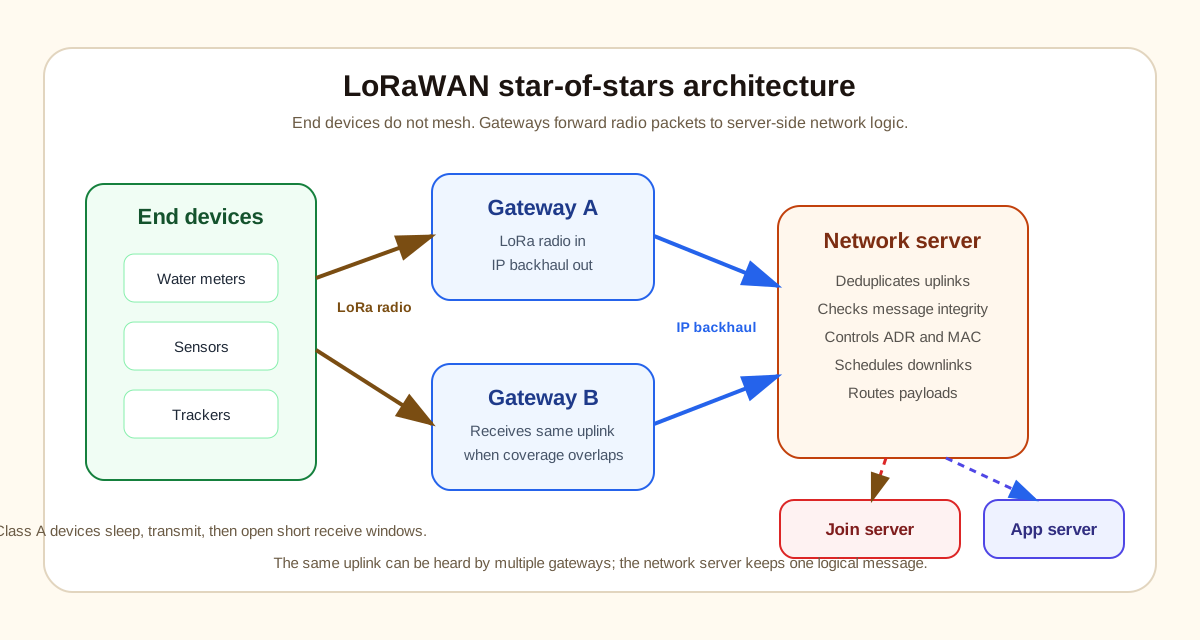
LoRaWAN is not a mesh network in the Zigbee or Thread sense. End devices do not relay traffic for one another. A device transmits over the air; one or more gateways may hear the same uplink; the gateways forward the packet and radio metadata over IP backhaul to a LoRaWAN Network Server.
The gateway is intentionally simple. It bridges radio traffic to an IP network through Ethernet, cellular, Wi-Fi, fibre or satellite backhaul. The Network Server is where the logic lives: deduplicating packets heard by several gateways, checking message integrity, applying regional parameters, issuing ADR commands, scheduling downlinks and routing payloads to applications.
Security is split by role. Over-the-air activation derives session keys from root keys through a Join Server. The Network Server can validate and route LoRaWAN traffic, while the Application Server handles application payloads. That separation only helps if keys are provisioned, stored and rotated with production discipline.
| Component | Role | Buyer question |
|---|---|---|
| End device | A battery or mains-powered sensor, meter, tracker or controller. | Which device class, regional band, payload size, send interval and battery target are required? |
| Gateway | Receives LoRa radio packets and forwards them to the network server over IP. | How many gateways are needed for indoor, outdoor, basement, rooftop and redundancy coverage? |
| Network Server | Deduplicates uplinks, validates frames, manages MAC behavior and schedules downlinks. | Who operates it, how is it monitored, and does it support the required regional parameters? |
| Join Server | Handles OTAA joins and session key derivation. | Where are root keys stored, and how is device onboarding governed? |
| Application Server | Decrypts payloads and connects LoRaWAN data to dashboards, APIs, MQTT, SCADA-adjacent tools or analytics. | Are payload codecs versioned, tested and documented? |
The Radio Economics
LoRaWAN's long range comes from a deliberate trade-off. A higher spreading factor improves link budget and makes weak signals easier to recover, but each symbol takes longer to send. Longer transmissions consume more battery and occupy the shared channel for more time.
That is why LoRaWAN planning starts with airtime math, not marketing range. Payload size, reporting interval, spreading factor distribution, gateway density, antenna placement, regional duty-cycle or dwell-time rules, confirmed-message use and downlink requirements decide whether a network scales.
Adaptive Data Rate, or ADR, is the main optimization loop for mostly fixed devices. The network observes link quality and can move a device toward a lower spreading factor or lower transmit power when the radio path allows it. ADR can improve battery life and capacity, but it needs care for mobile or fast-changing indoor deployments.
What Changed in 2026
The 2026 LoRaWAN story is less about a louder radio and more about operational maturity. The LoRa Alliance reported 125 million deployed LoRaWAN devices globally at the end of 2025, with utilities still the largest deployment vertical and smart water leading within that category. The same update cited 360 Alliance members and more than 625 certified devices.
For buyers, the important signal is not that LoRaWAN is universal. It is that the ecosystem is large enough for certification, interoperability and device onboarding to matter. A pilot can tolerate spreadsheet-driven device profiles; a utility-scale rollout cannot.
Two 2026-facing specification threads are especially practical. TS014-1.0.0, published February 27, 2026, defines an End Device Capabilities API so a home Network Server can retrieve a device profile from a server. TS018-1.0.0 covers LoRaWAN device identification QR codes for automated onboarding. Both target a boring but expensive problem: reliably enrolling large fleets.
Capacity work is also getting more formal. LoRaWAN's original channel access behavior is often described as ALOHA-like: devices transmit when they have data, and collisions are managed statistically through low traffic volume, channel diversity, spreading factors and gateway overlap. TR013-1.0.0 recommends Carrier Sense Multiple Access behavior to reduce collisions under congestion. It does not turn LoRaWAN into Wi-Fi, but it gives implementers a common way to be less blind before transmitting.
Industrial integration is the other notable development. In April 2026, the OPC Foundation and the LoRa Alliance announced joint work to map LoRaWAN to OPC UA. That is about semantics, not radio range: representing LoRaWAN-originated data in a way that industrial automation, enterprise and cloud systems can understand consistently.
LoRaWAN vs Cellular IoT
The useful comparison is not LoRaWAN versus 5G as a whole. It is private or public unlicensed LPWAN versus operator-managed licensed-spectrum IoT. NB-IoT and LTE-M are cellular LPWAN options with carrier infrastructure, SIM or eSIM provisioning and licensed spectrum behavior. LoRaWAN lets an enterprise or service provider deploy gateways and tune coverage in places where public cellular economics or coverage do not fit.
| Decision factor | LoRaWAN | NB-IoT / LTE-M / 5G IoT |
|---|---|---|
| Network ownership | Private, public, community or hybrid. Gateways can be enterprise-owned. | Usually carrier-managed, using SIM or eSIM provisioning and subscription economics. |
| Spectrum model | Typically unlicensed ISM bands such as AS923, EU868, US915, AU915 and IN865, subject to local rules. | Licensed cellular spectrum with operator radio planning and interference control. |
| Traffic pattern | Sparse small payloads and constrained downlink. | Better fit for richer downlink, mobility, higher data rates or firmware-heavy devices. |
| Cost model | Low-cost endpoints and private coverage can be attractive at scale, but operations are the owner's responsibility. | Per-device service plans and operator dependency, but less private radio infrastructure to run. |
| Best-fit workloads | Smart water, metering, agriculture, environmental sensing, campus monitoring and building controls. | Mobile assets, carrier-covered deep indoor metering, national fleets and higher-frequency telemetry. |
Deployment Checklist
Most LoRaWAN disappointments are planning failures. The team assumes one rooftop gateway will cover basements and meter pits. Payloads grow after launch. Confirmed messages are enabled too widely. Device keys live in spreadsheets. Nobody budgets for antenna work, site access, firmware behavior or field replacement.
Planning a private LoRaWAN or IoT connectivity rollout?
Browse Singapore IoT providers, telecom providers and system integrators who can help with sensors, gateways, network-server selection, radio planning and integration into business systems.
Frequently asked questions
What is the difference between LoRa and LoRaWAN?
LoRa is the long-range radio modulation. LoRaWAN is the network protocol and architecture that runs over LoRa, covering joining, security, gateways, network servers, device classes, MAC behavior and application routing.
Is LoRaWAN a mesh network?
No. LoRaWAN normally uses a star-of-stars topology. End devices transmit to gateways, gateways forward packets over IP backhaul, and the network server deduplicates and routes traffic. End devices do not relay messages for one another.
When should a business choose LoRaWAN instead of NB-IoT or LTE-M?
LoRaWAN is a strong fit when devices send small, infrequent payloads, battery life is important, private coverage is useful and the business wants control over gateways. NB-IoT or LTE-M may be better for carrier-managed national fleets, richer downlink, mobility, licensed-spectrum behavior or firmware-heavy devices.
Can LoRaWAN handle firmware updates?
It can, through standardized packages such as fragmented data block transport, multicast and firmware management, but it must be planned carefully. LoRaWAN is not designed for routine bulk transfer, so firmware updates need small images, patient scheduling and a tight downlink budget.
What is the biggest LoRaWAN deployment risk?
The biggest risk is treating LoRaWAN like a normal IP network. Oversized payloads, frequent reporting, excessive confirmed messages, weak key management and poor gateway placement can turn a technically sound protocol into an expensive field problem.
Sources and further reading
- LoRa Alliance: LoRaWAN enters its next growth phase as Massive IoT scales globally
- LoRa Alliance: TS001-1.0.4 LoRaWAN L2 1.0.4 Specification
- LoRa Alliance: LoRaWAN Specification v1.1
- LoRa Alliance: TR013-1.0.0 Carrier Sense Multiple Access
- LoRa Alliance: TS014-1.0.0 End Device Capabilities API
- OPC Foundation and LoRa Alliance: joint activities to map LoRaWAN to OPC UA