What is software engineering? At its simplest, it is the disciplined practice of turning a need into software that can be specified, built, tested, operated, changed and eventually retired with control. Programming is part of the work, but software engineering is wider: it includes requirements, architecture, quality, security, team coordination, delivery pipelines, production operations and long-term maintenance.
That broader view matters because software now sits inside banking, logistics, healthcare, telecom networks, public services, e-commerce, industrial systems and almost every modern business process. A small script can be written by one person. A payment platform, hospital workflow system or cloud service used by millions needs engineering discipline. The value of software engineering is not only that software gets created; it is that the system can keep serving users under real constraints of cost, time, reliability, privacy and change.
- The primary keyword for this article is what is software engineering. Secondary themes include SDLC, software engineering principles, software architecture, DevOps, secure SDLC and AI in software engineering.
- Software engineering treats software as a long-lived system, not a one-time coding task.
- The software development lifecycle is iterative in modern teams, even when an organization uses formal gates for compliance.
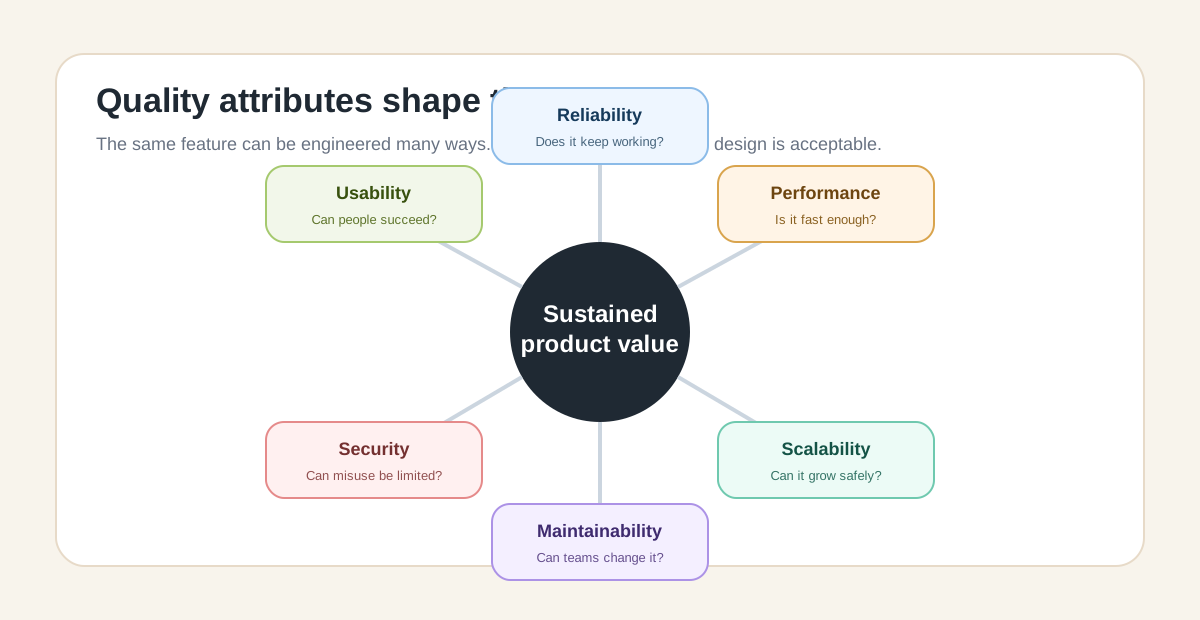
- Security, reliability, maintainability and usability are engineering requirements, not clean-up work at the end.
- AI coding tools are changing the workflow, but human review, architecture judgment and evidence-based validation remain central.
What Is Software Engineering? Core Concepts
The IEEE Computer Society's SWEBOK Guide V4.0a describes software engineering as a body of generally accepted knowledge covering requirements, design, construction, testing, maintenance, quality, security, operations and professional practice. The current ISO/IEC/IEEE 12207:2026 standard frames software around full life cycle processes from conception through development, operation, maintenance and retirement. Both sources point to the same idea: software engineering is the organized management of software work across the whole life of a system.
The discipline emerged because large software projects were failing in predictable ways. Requirements were unclear, schedules slipped, code became hard to change, defects escaped into production and teams lacked a shared process for controlling complexity. The 1968 NATO Software Engineering Conference is widely treated as the formal starting point of the field. Since then the practice has absorbed structured programming, object-oriented design, formal methods, agile delivery, DevOps, cloud-native architecture, site reliability engineering and now AI-assisted development.
Software engineering is broader than coding
A useful distinction is scope. Coding asks whether a program can be written to perform a task. Software engineering asks whether a team can build and operate the right system, prove it works well enough, change it without breaking trust and keep it useful over time. That is why software engineers work with version control, code review, automated tests, design documents, service-level objectives, security controls, observability, incident reviews and product feedback. The code is the visible artifact, but the engineering system around it determines whether the code can survive contact with users.
| Concept | What it means in practice | Typical output |
|---|---|---|
| Requirements | Define what the system must do and what constraints it must satisfy. | User stories, use cases, acceptance criteria, risk notes. |
| Architecture | Decide the major components, interfaces, data flows and quality trade-offs. | Architecture decision records, diagrams, service contracts. |
| Construction | Implement code, review changes and manage dependencies. | Source code, pull requests, build artifacts. |
| Verification and validation | Check whether the system was built correctly and solves the intended problem. | Automated tests, test reports, acceptance evidence. |
| Operations | Run the system in production with monitoring, incident response and capacity planning. | Dashboards, alerts, SLOs, runbooks. |
| Maintenance | Fix defects, adapt to new needs and reduce avoidable complexity. | Patches, refactors, migration plans, deprecation notes. |
Software engineering roles in large technology companies
Large technology companies organize software engineering work by levels and responsibility, though names differ by employer. Entry-level engineers usually handle well-scoped fixes, tests and small features under close review. Mid-level engineers own complete features or services. Senior engineers shape designs, resolve ambiguity, mentor others and protect system health. Staff or principal engineers work across teams, while a tech lead is often a role rather than a formal management level: the person accountable for technical direction on a project. The pattern is not bureaucracy for its own sake. It is a way to match judgment, scope and coordination to the complexity of systems serving very large user populations.
Software engineering as professional responsibility
Software engineers also make choices that affect people who never see the source code. A routing bug can delay deliveries, an access-control flaw can expose personal data, and a misleading interface can push users into decisions they would not otherwise make. The ACM/IEEE-CS Software Engineering Code of Ethics frames the profession around public interest, client and employer duty, product quality, judgment, management, colleagues and self-development. For business readers, the practical lesson is simple: engineering maturity is partly technical and partly ethical. Teams need room to raise risks, document trade-offs, refuse unsafe shortcuts and keep evidence for decisions that could affect users, regulators or customers.
How Software Engineering Works: The Technical Breakdown
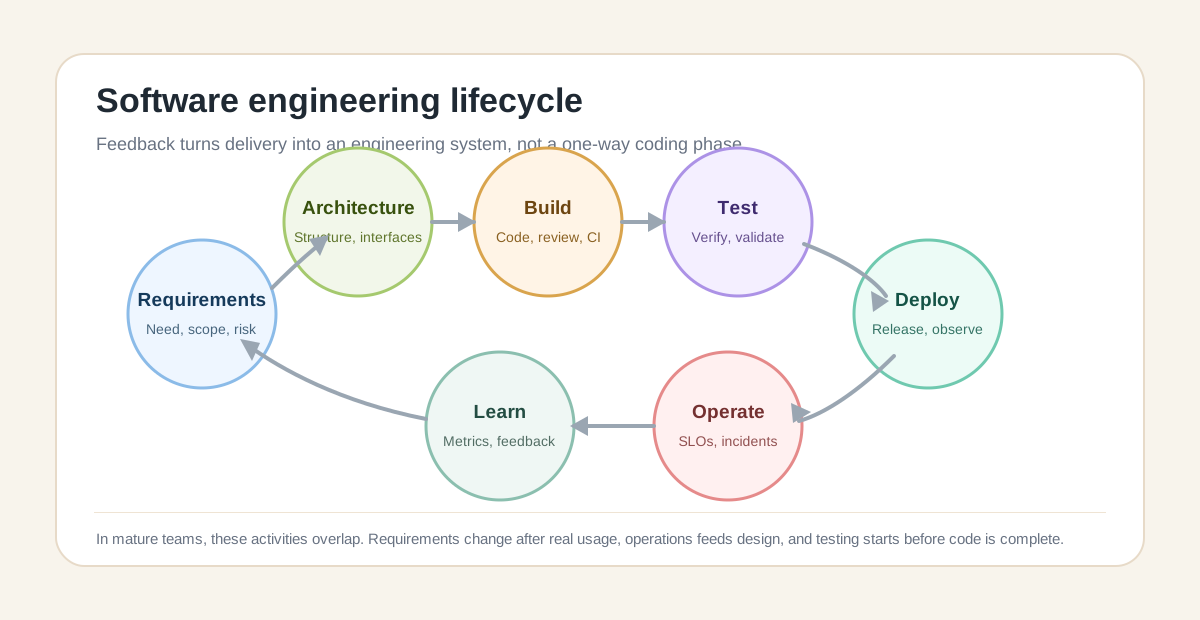
Software engineering works by turning uncertain business or user needs into a controlled stream of technical decisions. The common shorthand is the software development lifecycle, or SDLC: requirements, design, implementation, testing, deployment and maintenance. Modern teams rarely execute those steps as a single straight line. Even regulated teams iterate within gates, because user feedback, security findings, production incidents and market changes alter what the system needs to become.
Requirements and constraints
Requirements engineering turns a vague goal into verifiable statements. Functional requirements describe behaviour: create an account, calculate tax, reconcile a payment, send a notification. Non-functional requirements describe system properties: latency, availability, privacy, accessibility, auditability, retention, resilience and cost limits. ISO/IEC/IEEE 29148:2018, confirmed current in 2024, remains a reference point for requirements processes and information items.
Architecture, design and trade-offs
Architecture is where software engineering becomes explicit about trade-offs. A monolith may be easier to understand and deploy for a small team. Microservices can support independent scaling and team ownership, but introduce network failure, distributed tracing, deployment coordination and data consistency problems. Event-driven designs are useful where systems need to react to changes asynchronously, but debugging causal chains becomes harder. The right design is the one whose trade-offs fit the product, team and operating model.
Implementation, review and delivery pipelines
Implementation is more than typing code. Engineers select data structures, APIs, libraries and runtime patterns; write tests; review one another's changes; and use continuous integration to compile, lint, scan and exercise the system before release. Good teams keep changes small enough to understand. They avoid unreviewed dependency upgrades, undocumented configuration changes and manual deployment steps that cannot be repeated.
Testing, deployment and operations
Testing spans unit tests, integration tests, contract tests, system tests, performance tests, security tests and acceptance tests. None proves perfection. Each reduces uncertainty from a different angle. Deployment then moves software into production through release controls such as feature flags, canaries, blue-green deployments and rollback plans. Once live, software engineering continues through monitoring, incident response, capacity planning and post-incident learning. Google's SRE material frames reliability around service-level indicators, service-level objectives and error budgets; that language is now common far beyond Google.
Software Engineering Benefits and Use Cases
The benefit of software engineering is controlled change. Most businesses do not need beautiful code for its own sake. They need systems that let them launch products, serve customers, meet regulatory obligations, integrate with partners and adapt without repeated rewrites. Strong engineering practices create that capacity.
- Reliable digital products. Banking apps, booking platforms, logistics portals and healthcare systems need predictable behaviour under load.
- Enterprise integration. Software engineering connects CRM, ERP, payment, identity, analytics and operational systems without turning every interface into a fragile custom bridge. See API management for application interoperability for the integration layer.
- Cloud and SaaS platforms. Multi-tenant systems need careful isolation, observability, scaling and deployment design.
- Internal productivity tools. Good engineering can turn repeated manual work into maintained internal software rather than unmanaged spreadsheets and scripts.
- Safety and compliance systems. Regulated environments need traceability, audit evidence, security controls and documented change management.
- AI-enabled products. AI features still need conventional engineering around data pipelines, evaluation, security, user experience, fallback behaviour and monitoring.
For buyers, software engineering maturity is a way to evaluate a vendor. A credible software development agency should be able to explain how it manages requirements, code ownership, test coverage, security, CI/CD, handover and post-launch support. For larger integration projects, compare those answers with the operating model in our system integration explainer.
Maintenance is where this becomes visible commercially. A lower initial build price can become expensive if the client receives no repository access, no deployment scripts, weak test coverage, hard-coded secrets, undocumented infrastructure or a design that only the original vendor understands. Strong software engineering makes handover possible. It records assumptions, keeps environments reproducible, separates configuration from code, documents dependencies and leaves the buyer with enough operational knowledge to change suppliers without starting again.
Software Engineering Challenges and Limitations
Software engineering reduces risk, but it does not remove uncertainty. Many failures come from treating software as if all work were visible at the start. In reality, teams learn while building, users change behaviour, dependencies move, security threats evolve and old decisions constrain new ones.
- Ambiguous requirements. Stakeholders often know the pain but not the precise workflow, exception handling or success metric.
- Complexity growth. Every feature adds paths through the system. Complexity becomes expensive when boundaries, ownership and tests are weak.
- Technical debt. Shortcuts can be rational in the moment, but untracked debt raises future change cost and incident risk.
- Security exposure. The current OWASP Top 10 is a practical reminder that access control, insecure design, injection, outdated components and configuration errors remain common web risks.
- Estimation limits. Novel work cannot be estimated like manufacturing. Ranges, assumptions and incremental delivery are more honest than false precision.
- Human coordination. Large systems fail through communication gaps as often as through algorithms.
Security deserves special treatment because defects can become public harm. NIST SP 800-218 recommends a Secure Software Development Framework with practices for preparing the organization, protecting software, producing well-secured software and responding to vulnerabilities. OWASP's Application Security Verification Standard 5.0, released in 2025, gives teams a more detailed checklist of security requirements for modern web applications and services.
Software Engineering Developments and Market Sentiment in 2026
The software engineering field in 2026 is defined by two forces moving at different speeds. The standards base is becoming more complete and current: SWEBOK V4.0a reflects agile, DevOps, software architecture, operations and software security as accepted parts of the discipline, while ISO/IEC/IEEE 12207:2026 updates the life cycle process framework. At the same time, AI coding assistants and agents are changing how quickly code can be produced.
Market sentiment is mixed rather than uniformly positive. Stack Overflow's 2025 Developer Survey reported that 84 per cent of respondents use or plan to use AI tools in their development process, but only 33 per cent trust the accuracy of AI outputs and 46 per cent actively distrust them. DORA's research on generative AI in software development found that a 25 per cent increase in AI adoption was associated with lower delivery throughput and lower delivery stability, a sign that faster code generation can create review, testing and integration pressure if teams do not adapt their process. Gartner, meanwhile, estimated the enterprise AI coding-agent market at roughly US$9.8 billion to US$11.0 billion annualized as of April 2026 and expects agentic workflows to reshape development environments.
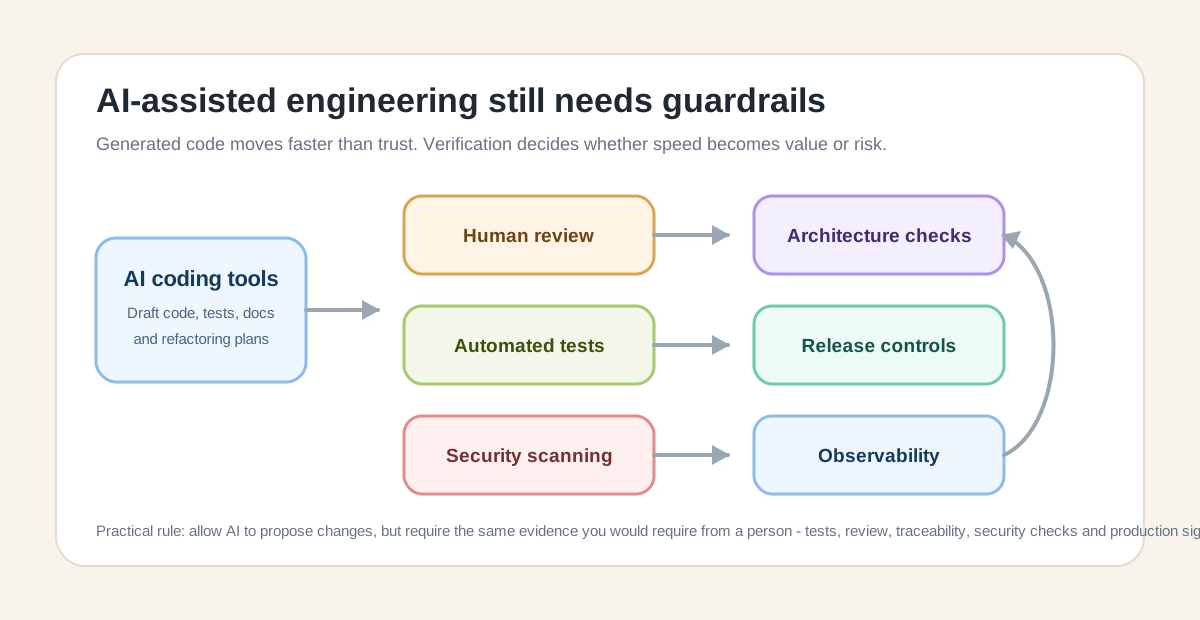
The practical direction is not AI replacing software engineering. It is AI increasing the premium on good software engineering. Teams that already have clear architecture, test automation, small batches, observability and secure SDLC practices can absorb generated code more safely. Teams without those controls may simply generate defects faster. This is why software buyers should ask vendors how AI-generated work is reviewed, attributed, tested and secured before accepting claims about faster delivery.
Software Engineering Compared With Programming, Computer Science and IT
Software engineering overlaps with nearby fields, but it is not identical to them. The differences are useful when hiring, buying services or planning a career path.
| Field | Primary concern | How it relates to software engineering |
|---|---|---|
| Programming | Writing code to implement logic. | A core craft inside software engineering, but not the whole discipline. |
| Computer science | Theory, algorithms, computation, data structures and formal models. | Provides foundations that software engineers apply to real systems. |
| Information technology | Operating, supporting and governing technology services in an organization. | Overlaps in infrastructure, support, security and service management. |
| System integration | Connecting existing systems, data flows and vendors. | Uses software engineering practices when integrations become custom products. |
| Product management | Choosing what problem to solve and how success is measured. | Works with engineering to turn product direction into feasible system increments. |
| DevOps and SRE | Improving delivery flow and production reliability. | Operational disciplines that are now central to modern software engineering. |
Future Outlook for Software Engineering
The future of software engineering will be less about whether engineers type every line of code and more about whether teams can define, verify and operate software with enough evidence to trust it. AI assistants will draft code, tests, migrations and documentation. Platform engineering will hide more deployment and infrastructure detail behind internal developer portals. Security requirements will move earlier in procurement and design. Observability will become a design requirement rather than an operations afterthought.
The durable skills are not going away: clear requirements, modular design, readable code, thoughtful interfaces, test strategy, operational thinking, secure defaults and communication across roles. For organizations buying software, the implication is direct. Do not evaluate a software partner only by demo speed or hourly rate. Evaluate the engineering system behind the demo: how work is scoped, reviewed, tested, secured, deployed, monitored and handed over. That system is what determines whether the software remains an asset after launch.
Find software development partners in Singapore
Compare software development agencies, system integrators and technology vendors on TechDirectory by capability, category and buyer context.
Browse software development agencies
Frequently asked questions
What is software engineering in simple terms?
Software engineering is the disciplined way of building software so it can work reliably, be changed safely and continue delivering value over time. It includes coding, but also requirements, design, testing, security, deployment, operations and maintenance.
What is the difference between software engineering and programming?
Programming is writing code. Software engineering includes programming but also the wider engineering system around it: deciding what to build, designing architecture, reviewing code, testing, securing, deploying, monitoring and maintaining the software across its life.
What are the main phases of the software development lifecycle?
The common SDLC phases are requirements, design, implementation, testing, deployment and maintenance. In modern teams these phases usually overlap and repeat. Feedback from users and production systems shapes the next iteration.
Why is software engineering important for businesses?
Software engineering helps businesses reduce delivery risk, avoid fragile systems, meet security and compliance needs, integrate with other platforms and adapt software after launch. It turns software from a one-off build into a maintained business capability.
How is AI changing software engineering?
AI tools can draft code, tests and documentation faster than before, but they also create accuracy, security and review risks. The main shift is that engineers spend more time specifying, reviewing, testing and integrating AI-assisted work rather than relying on generated code without evidence.
What should buyers ask a software development vendor?
Ask how requirements are captured, who owns the code, what test coverage is expected, how security is handled, how deployments work, what documentation is delivered and what support exists after launch. Also ask whether AI-generated code is used and how it is reviewed.
Sources and further reading
- IEEE Computer Society - Guide to the Software Engineering Body of Knowledge (SWEBOK) V4.0a
- ISO - ISO/IEC/IEEE 12207:2026 Software life cycle processes
- ISO - ISO/IEC/IEEE 29148:2018 Requirements engineering
- NIST SP 800-218 - Secure Software Development Framework
- OWASP Top Ten Web Application Security Risks
- OWASP Application Security Verification Standard
- DORA - Accelerate State of DevOps Report 2024
- DORA - Impact of Generative AI in Software Development
- Stack Overflow - 2025 Developer Survey: AI
- Gartner - Enterprise AI Coding Agents market
- Google SRE - Site Reliability Engineering books
- ACM/IEEE-CS - Software Engineering Code of Ethics
- Should You Build Your App With AI Coding Tools, or Hire a Software Agency?
- system integration explained
- api management application interoperability
- Cybersecurity Basics: Core Concepts, Controls and How They Fit Together
- Inside Large Language Models: How the Engines Behind ChatGPT, Claude, and Gemini Actually Work
- What Is a System Integrator? A Buyer's Guide to SIs and Enterprise Integration