SEO and AI SEO are two ways of making a business discoverable when a buyer has a question. Traditional SEO helps a search engine crawl, understand and rank a page. AI SEO extends that work to answer surfaces such as Google AI Overviews and AI Mode, ChatGPT Search, Gemini, Claude with web search, Perplexity and other assistants that synthesise information. The underlying discipline is not a collection of secret prompts or special files. It is the consistent production of pages that are technically accessible, useful, specific, trustworthy and easy for retrieval systems to interpret.
What Are SEO and AI SEO?
Search engine optimisation is the process of improving a site so search engines can discover its pages, interpret their subject and intent, and show them to people who are looking for that information. Google describes SEO in similar terms: helping search engines understand content and helping users decide whether a result is relevant. It is not a guarantee of ranking.
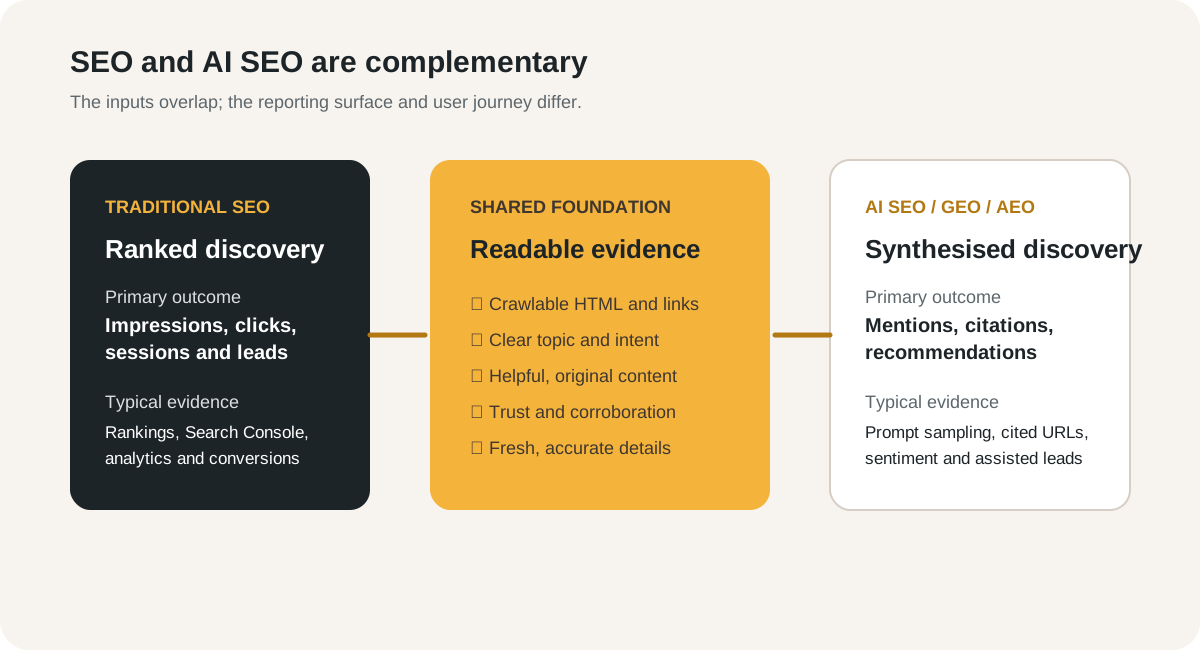
AI SEO is a practical umbrella term for improving visibility in generative search and answer systems. AEO (Answer Engine Optimisation) usually refers to being selected as a direct answer, while GEO (Generative Engine Optimisation) usually refers to being mentioned, quoted, cited or recommended inside a generated response. The labels overlap, and the market uses them inconsistently. The useful distinction is the outcome being measured: a position and click in classic search, or a presence and accurate description in an AI answer.
| Dimension | Traditional SEO | AI SEO / AEO / GEO |
|---|---|---|
| User interface | Ranked links, snippets, maps and other search features | A generated answer with supporting links, citations or recommendations |
| Core objective | Earn relevant impressions and clicks | Become a trusted, retrievable source or named option |
| Useful evidence | Rankings, impressions, CTR, sessions and conversions | Mentions, cited URLs, recommendation rate, accuracy and assisted conversions |
| Main risk | Low ranking or poor click-through | Being absent, misrepresented or visible without a measurable click |
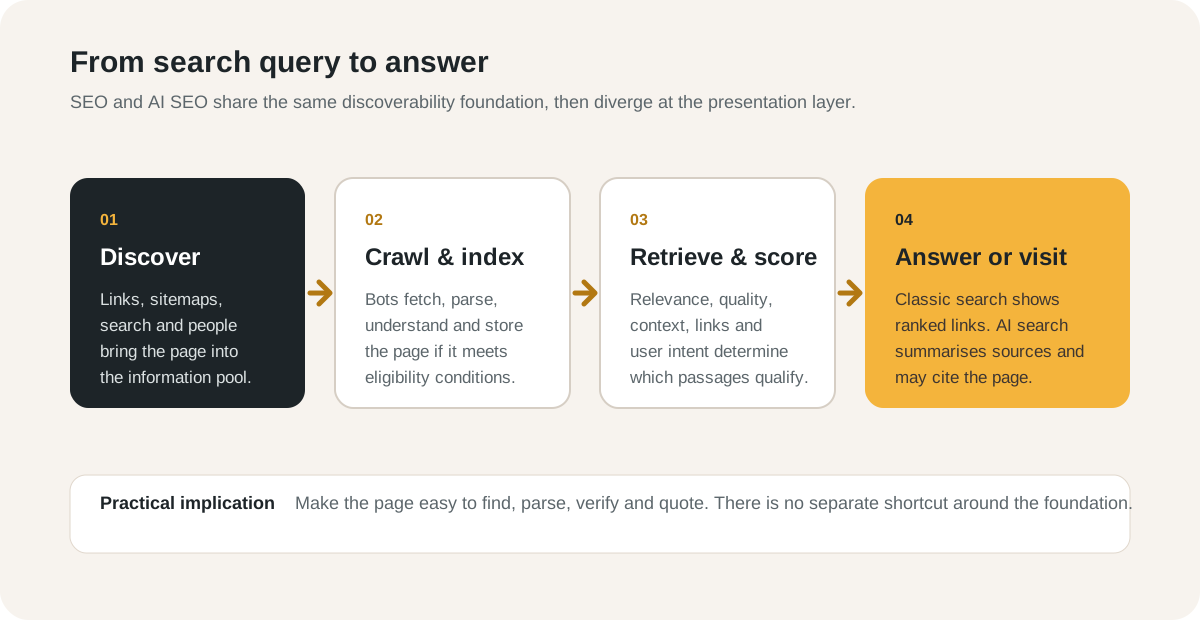
How Traditional SEO Works
A search engine has to find a page before it can rank it. The simplified process is crawling, indexing and serving. Crawlers discover URLs through links, sitemaps and redirects, fetch the page and its resources, and parse the content. The engine then decides whether and how to store the page in its index. For a particular query, ranking systems select and order eligible results using relevance, quality, context, freshness, location, language and many other signals.
- Technical accessibility: return a reliable status code, use a stable canonical URL, allow important resources to be crawled, provide internal links and submit a sitemap when it helps discovery. A page that is blocked, orphaned or rendered without accessible text cannot reliably compete.
- Intent and information architecture: map a page to a real need — informational, comparative, commercial, transactional or navigational — then make the relationship between related pages clear. One page should have a clear primary job.
- On-page evidence: use an accurate title, descriptive headings, visible text, meaningful image alt text, examples and terminology that people actually use. Keyword research supports language and prioritisation; repeating a phrase does not create relevance.
- Authority and trust: earn relevant references, publish original analysis, identify authors and reviewers, explain methods, keep claims current and make it easy to contact the organisation. Links are useful signals, but a large volume of unrelated or paid links is not a substitute for credibility.
Search intent matters more than a target word count
A page can be long and still fail if it does not answer the question behind the query. Google’s own guidance says there is no magical minimum or maximum word count. A better workflow is to identify the decision the reader is trying to make, cover the necessary sub-questions, state important limitations and provide a next step. That produces content that is more useful to people and easier for retrieval systems to classify.
How SEO and AI SEO Work at the Retrieval Layer
AI search adds a synthesis stage. Instead of only returning a ranked list, an answer system may interpret the question, expand it into related searches, retrieve candidate pages, select supporting passages, and generate a response with links or citations. Google explicitly documents query fan-out for AI Overviews and AI Mode: the system can issue multiple related searches across subtopics and data sources before composing an answer. Other platforms use different retrieval, ranking and citation systems, so the exact path varies.
- Interpret the prompt: the system identifies entities, constraints, location, time period, comparison criteria and likely follow-up questions. “Which Singapore system integrator can modernise our voice platform?” is broader than a single keyword and may expand into capability, geography, standards, cost and evidence queries.
- Retrieve candidates: the platform searches an index, a partner search service, its own corpus, or a combination. A page still needs to be discoverable, accessible and eligible for retrieval. For ChatGPT Search, OpenAI says sites should allow OAI-SearchBot and avoid blocking the host or CDN from serving it.
- Select passages and entities: clear definitions, specific claims, tables, dates, product names, author context and consistent organisation details give a system usable evidence. This is why answer-first writing and descriptive headings help, even though no fixed “AI paragraph length” is required.
- Reconcile and synthesise: the answer system compares sources, resolves or exposes disagreement, and writes a response. It may combine several pages rather than reproduce one article. Unsupported certainty, stale claims and inconsistent descriptions increase the risk of omission or misrepresentation.
- Present the answer: the system may show a citation, a link carousel, a recommendation list or no link at all. A citation is not a ranking guarantee, and a ranking is not a guarantee of citation. Both are probabilistic outcomes that need to be sampled over time.
What changes across ChatGPT, Gemini, Claude and DeepSeek?
Do not treat ChatGPT, Gemini, Claude, DeepSeek and Perplexity as one search engine. Google’s AI features are integrated with Google Search and its existing eligibility requirements. ChatGPT Search has a documented OAI-SearchBot access path. Microsoft’s Copilot and Bing experiences are covered by Bing’s indexing and AI citation ecosystem. Claude can use web search through Anthropic’s server-side tool in supported applications and APIs. DeepSeek and other assistants may expose different retrieval and browsing behaviours. The shared strategy is therefore to publish strong, accessible evidence and measure each surface separately where it matters to the audience.
How SEO and AI SEO Work Together
The most efficient programme treats AI visibility as an additional distribution outcome for a well-run search and content operation. Start with technical health and intent mapping. Then make the pages that matter easy to extract, corroborate and update. The work should improve the human page even if an AI system never cites it.
- Choose a question set: combine Search Console queries, sales questions, support tickets, competitor comparisons and location-specific prompts. Include the questions where the business is absent, not only the ones it already wins.
- Build or improve the right page: give each intent a canonical home. Use definitions, comparisons, implementation details, evidence and honest trade-offs instead of a collection of short pages that repeat the same claim.
- Strengthen entity clarity: keep the organisation name, services, markets, people, products and credentials consistent across the site, structured data and credible third-party profiles. Structured data should describe visible content; it is not a hidden message to an AI model.
- Make access deliberate: review robots.txt, CDN and WAF rules, authentication, JavaScript rendering, sitemaps and noindex controls. Decide separately whether training crawlers and answer-time crawlers fit the organisation’s publishing policy.
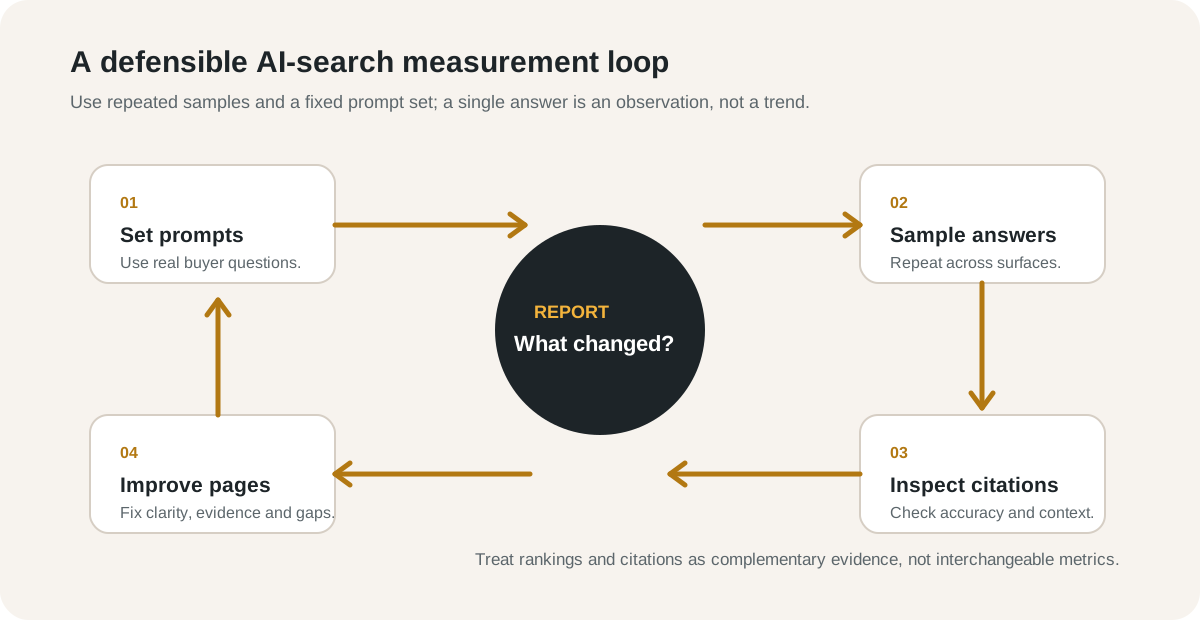
- Measure and refresh: use Search Console and analytics for classic search, then run a fixed, repeated prompt set for AI surfaces. Record the cited page, claim accuracy, competitor presence, source position and downstream action.
Key Benefits and Use Cases
| Use case | What SEO contributes | What AI SEO adds |
|---|---|---|
| Technical education | Ranks explainers and implementation guides | Makes definitions and evidence available inside conversational research |
| B2B vendor discovery | Captures category, service and location searches | Increases the chance of appearing in shortlists and comparisons |
| Local services | Supports location, profile and review discovery | Helps assistants answer “who can help near me?” with context |
| Complex buying decisions | Builds topical coverage and comparison pages | Supports multi-step research where the answer is assembled from several sources |
The value is not only traffic. A cited explanation can shape the shortlist before a buyer visits a site; a well-structured page can reduce support load; and consistent public facts can reduce the chance that an assistant describes a company incorrectly. The commercial result still needs to be validated through qualified enquiries, assisted conversions and customer research rather than assumed from a mention.
Challenges and Limitations
- Variable answers: generative responses can change with wording, location, model version, freshness and the sources available at the time. One screenshot is not a reliable performance baseline.
- Incomplete attribution: an AI answer may influence a buyer without generating a referral. Referrals that do arrive can be classified as direct or be stripped of useful detail, so analytics understates assisted impact.
- Zero-click pressure: a helpful answer can satisfy the question before the user reaches the source. A business must give the reader a reason to continue — original data, tools, expertise, examples, product detail or a clear next action.
- Platform fragmentation: each assistant may use a different index, crawler policy, citation style and update cycle. A tactic that appears to help one surface may not transfer cleanly to another.
- Content quality and governance: mass-produced AI text, unsupported claims, stale statistics and inconsistent brand information create editorial and reputational risk. Human review, source tracking and a clear update cadence remain necessary.
- No guaranteed placement: neither rankings nor AI citations can be purchased as a predictable outcome. A provider promising guaranteed inclusion in ChatGPT, Gemini or Google AI features is selling certainty that the systems do not offer.
Current Technological Developments and Market Sentiment Trends
The direction of travel in 2026 is clearer than the final market shape. Google published a dedicated guide for AI features in May 2026, but its advice is deliberately conservative: the same SEO fundamentals apply, indexed pages need to be eligible for snippets, and there is no special AI markup or machine-readable file required. That is a useful correction to vendor claims that every site needs an “AI SEO hack.”
- Query fan-out is becoming a planning model: content teams should cover the surrounding questions a buyer is likely to ask, not only the head term. This argues for topic depth, comparison pages and clear relationships between related documents.
- Measurement is moving closer to the answer: Bing’s AI Performance public preview reports total citations, cited pages and grounding queries across supported Copilot and Bing AI experiences. That is an early sign that visibility reporting is becoming a first-party webmaster concern.
- Crawler access is now a publishing choice: OpenAI documents OAI-SearchBot access for ChatGPT Search and separates it from controls for other crawler uses. Site owners should review robots.txt and perimeter controls instead of treating all automated access as identical.
- AEO and GEO are converging with SEO: the labels help describe new outcomes, but the durable work is still technical accessibility, useful content, entity clarity, evidence, links and measurement. Buyers should ask what a provider will actually deliver, not which acronym appears on the proposal.
- Agentic discovery is an emerging extension: when systems can compare options, call tools or take actions, machine-readable product, service, policy and availability information will matter more. That raises the cost of ambiguity and stale data, not the value of keyword stuffing.
SEO and AI SEO Compared with Alternatives
| Channel | Strength | Limitation |
|---|---|---|
| Traditional SEO | Compounding discoverability and measurable organic visits | Slow to build; rankings and clicks are competitive |
| AI SEO | Influence inside conversational research and shortlists | Variable outputs, weaker attribution and fragmented measurement |
| Paid search | Fast control over visibility for selected queries | Requires ongoing spend; ads do not create organic authority |
| Social and communities | Human distribution, discussion and first-hand signals | Reach and discoverability depend on platform dynamics and participation |
| Digital PR | Third-party credibility, links and brand association | Harder to control, slower to repeat and difficult to attribute directly |
A sensible mix depends on the buying cycle. Paid search can cover an immediate launch, SEO can build an owned information base, digital PR can establish corroboration, and AI SEO can make that information available inside a buyer’s conversational workflow. These channels reinforce one another, but they should keep separate budgets and measurement definitions.
Future of SEO and AI SEO
The most likely future is not the replacement of SEO by a single AI engine. It is a wider search layer in which classic results, summaries, citations, maps, product data, communities and agent interfaces coexist. The winning operating model will be less about chasing a named feature and more about maintaining a dependable public knowledge base that systems can retrieve and people can verify.
Three priorities follow. First, preserve the technical basics: crawlability, indexability, speed, accessibility, canonicalisation and internal linking. Second, invest in original evidence and clear entities because generic summaries are easy to replace. Third, build measurement that combines search performance, AI visibility, brand accuracy and business outcomes. The labels will change; those requirements are likely to persist.
For most organisations, the first step is modest: audit the pages that already matter, identify the buyer questions they fail to answer, make the evidence clearer, check crawler access and establish a baseline across both search and AI prompts. That creates a useful decision loop without assuming that every new assistant deserves a separate optimisation programme.
Frequently asked questions
What is the difference between SEO and AI SEO?
SEO improves a page’s ability to be discovered, understood and ranked in traditional search. AI SEO applies the same foundations to generative answer surfaces, with additional attention to extractable evidence, entity clarity, citations and recommendation visibility. The two are complementary rather than substitutes.
How does SEO work with ChatGPT, Gemini and Claude?
Each platform has its own retrieval and citation behaviour, so no single tactic guarantees visibility. In general, the page must be accessible, relevant, clear, trustworthy and eligible for the platform’s retrieval system. Measure each surface separately and avoid claims that one ranking or citation proves performance everywhere.
Do I need special schema or an llms.txt file for AI SEO?
Google’s current guidance says there is no special schema or AI-specific machine-readable file required for AI Overviews or AI Mode. Use structured data when it accurately describes visible content, keep the HTML accessible, and focus on people-first information.
How do I measure AI SEO results?
Track classic search in Search Console and analytics, then use a fixed prompt set across the AI surfaces relevant to your buyers. Record whether the brand appears, which page is cited, how accurate the description is, how often competitors appear, and whether the interaction leads to a qualified action. Repeat sampling because answers vary.
Is AI SEO replacing traditional SEO?
No. AI search expands the ways people discover information, but crawlability, indexability, relevance, helpful content, authority and user experience remain the foundation. The practical change is to measure an additional outcome — visibility in synthesised answers — alongside rankings and traffic.
SEO Recommendations
Suggested internal links
- AEO & GEO Playbook — Link from the AI SEO workflow section for readers who want implementation tactics.
- Measuring AI Search Visibility — Link from the measurement and limitations sections for prompt-set methodology.
- Singapore's AI Search Optimisation Market — Link for readers comparing regional providers, pricing and market positioning.
- Browse marketing agencies in Singapore — Use as a commercial next step after the integrated workflow.
Image placement suggestions
- After the definition section — alt text: Flow diagram showing how a search query moves through discovery, crawling and indexing, retrieval and scoring, then becomes a ranked visit or an AI answer.
- After the retrieval-layer explanation — alt text: Comparison diagram showing traditional SEO, a shared content and technical foundation, and AI SEO with citations and recommendations.
- Before the comparison section — alt text: Circular five-step diagram showing an AI search measurement loop: set prompts, sample answers, inspect citations, improve pages and report what changed.
Additional long-tail keyword opportunities
- how SEO and AI SEO work together
- how to optimise a website for ChatGPT search
- SEO vs GEO vs AEO explained
- how to appear in Google AI Overviews
- how to measure AI search visibility
- AI SEO strategy for B2B technology companies
- does schema markup help AI search
- ChatGPT Gemini Claude DeepSeek SEO
Sources and further reading
- Google Search Central — SEO Starter Guide
- Google Search Central — AI features and your website
- Google Search Central — Creating helpful, reliable, people-first content
- Google Search Central — Introduction to structured data markup
- OpenAI Help — ChatGPT Search
- OpenAI Help — Publishers and Developers FAQ
- Microsoft Bing Webmaster Blog — AI Performance public preview
- Anthropic Documentation — Tool use overview