Introduction
Enterprise voice calls now sit across several layers: VoIP for packet-based voice transport, IPPBX or on-premises PBX platforms for call control, cloud PBX services for hosted administration, and voice SaaS platforms such as Microsoft Teams Phone and Zoom Phone for user experience. The design question is rarely "cloud or on-premises?" in isolation. It is how to connect numbers, carriers, users, sites, recording policies, emergency behaviour and failover paths into one dependable voice calling environment.
This article focuses on enterprise voice for multi-site organisations: companies running Cisco Unified Communications Manager (CUCM), Avaya Aura, Mitel, Asterisk-based IPPBX, carrier SIP trunks, Microsoft Teams Phone, Zoom Phone, contact centre queues, concall workflows and mobile users at the same time. It builds on our VoIP fundamentals, PSTN to SIP migration and SBC explainers.
Table of Contents
- Core concepts
- How VoIP works
- Key benefits and use cases
- Challenges and limitations
- Current standards and technologies
- Comparison with alternatives
- Future outlook
- Frequently asked questions
Core Concepts: Enterprise Voice, VoIP, IPPBX, PBX and Cloud PBX
Enterprise voice is the business calling architecture that handles internal extensions, public phone numbers, inbound routing, outbound dialling, voicemail, recording, emergency calling, conference calling, contact centre routing and reporting. In a small company it may be a cloud PBX with softphones. In a larger estate it may include on-prem IPPBX clusters, SBCs, carrier SIP trunks, Microsoft Teams Phone, Zoom Phone, branch survivability appliances and regional call routing.
| Concept | Plain-English meaning | Where it fits |
|---|---|---|
| PBX | Private Branch Exchange. A business phone system that manages extensions, routing, voicemail and external lines. | Traditional telephony, often TDM or hybrid IP/TDM. |
| IPPBX | An IP-based PBX that uses packet networks and SIP endpoints instead of purely circuit-switched phone wiring. | On-premises call control for Cisco CUCM, Avaya, Mitel, Asterisk and similar platforms. |
| VoIP | Voice over Internet Protocol. The method of carrying voice media over IP networks. | The transport layer used by IP phones, softphones, cloud PBX and SIP trunks. |
| Cloud PBX | PBX functions delivered from a provider cloud rather than a customer-owned server room. | Hosted extensions, auto attendants, queues and voicemail for distributed teams. |
| SBC | Session Border Controller. A voice edge element that secures, normalises, routes and monitors SIP/RTP traffic. | Between IPPBX, cloud PBX, SIP trunks, Teams, Zoom and carriers. |
| UCaaS | Unified Communications as a Service. Voice plus messaging, meetings, presence and collaboration. | Platforms such as Microsoft Teams, Zoom, Webex, RingCentral and 8x8. |
| Concall | A common regional shorthand for conference call. | Ad hoc or scheduled multi-party voice calling, often inside UCaaS meeting platforms. |
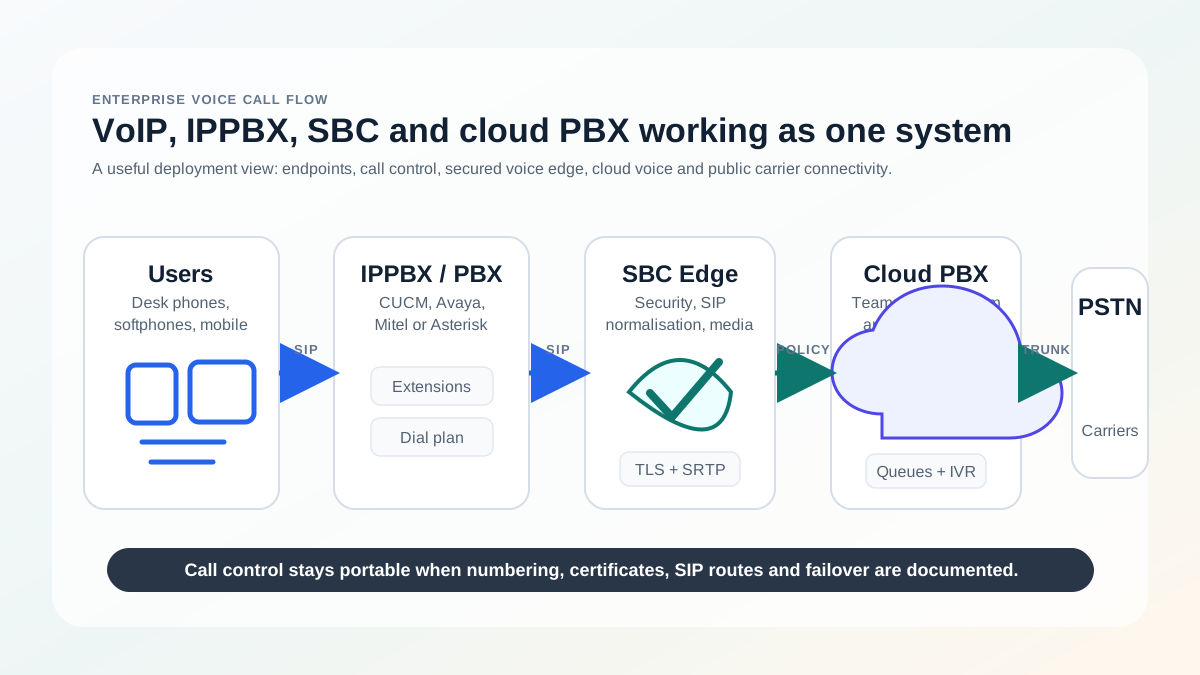
The practical distinction between PBX, IPPBX and cloud PBX matters because it decides where call control lives, who manages upgrades, how numbers are routed, how emergency calls are handled and what happens if a WAN link or provider service fails. A hybrid design can be sensible when a company has existing Cisco or Avaya investment, analogue lift phones, fax lines, trading floors, contact centres or regulated recording needs that cannot move all at once.
How VOIP Works in Enterprise Voice Calls
A VoIP call has two main jobs: signalling and media. Signalling sets up, changes and ends the call. Media carries the actual audio that users hear. The Internet Engineering Task Force defines SIP in RFC 3261 as a protocol for creating, modifying and terminating sessions, while RFC 3550 defines RTP for carrying real-time media.
1. Registration and call setup
An IP phone, softphone or Teams/Zoom client authenticates to a call control platform. That platform may be an on-prem IPPBX, a cloud PBX, or a SaaS voice service. When a user dials, SIP messages negotiate the destination, codec, security parameters and media path. If the call needs the public telephone network, it normally leaves through a SIP trunk or carrier interconnect.
2. Media path, codecs and bandwidth
Once the call is established, audio is encoded by a codec and sent as RTP or Secure RTP packets. G.711 uses a 64 kbps payload and is common for PSTN-quality voice; G.729 uses lower bandwidth but adds licensing and transcoding considerations; Opus is a flexible modern codec defined in RFC 6716 and widely used in real-time applications. With packet overhead, a G.711 voice call often consumes roughly 80-100 kbps per direction depending on packetisation and link layer overhead.
3. SBC control at the enterprise edge
The SBC is the voice equivalent of a security and translation border. It can terminate TLS, enforce SRTP, hide internal topology, block malformed SIP traffic, limit call rates, normalise SIP headers between vendors, transcode media, anchor calls, perform least-cost routing and fail traffic to alternate trunks. Microsoft Teams Direct Routing is planned around a supported SBC between Teams Phone and customer telephony services, and Microsoft publishes a certified SBC list for that use case.
Zoom Phone follows a similar enterprise pattern when customers bring carrier or PBX connectivity through supported voice routes. Zoom describes Phone capabilities including Bring Your Own Carrier and Local Survivability on its Zoom Phone product pages. In both cases, the architecture is not just an app licence. It is a voice edge, numbering, routing, certificates, media handling and operational support model.
Key Benefits and Use Cases for Enterprise Voice and Cloud PBX
Enterprise voice modernisation is usually driven by operational needs rather than by a single technology label. A company may want users to answer business numbers from laptops and mobiles, connect regional branches under one dial plan, reduce dependency on ageing TDM hardware, or move customer-facing teams into Microsoft Teams Phone or Zoom Phone while keeping existing carrier contracts.
- Phased migration. Keep a Cisco CUCM or Avaya IPPBX in service while selected users move to Teams Phone, Zoom Phone or cloud PBX.
- Unified dial plan. Standardise extensions, site prefixes, emergency routing, international dial rules and outbound caller ID across locations.
- Carrier flexibility. Use Bring Your Own Carrier patterns, SIP trunks or regional carriers rather than accepting one bundled PSTN model everywhere.
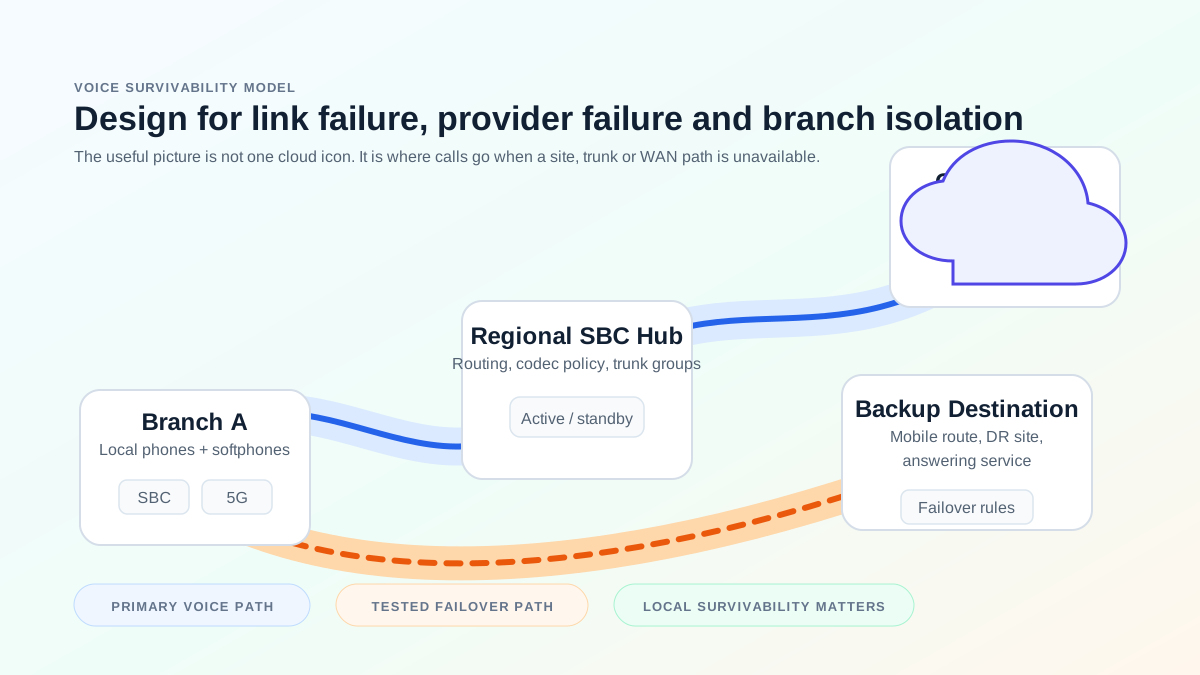
- Business continuity. Route calls to alternate SBCs, mobile numbers, another branch, voicemail, contact centre overflow or an answering service during outages.
- Better user reachability. Support desk phones, softphones, mobile apps, browser clients and scheduled concall sessions on one policy model.
- Reporting and governance. Centralise call detail records, quality monitoring, recording policy, fraud alerts and service-level reporting.
The strongest use cases are multi-site estates, customer support teams, regulated call recording environments, regional headquarters, contact centres, companies with existing IPPBX investment, and organisations replacing copper or ISDN services with SIP trunks. For a Singapore buyer, enterprise voice also intersects with WAN design, local number porting, carrier diversity and the telecom provider landscape covered in our telecom buyer's guide.
Challenges and Limitations of VoIP, IPPBX and Cloud PBX
Voice is unforgiving because users notice delay, echo, clipping and failed transfers immediately. A cloud PBX can simplify server ownership, but it does not remove the need for LAN quality, WAN resilience, certificate management, dial-plan discipline and tested failover.
| Challenge | Why it happens | Practical mitigation |
|---|---|---|
| Interoperability | Cisco, Avaya, cloud PBX and carrier SIP trunks may use different SIP headers, timers or codec preferences. | Use an SBC for SIP normalisation, lab testing and vendor-supported reference designs. |
| Call quality | Voice packets are sensitive to loss, latency, jitter, Wi-Fi roaming and congested WAN links. | Apply QoS, measure MOS, avoid overloaded firewalls and validate Teams or Zoom network readiness. |
| Certificates and FQDNs | Teams Direct Routing and many SaaS voice integrations expect trusted TLS certificates and correctly named SBCs. | Document certificate renewal, DNS ownership and monitored expiry alerts. |
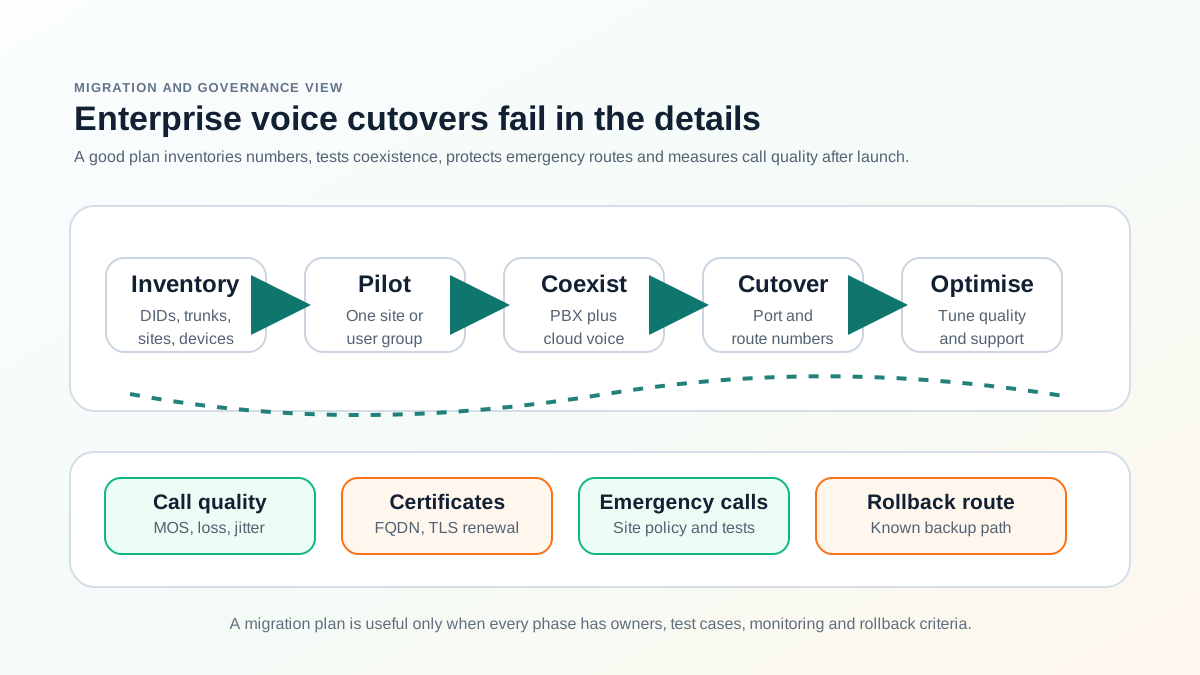
| Emergency calling | Cloud users, remote workers and failover routes can make caller location harder to determine. | Define emergency policies by site, user group and fallback path before cutover. |
| Numbering complexity | Porting DIDs, normalising caller ID and supporting site prefixes can take longer than expected. | Build a numbering inventory and test inbound, outbound and transfer scenarios. |
| Operational ownership | Carrier, UCaaS vendor, SBC partner and internal network team boundaries can blur during incidents. | Agree escalation paths, logging access, packet-capture process and support hours. |
Current Standards and Technologies for Enterprise Voice
Enterprise voice is built from a mix of open standards, vendor-specific certifications and carrier operational practices. The open standards keep the ecosystem interoperable; the certifications and support matrices decide what is actually supported in production.
- SIP. The dominant signalling protocol for IP telephony, SIP trunking and cloud PBX interconnects. See RFC 3261.
- SDP. Session Description Protocol negotiates media details such as codecs, IP addresses and ports during session setup.
- RTP and SRTP. RTP carries voice and video media; SRTP adds encryption and authentication. See RFC 3550 and RFC 3711.
- TLS. Used to protect SIP signalling between SBCs, cloud PBX platforms and SaaS voice providers.
- Codecs. G.711, G.729 and Opus remain common; transcoding should be planned because it consumes SBC resources and may affect quality.
- QoS and network readiness. Microsoft publishes Teams network guidance covering network preparation, bandwidth, endpoints and quality requirements in its network preparation documentation.
- Vendor call control. Cisco Unified Communications Manager, Cisco CUBE, Avaya Aura, Avaya Session Border Controller, AudioCodes, Ribbon and Oracle SBCs all appear in enterprise voice designs depending on scale and installed base.
The enterprise pattern is increasingly hybrid: use open protocols for interconnect, certified SBCs for supported SaaS voice edges, and a documented dial plan to keep cloud PBX, IPPBX and carrier routing aligned.
Comparison: IPPBX, PBX, Cloud PBX, Teams Phone and Zoom Phone
| Option | Best fit | Strengths | Limitations |
|---|---|---|---|
| Traditional PBX | Sites with legacy analogue or digital telephony still in service. | Stable for known workflows and older endpoints. | Harder to integrate with SaaS voice, remote work and modern reporting. |
| On-prem IPPBX | Enterprises with Cisco CUCM, Avaya, Mitel or Asterisk skills and complex site needs. | Strong local control, mature feature sets and integration with existing endpoints. | Requires lifecycle management, HA design, server capacity and skilled operations. |
| Cloud PBX | SMBs and mid-market teams wanting hosted phone-system functions. | Fast provisioning, lower onsite hardware burden and web administration. | Depends on provider resilience, internet quality and clear emergency policies. |
| Teams Phone | Microsoft 365-centred organisations that want voice inside Teams. | Unified client, Teams meetings, policy control and Direct Routing options. | Requires licence planning, SBC design for Direct Routing and careful coexistence with existing PBX. |
| Zoom Phone | Zoom-centred organisations wanting voice, meetings and contact workflows in one user experience. | Simple user adoption for Zoom users, BYOC options and local survivability patterns. | Needs route design, provider support checks and clear integration ownership. |
| Hybrid SBC architecture | Multi-site enterprises moving gradually from IPPBX to cloud voice. | Supports phased migration, least-cost routing, failover and carrier flexibility. | More moving parts: certificates, dial plan, SBC capacity, monitoring and support boundaries. |
A centralised SBC design can simplify carrier peering and policy management, but it may backhaul media and make branch survivability dependent on WAN health. A distributed design places SBCs closer to sites or regions, improving local breakout and resilience at the cost of more devices, certificates and monitoring. Many large deployments combine both: regional SBC hubs plus site-level survivability where the business impact justifies it.
Future Outlook for Enterprise Voice Calls
Enterprise voice will continue moving from standalone phone systems toward integrated collaboration, contact centre and workflow platforms. The shift is gradual because phone numbers, emergency calling, customer support queues, regulated recording and physical endpoints make voice harder to replace than chat or meetings.
- Hybrid voice will remain common. Large organisations will keep IPPBX and cloud voice side by side until every site, number and workflow is ready.
- SBCs will become more software-defined. Virtual and cloud SBCs will be used for elastic capacity, regional redundancy and managed service models.
- Voice observability will matter more. Teams will expect call quality dashboards, CDR analysis, packet captures, MOS trends and carrier incident timelines.
- AI will enter call workflows carefully. Summaries, transcription, sentiment routing and agent assist can help, but recording consent, data retention and privacy controls need design attention.
- Network design will still decide user experience. Cloud PBX cannot compensate for weak Wi-Fi, congested WAN links or untested failover paths.
Compare enterprise voice and telecom providers
Shortlist Singapore telecom providers, system integrators and cloud communications specialists for SIP trunking, SBC design, Teams Phone, Zoom Phone and cloud PBX projects.
Browse telecommunications providers
Frequently asked questions
What is enterprise voice?
Enterprise voice is the business calling architecture for extensions, phone numbers, routing, voicemail, recording, emergency calling, contact centres and cloud voice platforms across multiple users, sites and networks.
How is VoIP different from PBX or IPPBX?
VoIP is the method for carrying voice over IP networks. PBX or IPPBX is the phone system that controls extensions, routing, voicemail and call features. A PBX may use VoIP, legacy circuits or both.
Do Microsoft Teams Phone and Zoom Phone need an SBC?
They need an SBC when integrating with customer carriers, SIP trunks or existing IPPBX platforms through Direct Routing, BYOC or hybrid voice designs. Pure provider-calling plans may not require a customer SBC.
Is cloud PBX better than on-prem IPPBX?
Cloud PBX is simpler to provision and suits distributed teams. On-prem IPPBX gives more local control and can fit complex legacy environments. Many enterprises run both during phased migration.
What should enterprises test before a voice cutover?
Test inbound calls, outbound calls, transfers, emergency routing, caller ID, voicemail, queues, recording, failover, codec behaviour, mobile users, Wi-Fi calling and support escalation before moving production numbers.
Sources and further reading
- Microsoft Learn: Plan Direct Routing
- Microsoft Learn: Certified Session Border Controllers for Direct Routing
- Microsoft Learn: Prepare your organization's network for Teams
- Zoom Phone product information
- RFC 3261: SIP, Session Initiation Protocol
- RFC 3550: RTP, A Transport Protocol for Real-Time Applications
- RFC 3711: The Secure Real-time Transport Protocol
- RFC 6716: Definition of the Opus Audio Codec
- Cisco Unified Communications Manager
- Cisco Unified Border Element