
Microsoft signed first. On 20 July — three days before AMD's chief executive, Dr Lisa Su, was due on stage at the company's Advancing AI 2026 event in San Francisco — Microsoft said it would install AMD's new Helios machines across its cloud service, Azure. The machine it committed to had never shipped. First deliveries to customers begin in the second half of 2026. AMD's share price rose about 5% on the news anyway.
Helios is AMD's first attempt at selling a whole cabinet rather than individual chips. Inside are 72 of its most powerful AI chips, 18 general-purpose processors, its own networking hardware, and its own software. The parts are designed together and cooled by liquid rather than fans, and the whole thing behaves, as far as any program is concerned, like one enormous computer. It is aimed squarely at the machines Nvidia sells to every major AI lab.
The order book filled up before the product existed. OpenAI signed in October 2025. Oracle followed eight days later. Meta signed in February 2026, and the Indian technology group TCS attached a plan for a large national AI facility the same month. Nvidia still holds roughly nine-tenths of the market for AI chips, and it earned that position. What has changed is that the buyers who matter most have now paid to create a second option.
What AMD Actually Built
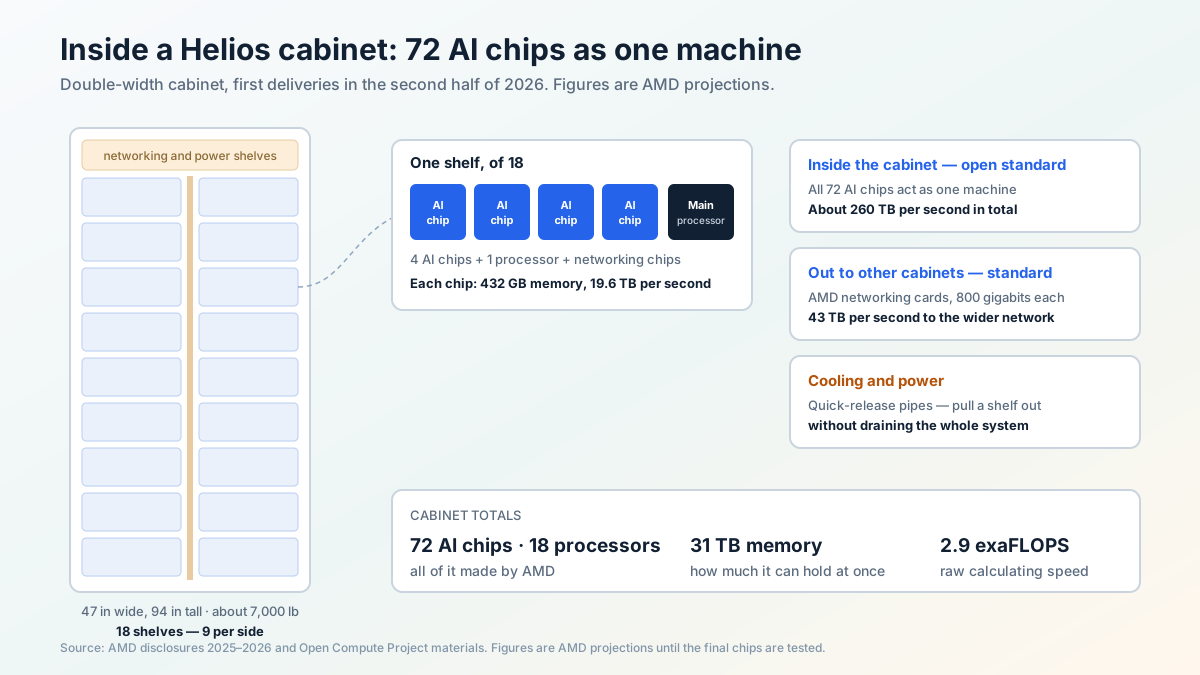
Helios is built as one computer rather than forty servers stacked in a cupboard. All 72 AI chips work together as a single unit.
The cabinet itself follows a shared industry design that Meta gave away to the industry in October 2025. It is about 47 inches wide and 94 inches tall — roughly twice the width of a normal server cabinet. AMD was the first company to build on it.
Inside are 18 shelves, nine down each side. Each shelf holds four AI chips and one general-purpose processor. Power is delivered up a central spine, and the cooling pipes have quick-release connectors, so an engineer can pull out a shelf without draining the liquid from the whole machine. That last detail is not cosmetic. When you run thousands of these, how long a repair takes is a cost the biggest buyers put a number on.
The AI chip is the real argument. Each one carries 432 GB of very fast memory sitting right beside it, and can pull data from that memory at 19.6 terabytes per second. Add it up across the cabinet and you get 31 terabytes of memory in total. AMD says the new chip is up to ten times better than its previous generation at answering questions from the largest AI models.
The supporting processors are not an afterthought either. They come in versions with up to 256 separate processing units each, and AMD's own networking chips handle the traffic, storage and security work so the AI chips are not distracted by it. Apart from the memory itself, nothing in the cabinet comes from outside AMD. Until now, only Nvidia could say that.
How It Compares With Nvidia's Machine
The comparison comes down to a clean trade. AMD wins on memory. Nvidia wins on raw speed and price. And for the first time, both go on sale in the same window.
AMD has spent three product generations closing the gap from behind. Its earlier chips arrived a year late and with less mature software each time. This generation lands alongside Nvidia's, in front of the same buyers.
Four measures matter in the table below, and each is simpler than it sounds. Memory is how much of an AI model the machine can hold ready to use at once — more memory means fewer machines needed. Memory speed is how fast each chip can reach that stored information. Calculating speed is raw processing power; the unit is exaFLOPS, and bigger is faster. Wiring is how the chips talk to each other, inside the cabinet and between cabinets, measured in how much data can move per second.
| What you are comparing | AMD Helios | Nvidia's Vera Rubin machine |
|---|---|---|
| AI chips per cabinet | 72 | 72 |
| Memory beside each chip | 432 GB | 288 GB |
| Total memory per cabinet | 31 TB | About 20.7 TB |
| How fast each chip reaches its memory | 19.6 TB per second | Up to 22 TB per second |
| Raw calculating speed | 2.9 exaFLOPS | About 3.6 exaFLOPS |
| Wiring inside the cabinet | Open industry standard, about 260 TB per second in total | Nvidia's own design, about 260 TB per second in total |
| Wiring out to other cabinets | Standard networking, 43 TB per second in total | Nvidia networking cards, 1.6 Tb per second per chip |
| General-purpose processors | 18, with up to 256 processing units each | 36, with 88 processing units each |
| Size, weight and cooling | Double-width cabinet, liquid-cooled, about 7,000 lb | Standard-width cabinet, liquid-cooled |
| First deliveries | Second half of 2026 | Second half of 2026 |
| Estimated price per cabinet | US$5m–5.5m | US$3.5m–4m |
The 50% memory advantage is the number AMD's entire pitch rests on. The largest AI models today are built as a collection of specialist parts, and they work best when all those parts sit in memory at once rather than being fetched from elsewhere. More memory per chip means fewer cabinets for the same model, and less traffic bouncing between them. For the job Microsoft is explicitly buying Helios to do — answering user questions rather than training new models — memory is what sets the limit on how many requests you can handle at once and how much conversation the system can remember. Those limits, in turn, set the floor under what each answer costs you.
Nvidia's counter-argument is speed and experience. Its new chips are faster per unit, its memory is slightly quicker, and its previous generation has already been running real production work at scale since 2025. It also has its next machine, with 576 chips per cabinet, scheduled for 2027. AMD is no longer a year behind. It now has to stay level against a company that has released something new every year and broken every previous challenger.
The Real Fight Is Over the Wiring
AMD's genuine difference is not that its wiring is faster. It is that none of it is owned by AMD.
Inside the cabinet, all 72 chips talk to each other over an open standard published in April 2025 by a group whose members include AMD, Meta, Microsoft, Google, Amazon, Cisco, HPE and Intel. It moves about 260 terabytes of data per second — the same figure Nvidia quotes for its own equivalent — while remaining, on paper, something anyone can build.
Leaving the cabinet, Helios uses ordinary networking of the kind data centres already run. That means the wider network can be built with switches from Broadcom or Cisco without special arrangements. There is no separate proprietary network to buy and no single-vendor switch component to source.
The technical reason this matters is that when you train the largest AI models, the chips spend a great deal of time waiting for each other rather than calculating — and expensive chips sitting idle is pure waste. But the commercial reason is the one finance directors will remember: wiring built on open standards is wiring you can renegotiate. That is the sale.
The Software Problem AMD Has Not Solved
Matching Nvidia on hardware can now be shown on a specification sheet. Matching it on software cannot, and it is the first question every technology chief asks.
AMD's software supports the main tools developers use, from day one, and the company has added management and monitoring tools ahead of the Helios launch. The gap against Nvidia's software has narrowed every quarter since AMD's first serious AI chip shipped. It has not closed.
The telling detail sits inside Microsoft's own announcement. Azure is deploying Helios for answering questions, not for training new models. Answering questions is where Nvidia's software advantage is weakest, because the popular serving tools hide the underlying differences between chip brands. Training the very largest models is the harder claim — which is exactly why the OpenAI agreement includes joint engineering work on AMD's hardware and software plans, rather than being a simple supply contract. The customer is helping to build its own way out of depending on one supplier.
AMD's software has disappointed early adopters before, and buyers remember. What is different in 2026 is who is doing the adopting. Meta, OpenAI, Microsoft and Oracle all employ the specialist engineers needed to make open software work. And national AI programmes, including the Indian build, are buying the openness itself — because a national facility that cannot switch supplier is a policy failure waiting for a price rise.
Who Has Signed, and What They Actually Signed
Five major commitments predate the first shipment. Read closely, they are staged agreements tied to milestones, not firm purchase orders — and that distinction is where the risk sits.
OpenAI's October 2025 agreement covers enough chips to draw 6 gigawatts of electricity, spread across several product generations, starting with a first gigawatt in the second half of 2026. Attached to it is the right for OpenAI to buy up to 160 million AMD shares, released in stages as deployments happen and as AMD's share price hits targets. Oracle followed with a 50,000-chip cluster on its cloud service, going in from the third quarter of 2026 and expanding into 2027.
Meta's position is the strangest and the strongest. Its February 2026 agreement matches OpenAI's scale but starts with a custom version of the chip built for Meta — and Meta helped design Helios in the first place, having created the cabinet standard the machine is built on. The company designed the enclosure, gave it away to the industry, and then became its customer.
Microsoft completed the set on 20 July: Helios across Azure for answering AI queries, two new cloud services built on AMD processors — one for automated AI work and data handling, one for chip design — and AMD networking hardware built into Azure's own systems. TCS, through a data-centre subsidiary, attached a 200-megawatt plan for India's national AI facility. And Supermicro is already packaging the design for ordinary businesses that do not buy by the gigawatt.
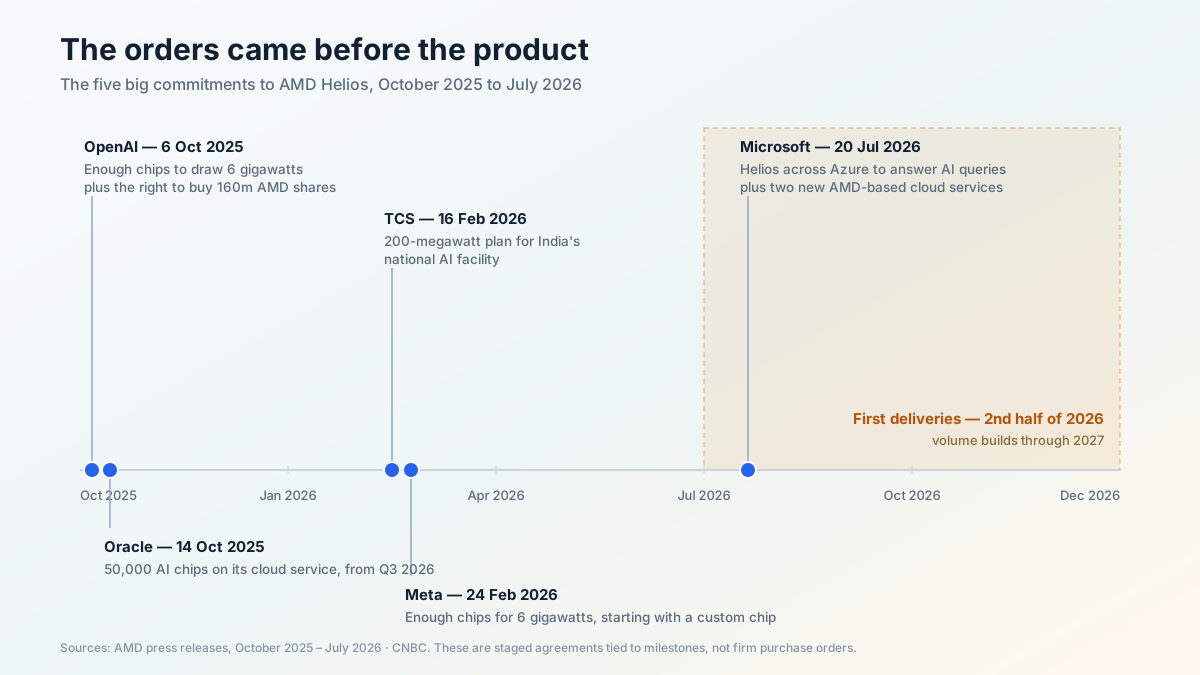
None of this becomes revenue until the chips test out as promised, the software holds under real production load, and the electricity becomes available on schedule. A press release guarantees none of those. AMD has told investors to expect meaningful revenue from Helios starting in 2027, and supply-chain reporting points to small shipments in late 2026 with the real volume arriving around the middle of 2027. The commitments are real. So is the risk that they do not convert.
What It Costs to Buy and to Run
Helios is priced as a premium product, and the argument for buying it rests on total running cost rather than the sticker price.
Daniel Newman of the Futurum Group estimates a Helios cabinet at US$5 million to US$5.5 million, against US$3.5 million to US$4 million for Nvidia's equivalent. That is a premium of roughly 40%. AMD's counter-sum is that 50% more memory per cabinet means you need fewer cabinets, fewer connections between them, and less work splitting a model across machines — so the cost of running the whole fleet can come in below the cheaper option. Whether that sum survives contact with real workloads is what every early deployment will be watched for.
The building bill is separate and unavoidable. AMD has not published an official power figure for the cabinet, and trade estimates range from roughly 140 kilowatts to the mid-200s. At either end, Helios can only live in rows cooled by liquid rather than air, it puts a 7,000-pound weight on one spot of the floor, and it needs the aisles redrawn for a cabinet twice the normal width.
New, purpose-built AI facilities absorb all of that in the design. Most existing rented data-centre halls cannot, without spending money to retrofit. That has particular bite in Singapore, where new capacity is rationed against efficiency rules and the operators who invested early in liquid cooling are the ones able to take this class of hardware — a constraint explained in our Singapore AI data-centres guide.
One more item explains how a chip company can ship entire cabinets at all. In March 2025 AMD completed a US$4.9 billion purchase of a company called ZT Systems, sold off its factories to another firm, and kept the teams that design cabinets and help large customers install them. Helios is the first product of that arrangement: design and deployment expertise in-house, manufacturing contracted out, and the heavy capital cost avoided.
Planning AI infrastructure capacity?
Compare data centre, colocation and AI computing provider profiles with recorded Singapore-presence and capability fields — including operators reporting liquid-cooled, high-density deployments.
Browse data centre providers →What Could Still Go Wrong
Everything above depends on AMD executing, and the conditions are specific. The final chips have to perform at the speeds AMD has projected. The memory has to arrive in the quantities needed — and that memory is fought over by AMD, Nvidia and every large cloud company's own chip programme, across just three suppliers. The software has to hold up across thousands of machines running work no test anticipated. And the rollout has to land before Nvidia's next move, because a 576-chip cabinet is already on Nvidia's 2027 plan, and a company with nine-tenths of the market and settled supply keeps every pricing lever that comes with it.
What This Means for Your Business
You do not need to care about any of the hardware detail above to act on four points.
- A second supplier now exists, and that is the whole story. Since 2022, choice has been the scarce commodity in AI hardware. The largest buyers on earth have now put money, engineers and shared design standards behind an alternative. Whether or not you ever buy AMD, having two credible suppliers changes what you can negotiate.
- Open standards are a commercial asset, not a technical preference. AMD's wiring and networking are built on standards anyone can implement. That means the equipment around them can come from multiple vendors. Wiring you can renegotiate is worth real money over a multi-year contract.
- A cheaper sticker price is not a cheaper machine. AMD's cabinet costs about 40% more than Nvidia's, but claims to need fewer cabinets for the same job. Any comparison that stops at the purchase price is answering the wrong question. Compare the cost of running the whole fleet.
- These are staged agreements, not orders. The 6-gigawatt headlines are frameworks tied to milestones. AMD itself points to meaningful revenue starting in 2027, not 2026. Treat announcement scale and delivered capacity as two separate numbers.
What to Do Next
If you buy, rent or plan computing capacity, these are the practical moves.
- Check whether your facility could physically host this class of machine. It needs liquid cooling rather than air, power in the hundreds of kilowatts per cabinet — published estimates run from roughly 140 kilowatts to the mid-200s — a floor that can take 7,000 pounds in one spot, and aisles wide enough for a double-width cabinet. Most existing rented halls cannot without paying to retrofit.
- Separate the two jobs when you plan. Training new AI models and answering user questions have different hardware needs. Microsoft is buying Helios for answering questions. If that is your workload too, the memory advantage is the number that matters.
- Ask any supplier which parts of their design are proprietary. The specific question is what happens to your wiring, networking and software if you want to change chip supplier in three years. The answer tells you what your negotiating position will actually be.
- Price the software risk, not just the hardware. AMD's software has improved every quarter but has not caught up. The companies making it work employ specialist engineers to do so. If you do not have those people, factor in the cost of buying that expertise.
- If you are in Singapore, ask providers about liquid cooling now. New capacity here is rationed against efficiency rules, and the operators who invested early are the only ones positioned to host high-density machines. That shortlist is shorter than the market looks.
The strategic fact holds whatever happens next. For the first time since the current AI boom began, the largest buyers on earth have committed money, staff and shared design standards to a second supplier before it shipped anything. Microsoft's chief executive, Satya Nadella, framed the Azure deal around "the performance, scale and choice" customers need. Choice, in this market, has been the scarce commodity since 2022.
The scoreboard is unusually explicit. OpenAI's right to buy up to 160 million AMD shares is released in stages tied to deployments and share-price targets — and the final stage is reported to require AMD's shares to reach US$600. The ambition now has a price attached to it.
Before you brief vendors
What to put in your brief
- Scope and the outcomes you expect
- Current stack and integration points
- Budget range and timeline
- Security and compliance requirements (PDPA, and MAS TRM where relevant)
- Evaluation criteria and decision date
Frequently asked questions
What is AMD Helios?
Helios is AMD's first complete AI machine sold as a whole cabinet rather than as individual chips. Inside are 72 of AMD's most powerful AI chips, 18 general-purpose processors, AMD's own networking hardware and its own software, all designed together and cooled by liquid. The cabinet holds 31 terabytes of fast memory in total and behaves like one very large computer. First customer deliveries begin in the second half of 2026.
How is Helios different from Nvidia's Vera Rubin machine?
Both are cabinets holding 72 AI chips, cooled by liquid, going on sale in the second half of 2026. Helios carries about 50% more memory per cabinet, 31 terabytes against roughly 20.7, and uses open industry standards for its internal and external wiring. Nvidia leads on raw calculating speed, roughly 3.6 against 2.9 exaFLOPS, uses its own wiring design, and has far more mature software behind it.
Who has committed to deploying AMD Helios?
Microsoft is installing Helios across its Azure cloud service to answer AI queries. OpenAI signed a multi-generation agreement covering enough chips to draw 6 gigawatts of electricity, starting with the first gigawatt in late 2026. Meta signed its own 6-gigawatt agreement beginning with a custom version of the chip. Oracle is deploying a 50,000-chip cluster from the third quarter of 2026, and TCS is building a 200-megawatt national AI facility for India using the design.
What does an AMD Helios cabinet cost?
Analyst Daniel Newman of the Futurum Group estimates US$5 million to US$5.5 million per cabinet, against US$3.5 million to US$4 million for Nvidia's equivalent. AMD argues the running costs favour Helios, because 50% more memory per cabinet means you need fewer cabinets and less work splitting a model across machines, which lowers the cost of each answer the system produces.
What does a data centre need to host Helios?
Liquid cooling rather than air, and power in the hundreds of kilowatts per cabinet, with published estimates ranging from roughly 140 kilowatts to the mid-200s. The cabinet weighs close to 7,000 pounds and is about 1.2 metres wide, so most existing rented data-centre halls need work on the floor loading and the aisle layout before they can take one.
Sources and further reading
- Primary source AMD — Microsoft to Deploy Next-Gen AMD Instinct and AMD EPYC Processors as the Companies Expand Their Long-Term Strategic Partnership (July 20, 2026)
- CNBC — AMD launches Helios, its first rack AI system to rival Nvidia, adding Microsoft as newest buyer (July 20, 2026)
- AMD — Helios Rackscale Solution product page
- AMD — Showcases "Helios" Rack-Scale Platform Built on the OCP Open Rack for AI, Introduced by Meta (October 14, 2025)
- AMD and OpenAI — Strategic Partnership to Deploy 6 Gigawatts of AMD GPUs (October 6, 2025)
- CNBC — Oracle Cloud to deploy 50,000 AMD AI chips, signaling new Nvidia competition (October 14, 2025)
- AMD and Meta — Expanded Strategic Partnership to Deploy 6 Gigawatts of AMD GPUs (February 24, 2026)
- AMD and TCS — Bringing 'Helios' Rack-Scale AI Architecture to India (February 2026)
- Nvidia Developer Blog — Inside the NVIDIA Vera Rubin Platform: Six New Chips, One AI Supercomputer (January 2026)
- The Register — AMD preps rack-scale Helios systems to contend with Nvidia's Vera Rubin NVL144 (June 12, 2025)
- AMD — Advancing AI 2026 event (San Francisco, July 22–23, 2026)
Related resources
Go deeper on this topic
Vendor directories
Research cluster
Start with the Singapore AI Data Centres pillar
This focused analysis sits under a broader, source-backed guide. Start there for the complete decision framework.
- Singapore AI Data Centres: Power, Cooling, GPUs, Capacity and RegulationA decision guide for enterprises designing or procuring Singapore-based AI compute and data-centre capacity.
- NVIDIA Blackwell Ultra: What High-Density AI Infrastructure Changes for Singapore BuyersA hardware-focused guide to evaluating NVIDIA Blackwell Ultra deployments as high-density data-centre systems rather than isolated GPUs.
Directory next step
Find Singapore providers for this work
Find Singapore partners for GPU infrastructure, deployment, and managed AI operations.
Compare AI computing providers →Reader notes
Questions, corrections, and field notes
Curated notes from verified readers. Submissions are reviewed before publication.
Loading reader notes...

