What changed in this guide
- — Added an original diagram
- — Revised
- — Published
Executive Summary
Key Takeaways
- Start with the obligation, not the logo. Laws and binding notices determine the minimum; customer and tender requirements determine which assurance evidence has commercial value.
- Use one control system for several outcomes. A well-scoped ISO/IEC 27001 ISMS can support SOC 2, ISO/IEC 27701, Cyber Trust and sector requirements without creating parallel compliance programmes.
- Frameworks and catalogues are implementation tools. NIST Cybersecurity Framework 2.0, NIST SP 800-53, CIS Controls and COBIT help design and govern a programme, but none is an organisational certification.
- Read the scope and report. A certificate logo alone does not show which legal entity, service, site or control exclusions were assessed.
- Singapore buyers need two maps. International assurance must be considered alongside PDPA, the Cybersecurity Act, MAS notices and national schemes such as Cyber Essentials, Cyber Trust, MTCS and DPTM.
What Are Cybersecurity Standards?
A cybersecurity standard is a documented, auditable set of requirements for how an organisation manages security risk — covering governance, technical controls, people and process. Standards do three jobs in enterprise IT. Internally, they give a security programme structure and a defensible answer to "have we done enough?". Externally, certification against a standard converts your security posture into a portable, independently verified signal that customers, regulators and insurers can rely on without inspecting your systems themselves. Commercially, they are increasingly the entry ticket: enterprise and government procurement in Singapore routinely screens vendors on certification before a conversation starts.
The terminology matters, because the words are used loosely in vendor marketing:
- Standard — the requirements document itself (ISO/IEC 27001, SS 584). You adopt a standard.
- Certification — a third-party audit outcome confirming you meet the standard, issued by an accredited certification body and time-limited. You hold a certification.
- Attestation — an auditor's formal report rather than a certificate; SOC 2 is an attestation under AICPA rules, which is why there is no such thing as being "SOC 2 certified" despite the common phrasing.
- Framework — a reference model such as NIST Cybersecurity Framework 2.0 or the CIS Controls. Useful for structuring a programme; not certifiable.
- Regulation — law. The PDPA, the Cybersecurity Act and MAS Notices bind you whether or not you hold any certificate.
In Singapore the picture has a distinctive national layer that many international guides miss: the Cyber Security Agency of Singapore (CSA) operates its own certification marks — Cyber Essentials and Cyber Trust — under the SG Cyber Safe programme, while IMDA and PDPC anchor cloud security (MTCS SS 584) and data protection (the Data Protection Trustmark, now Singapore Standard SS 714:2025). These sit alongside, not instead of, the international standards.
Why Standards Matter in 2026
Three forces are converging on Singapore buyers and vendors this year.
Security decisions must be demonstrable. Standards do not stop attacks by themselves, but they provide a repeatable way to assign ownership, choose controls, retain evidence and improve after failures. That record matters when boards, customers, insurers and regulators ask how risk was managed before an incident.
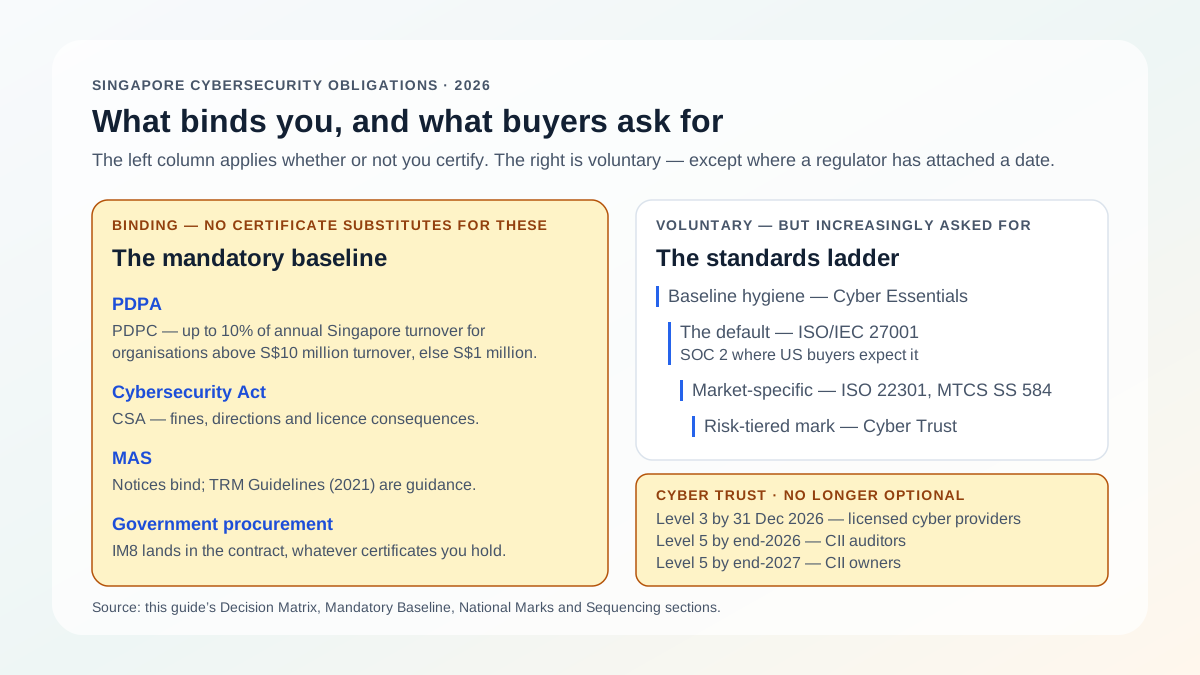
Voluntary is becoming mandatory. The most significant local development is CSA's March 2026 announcement converting the Cyber Trust mark from a voluntary badge into a compliance requirement for specific groups: licensed cybersecurity service providers must certify at Level 3 or higher by 31 December 2026, CII auditors at Level 5 by end-2026, and critical information infrastructure owners at Level 5 by end-2027. Meanwhile the Cybersecurity (Amendment) Act 2024 began commencing in October 2025, extending obligations to cloud-hosted CII and supply-chain incident reporting. The direction of travel is clear — assurance requirements are hardening, and they flow down contracts to suppliers.
Procurement is a practical enforcement mechanism. Long before a regulator asks, a tender may require a certificate, report or completed control questionnaire. For vendors, assurance can be a condition of market access. For buyers, it is a first filter—not a substitute for technical due diligence—which makes knowing what each artefact proves a procurement skill.
Quick Facts
| Fact | Detail (as of 12 August 2026) |
|---|---|
| Cross-industry management standard | ISO/IEC 27001:2022 — certifiable ISMS requirements, with ISO/IEC 27002 as implementation guidance |
| Singapore baseline mark | CSA Cyber Essentials — a baseline organisational cybersecurity mark with classical, cloud, OT and AI scopes |
| Singapore advanced mark | CSA Cyber Trust — risk-based preparedness tiers, a three-year certificate and annual surveillance |
| First Cyber Trust mandates | Licensed cybersecurity providers: Level 3 by 31 Dec 2026 · CII auditors: Level 5 by end-2026 · CII owners: Level 5 by end-2027 |
| Cloud security standard | MTCS SS 584:2020 — 3 levels; expected of cloud providers serving SG government and regulated sectors |
| Data protection mark | Data Protection Trustmark — now SS 714:2025, valid 3 years, SAC accreditation programme live since Jul 2025 |
| Payment card standard | PCI DSS v4.0.1 — v4.0 retired 31 Dec 2024; all future-dated requirements enforceable since 31 Mar 2025 |
| Comparable certification pricing | Not publicly standardised; scope, headcount, sites, audit days, maturity and consultant involvement materially change total cost |
| SME funding | CSA supports the first successful Cyber Essentials or Cyber Trust certification for eligible Singapore SMEs and NPOs until 6 Feb 2028; amounts depend on the scheme and scope |
| Incident-response references | ISO/IEC 27035-1:2023 and NIST SP 800-61 Rev. 3; the NIST revision superseded Rev. 2 in April 2025 |
Cybersecurity Standards Decision Matrix
Every standard relevant to a Singapore enterprise fits into one of four layers. Establish which layer a requirement comes from before you spend on it — the layers have different enforcement, different audiences and different costs of getting it wrong.
| Layer | Examples | Enforced by | If you ignore it |
|---|---|---|---|
| 1. Regulation (mandatory) | PDPA · Cybersecurity Act & CCoP · MAS TRM and Notices · sector rules | PDPC, CSA, MAS — legal penalties | Fines, directions, licence consequences; PDPA penalties reach 10% of SG turnover for larger firms |
| 2. National marks (voluntary → partly mandated) | Cyber Essentials · Cyber Trust · MTCS SS 584 · DPTM (SS 714) · CLS for devices | Market + CSA mandates for specific groups from 2026 | Excluded from tenders; from 2026–27, some organisations cannot operate without Cyber Trust |
| 3. International certifications (market-driven) | ISO 27001 · ISO 27701 · ISO 22301 · ISO 42001 · SOC 2 · CSA STAR · PCI DSS | Customers, partners, card schemes, insurers | Lost deals, longer security questionnaires, higher premiums |
| 4. Frameworks (reference, not certifiable) | NIST CSF 2.0 · CIS Controls · ISO 31000 · MITRE ATT&CK | Nobody — internal discipline | Weaker programme structure; no direct external consequence |
International Standards in Depth
ISO/IEC 27001 — the default
ISO/IEC 27001 certifies an information security management system (ISMS): a governed, risk-assessed, continuously improved set of controls drawn from its Annex A catalogue (93 controls in the 2022 revision, spanning organisational, people, physical and technological domains). Certification runs on a three-year cycle — initial two-stage audit, annual surveillance audits, then recertification. Since 31 October 2025 all valid certificates are to the 2022 edition, so any vendor still presenting a 27001:2013 certificate is presenting an expired one.
Its strength is universality: it is recognised across the markets Singapore firms sell to, and its management-system structure integrates efficiently with other standards — ISO/IEC 27701:2025 now provides standalone privacy information management requirements, ISO 22301 covers business continuity, and ISO/IEC 42001 applies the management-system pattern to AI. Its weakness is equally structural: it certifies the management system, within a scope the organisation defines. A certificate scoped to "the corporate IT function in Singapore" says nothing about the product engineering team in another country. Always read the certificate's scope statement — covered in the procurement section below.
SOC 2 — the US-market attestation
SOC 2 is not a certification but an attestation report under the AICPA's Trust Services Criteria (security, availability, processing integrity, confidentiality, privacy). A Type 1 report assesses control design at a point in time; a Type 2 report tests operating effectiveness over an observation window, typically three to twelve months — which is why it cannot be conjured quickly for a deal. US enterprise buyers expect SOC 2 from SaaS and service providers almost reflexively. Singapore vendors selling into the US usually end up holding both ISO 27001 and SOC 2; the control overlap is large, and competent auditors and compliance platforms will reuse one evidence base for both. If your revenue is regional, ISO 27001 alone is usually sufficient; add SOC 2 when US procurement asks.
Master comparison: scope, evidence and best fit
| Reference | Type and scope | Assurance route | Best fit |
|---|---|---|---|
| ISO/IEC 27001:2022 | Requirements for an information security management system (ISMS) | Accredited organisational certification | Cross-industry enterprise assurance and procurement |
| ISO/IEC 27002:2022 | Implementation guidance for information security controls | Not independently certifiable | Designing and interpreting an ISO/IEC 27001 control set |
| COBIT 2019 | Governance and management of enterprise information and technology | Framework; professional credentials exist, not organisational certification to COBIT | Boards, CIOs, audit and enterprise governance |
| NIST Cybersecurity Framework 2.0 | Outcome-based cyber-risk framework for any organisation | Self-adopted; not a NIST certification | Programme architecture, profiles and gap assessment |
| NIST SP 800-53 Rev. 5 | Detailed security and privacy control catalogue | Assessment against a selected baseline; not an organisational certification | High-assurance, regulated and US-government-aligned environments |
| CIS Controls v8.1 | 18 prioritised operational safeguards with implementation groups | Self-adopted; not a CIS organisational certification | Practical technical hardening, especially for smaller teams |
| PCI DSS v4.0.1 | Payment-account data security requirements | QSA assessment or self-assessment, depending on merchant/service-provider criteria | Entities that store, process or transmit payment account data |
| ISA/IEC 62443 | Industrial automation and control-system security across asset owners, integrators and suppliers | Scheme and product/process certifications are available | OT, manufacturing, energy, utilities and industrial product supply chains |
| HIPAA Security Rule | US legal safeguards for electronic protected health information | Regulatory compliance; no official HIPAA certification | US covered entities and business associates, including relevant Singapore vendors |
| ISO/IEC 27017 | Cloud-security control guidance for customers and providers | Usually assessed as an extension to an ISMS; check scheme rules | Cloud services and cloud-heavy operating models |
| ISO/IEC 27018:2025 | Protection of personally identifiable information in public clouds | Commonly assessed with ISO/IEC 27001; not a substitute for privacy law | Public-cloud processors of personal information |
| SOC 2 | CPA report on controls relevant to the Trust Services Criteria | Type 1 or Type 2 attestation report | SaaS and service providers selling to US enterprises |
| Common Criteria / ISO/IEC 15408:2022 | Security evaluation criteria for IT products and protection profiles | Product evaluation under national schemes and mutual-recognition arrangements | Security products and high-assurance procurement, not whole organisations |
| ISO/IEC 27034-1:2011 | Application-security concepts, processes and an organisational normative framework | Guidance; not a standalone organisational certificate | Secure software lifecycle and application portfolios |
| GDPR Article 32 | EU legal requirement for security of personal-data processing | Regulatory compliance; certification does not replace the law | Organisations within GDPR's material and territorial scope |
| ISO/IEC 27701:2025 | Standalone privacy information management system requirements and guidance | Organisational certification where an accredited scheme is available | Controllers and processors needing structured privacy assurance |
| ISO/IEC 27035-1:2023 | Principles and process for information-security incident management | Guidance; normally evidenced inside an ISMS | Incident governance, preparation and lessons learned |
| NIST SP 800-61 Rev. 3 | Incident-response recommendations integrated with CSF 2.0 risk management | Guidance; not certifiable | Operational incident-response programmes and playbooks |
Management and governance: ISO/IEC 27001, ISO/IEC 27002 and COBIT
ISO/IEC 27001 answers whether security is governed as a repeatable management system. It requires leadership, defined scope, risk treatment, competence, internal audit, management review and continual improvement. ISO/IEC 27002 is its control handbook: it explains the intent and implementation attributes of controls but does not provide a separate certifiable management-system requirement. Buyers should therefore reject claims of a standalone “ISO 27002 certification” unless the supplier can identify a legitimate scheme and precisely state what was assessed.
COBIT operates one level higher. It helps directors and executives allocate decision rights, align I&T with enterprise objectives, measure performance and distinguish governance from management. It is valuable when security is one part of a broader technology-governance problem; it is not a replacement for an ISMS or a technical control baseline.
Risk and control frameworks: NIST CSF, NIST SP 800-53 and CIS Controls
NIST Cybersecurity Framework 2.0 organises outcomes under six functions in lifecycle order: Govern, Identify, Protect, Detect, Respond, Recover. Govern, added in CSF 2.0, makes risk appetite, policy, roles and supply-chain oversight explicit. Organisations create a Current Profile, define a Target Profile and prioritise gaps; they do not become “NIST certified”.
NIST SP 800-53 Rev. 5 is a deeper catalogue of security and privacy controls. Its current Release 5.2.0 update was published in August 2025. The catalogue is deliberately tailorable: select a baseline, document overlays and parameters, and assess the controls that apply. A supplier saying it is “800-53 compliant” without naming its baseline, scope, assessment method and assessor provides little usable assurance.
CIS Controls v8.1 compresses the problem into 18 prioritised controls and three Implementation Groups. IG1 is a sensible minimum for smaller organisations; IG2 and IG3 add safeguards for greater complexity and risk. CIS is especially useful for translating a management-system requirement into concrete configuration and operating work.
Industry and infrastructure: PCI DSS, ISA/IEC 62443 and HIPAA
PCI DSS v4.0.1 applies through payment-brand and acquiring relationships to entities in the card-data environment. Validation can involve a Qualified Security Assessor or an applicable Self-Assessment Questionnaire; the correct route depends on merchant or service-provider status and transaction architecture. Outsourcing payments can reduce scope, but it does not automatically eliminate every responsibility.
ISA/IEC 62443 is a family rather than a single checklist. Its parts allocate duties across industrial asset owners, automation and control-system service providers, system integrators and product suppliers. For OT procurement, ask which part and security level a claim refers to, whether the evidence covers the deployed system or only a component, and how patching and remote access will work over the asset life.
HIPAA is US law, not an international certification. Its Security Rule requires administrative, physical and technical safeguards for electronic protected health information. A Singapore cloud or software provider may become a business associate through US healthcare work, but a marketing badge stating “HIPAA certified” is not an official HHS credential. Contractual status, risk analysis, safeguards and a business-associate agreement are what matter.
Cloud and service assurance: ISO/IEC 27017, ISO/IEC 27018, SOC 2 and CSA STAR
ISO/IEC 27017 adds cloud-specific guidance and clarifies shared responsibilities for both cloud customers and providers. As of this guide's cut-off, ISO lists a new edition in the publication transition, so buyers should record the edition used and ask how the provider will handle transition. ISO/IEC 27018:2025 focuses on public-cloud processing of personally identifiable information. Neither eliminates the need to review data location, subprocessors, encryption, deletion, portability and incident terms.
SOC 2 is an AICPA-governed attestation, not a certificate. Security is the common criterion; availability, processing integrity, confidentiality and privacy are included according to scope. Read the auditor's opinion, system description, tests, exceptions, complementary user-entity controls and subservice-organisation treatment. A Type 2 report gives evidence across a period; a Type 1 report only addresses design at a specified date.
CSA STAR uses the Cloud Controls Matrix to make cloud assurance more comparable. Level 1 is a public self-assessment; Level 2 involves third-party certification or attestation routes. It can complement ISO/IEC 27001 or SOC 2, but registry status and scope still require verification.
Product and application security: Common Criteria and ISO/IEC 27034
Common Criteria, aligned with ISO/IEC 15408:2022, evaluates defined security functionality in an IT product against a Security Target or Protection Profile. Evaluation assurance levels describe evaluation depth; they do not mean that a product is invulnerable or that every deployed configuration was tested. This is product evidence, not evidence that the vendor's whole security programme is mature.
ISO/IEC 27034 provides an application-security framework for embedding security across the application lifecycle and maintaining an organisation-level normative framework. It is useful for connecting governance, threat modelling, secure development, verification and application-specific controls. Use secure-development evidence, code and architecture review, penetration testing and vulnerability-management metrics alongside it.
Privacy and incident management: GDPR, ISO/IEC 27701, ISO/IEC 27035 and NIST SP 800-61
GDPR is law where its scope applies. Article 32 requires risk-appropriate technical and organisational measures; an ISO certificate can support evidence but cannot create compliance by itself. ISO/IEC 27701:2025 is now a standalone privacy information management system standard for controllers and processors, rather than only an extension dependent on ISO/IEC 27001. Integration with an ISMS remains operationally efficient.
ISO/IEC 27035-1:2023 sets principles and process for incident management, while NIST SP 800-61 Rev. 3, published in April 2025, integrates incident response into CSF 2.0 risk management and supersedes Rev. 2. Buyers should seek tested decision rights, escalation paths, evidence preservation, regulatory clocks, supplier coordination, recovery objectives and post-incident improvement—not merely a policy document.
Singapore's National Marks and Schemes
Singapore runs one of the more developed national certification ecosystems in Asia. Five schemes matter to enterprise buyers.
| Scheme | Administered by | Structure | Validity | Status in 2026 |
|---|---|---|---|---|
| Cyber Essentials | CSA (SG Cyber Safe) | Single-tier cyber-hygiene baseline; extensions for cloud, OT and AI security | 2 years | Voluntary; SME co-funding until Feb 2028; insurer discounts |
| Cyber Trust | CSA (SG Cyber Safe) | 5 preparedness tiers, 10–22 domains each; cloud/OT/AI extensions added 2025 | 3 years + annual surveillance | Mandated for licensed cyber providers (L3, end-2026), CII auditors (L5, end-2026), CII owners (L5, end-2027) |
| MTCS (SS 584:2020) | IMDA / Singapore Standards | 3 levels of cloud security, Level 3 most stringent — covers tenancy isolation, data sovereignty, resilience | 3-year cycle | De facto expectation for CSPs serving government and regulated sectors; hyperscalers hold Level 3 |
| DPTM (SS 714:2025) | IMDA / PDPC | Enterprise-wide data-protection maturity certification | 3 years | Elevated to a Singapore Standard in 2025 with SAC-accredited certification bodies |
| CLS / CLS(MD) | CSA | Product security labelling for consumer IoT and medical devices, multiple levels | Product-lifecycle based | Product-level, not organisational; relevant to device manufacturers and buyers |
Cyber Essentials is deliberately scoped for organisations without a security team: it certifies that baseline hygiene — asset inventory, access control, patching, backup, incident readiness — is in place. For an SME it is the highest-signal-per-dollar credential available, and CSA funds much of the cost of a first certification for eligible SMEs and non-profits (until 6 February 2028, applied per digital pillar including the cloud, OT and AI extensions).
Cyber Trust is the enterprise-grade mark: organisations certify at the tier matching their risk profile, with more domains audited at higher tiers. The 2025 expansion added cloud security, OT security and AI security extensions, making it one of the few schemes anywhere that audits AI security posture. Its trajectory is the story: what began as a voluntary mark is now a regulatory instrument, with CSA using certification tiers as licence and designation conditions. If you are a licensed cybersecurity service provider, Level 3 by end-2026 is no longer optional; if you operate CII, plan the Level 5 runway now — it is a substantial audit.
MTCS SS 584 matters in one direction for providers and another for buyers. Providers targeting Singapore government or regulated-enterprise workloads should treat Level 3 as the credible target. Buyers should use a provider's MTCS level as a scoping signal — it is one of the few certifications that directly addresses data sovereignty and tenancy separation, which generic ISO 27001 scopes often do not. Our certifications reference covers how it complements ISO 27001.
The Mandatory Baseline: Regulations You Comply With Regardless
No certification substitutes for these. In brief — our IT compliance guide covers each in depth:
- PDPA — applies to virtually every organisation handling personal data in Singapore. Notifiable breaches must be reported to PDPC within three calendar days of assessment; financial penalties reach 10% of annual Singapore turnover for organisations with SG turnover above S$10 million, or S$1 million otherwise. ISO 27701 and the DPTM help evidence compliance; they do not confer it.
- Cybersecurity Act — obligations on designated critical information infrastructure across 11 sectors: codes of practice (the CCoP), audits, incident reporting. The 2024 Amendment Act began commencing on 31 October 2025, notably extending coverage to cloud-hosted and third-party-operated CII and adding supply-chain incident reporting — which is how CII security requirements now reach ordinary vendors contractually.
- MAS requirements — for financial institutions, the Technology Risk Management Guidelines (2021) are formally guidance, but the MAS Notices on Cyber Hygiene and Technology Risk Management are legally binding, and MAS expects FIs to flow requirements down to their technology vendors. See our fintech regulations guide.
- Government procurement — agencies apply the Government's internal IM8 instruction requirements to suppliers through contract clauses; vendors selling to the public sector inherit security requirements via the tender, whatever certificates they hold.
Which Standards Does Your Organisation Actually Need?
Match the investment to who is asking. The matrix below reflects what Singapore procurement and regulation actually demand in 2026 — not what certification marketing suggests.
| Organisation profile | Need now | Strongly expected | Differentiator |
|---|---|---|---|
| SME, domestic customers | PDPA compliance; basic hygiene | Cyber Essentials | Cyber Trust (lower tier), DPTM |
| Mid-market enterprise, regional customers | PDPA; NIST CSF/CIS internally | ISO 27001 | ISO 22301, Cyber Trust mid-tier |
| SaaS / software vendor selling to US | ISO 27001 or SOC 2 (buyer-driven) | Both, on one control set | ISO 27701, ISO 42001 if AI-heavy |
| Cloud / hosting provider | ISO 27001 | MTCS SS 584 (L2–L3), CSA STAR | SOC 2, ISO 22301 |
| Managed services / SI serving enterprises | ISO 27001; client flow-down clauses | Cyber Trust, ISO 22301 | MTCS if hosting; sector attestations |
| Financial institution / FI supplier | MAS Notices compliance (binding) | ISO 27001; OSPAR for outsourced service providers | ISO 22301, SOC 2 |
| CII owner / operator | Cybersecurity Act + CCoP | Cyber Trust Level 5 by end-2027 (mandated) | ISO 27019/OT extensions, ISO 22301 |
| Licensed cybersecurity service provider | CSA licence | Cyber Trust Level 3 by 31 Dec 2026 (mandated) | ISO 27001, product certifications |
| AI product company | PDPA; model/data governance | ISO 27001 | ISO 42001, AI Verify participation, Cyber Trust AI extension |
| Anyone touching card payments | PCI DSS v4.0.1 (contractual) | — | — |
Sequencing: A Practical Certification Roadmap
Certifications compound when sequenced deliberately, because they share the same underlying control set. A typical progression for a growing Singapore technology company:
- Gap assessment against a framework. Baseline yourself against NIST CSF 2.0 or CIS Controls. This tells you how far each certification actually is and gives stakeholders a common language for prioritising remediation.
- Scope decision. Decide what the certified boundary will be — legal entities, systems, sites, data. Scope drives every cost that follows. Scope honestly: a certificate that excludes the systems your customers rely on will be noticed in due diligence.
- Cyber Essentials (weeks to ~2 months). Fast, funded, and forces the hygiene fundamentals that every later standard assumes.
- ISO 27001 (4–8 months for an SME; longer for complex enterprises). Build the ISMS once, properly — risk register, statement of applicability, internal audit, management review — then certify. This becomes the chassis for everything else.
- Market-specific additions. SOC 2 Type 2 for US customers (remember the 3–12 month observation window — start before the pipeline needs it); MTCS for cloud provision; ISO 27701 or DPTM where data protection is the selling point; ISO 22301 where continuity is contractual; Cyber Trust at the tier your market or mandate requires — much of the ISO 27001 evidence reuses directly.
- Integrate the audit calendar. Run surveillance audits, SOC 2 periods and internal audits on one schedule with shared evidence. Organisations that treat each certificate as a separate annual fire drill pay for the same work twice.
Implementation Considerations
The implementation unit is not a document set; it is a functioning control system. Before selecting an assessor or platform, settle the design decisions below.
- Define the business outcome and accountable owner. Record the regulatory, customer, tender or risk reason for each target. Name an executive sponsor and a day-to-day control owner. A credential without an owner becomes a deadline-driven paperwork exercise.
- Set an honest scope. List legal entities, people, sites, products, infrastructure, data flows and suppliers. Explicitly document exclusions and dependencies. The scope should cover the service the buyer relies on, not merely the easiest office to audit.
- Build a crosswalk once. Maintain a single control register that maps each control to ISO/IEC 27001, NIST CSF, relevant NIST or CIS safeguards, local obligations and customer commitments. Store one evidence object against multiple requirements where the substance is shared.
- Choose evidence before tooling. Define what proves design and operation—configuration exports, access reviews, incident records, restoration tests, supplier reviews and management decisions—plus its owner, frequency and retention. Automation is useful only after these rules exist.
- Test effectiveness, not document presence. Sample joiner-mover-leaver records, restore backups, exercise incident escalation, inspect cloud configurations and close vulnerabilities. Internal audit must be independent of the work being audited.
- Plan transitions and surveillance. Standards change edition, reports expire, surveillance recurs and scopes evolve. Contract for transition support, record certificate and report dates, and trigger reassessment when a material acquisition, product or hosting change occurs.
- Integrate suppliers. Identify inherited controls and complementary customer controls, validate subprocessors, and put notification, evidence, remediation and right-to-audit terms into contracts. Supplier certification narrows diligence; it does not transfer accountability.
- Measure the programme. Track overdue risk treatment, control exceptions, access-review completion, restoration results, incident detection and recovery, supplier findings, audit findings and time to close. Report trends and decisions, not a single “compliance percentage”.
Costs & Funding Support
Comparable total pricing is not publicly available. Standards bodies publish requirements, not a Singapore market rate card. Certification and assessment fees vary with headcount, sites, scope, complexity, audit days and assurance route; consulting, tooling and internal labour are separate. The table therefore shows cost drivers rather than invented point estimates. Obtain at least two itemised quotes and compare three-year total cost.
| Credential | External cost drivers | Quote checks | Recurring? |
|---|---|---|---|
| Cyber Essentials | Endpoints, digital-technology scopes and remediation support | Confirm current CSA funding eligibility, assessment, retest and additional-scope fees | Recertification required |
| Cyber Trust | Preparedness tier, applicable domains, digital-technology scopes and organisation size | Separate initial assessment, surveillance, remediation and extension-scope fees | Annual surveillance; three-year certificate cycle |
| ISO/IEC 27001 | Audit days driven by people, sites, scope, complexity and integrated standards | Stage 1, Stage 2, surveillance, recertification, travel and scope-change fees | Annual surveillance; three-year certificate cycle |
| SOC 2 Type 2 | System scope, criteria, locations, subservice organisations and review period | Readiness work, CPA examination, platform fees, bridge letters and exception retesting | New report periods are normally commissioned regularly |
| DPTM (SS 714) | Organisation size, complexity, sites and readiness | Application, assessment, surveillance, remediation and renewal fees | Annual surveillance within the certification cycle |
| MTCS SS 584 | Selected level, cloud services, locations and technical complexity | Confirm which services and regions the quote and resulting certificate will cover | Surveillance and recertification apply |
Two cost realities deserve emphasis. First, external fees are the minority of true cost — internal time to build and operate the management system usually exceeds what you pay consultants and auditors. Second, certification is an annuity, not a purchase: surveillance audits, evidence upkeep, tooling subscriptions and recertification recur for as long as you hold the credential. Model three-year total cost, not year-one cost.
On funding: CSA's current Cyber Essentials and Cyber Trust pages state that support for the first successful certification of eligible Singapore SMEs and non-profit organisations is available until 6 February 2028. Amounts vary by scheme, endpoint band and digital-technology pillar. Check the official page and written eligibility before budgeting; do not assume a grant applies to consulting or every assessment attempt. Broader capability-building grants may apply to a larger programme—see our IT grants guide—but confirm the proposed scope with the agency.
Choosing Certification Bodies & Consultants
The assurance value of a certificate is only as good as the body that issued it. Evaluation criteria that matter:
- Accreditation. For ISO standards, the certification body should be accredited (in Singapore, by the Singapore Accreditation Council; overseas bodies by IAF-member accreditors), and for CSA marks it must be on CSA's appointed certification body list — which includes firms such as TÜV SÜD PSB, SGS, Bureau Veritas, SOCOTEC and ISOCERT. An unaccredited "certificate" is a PDF, not assurance, and buyers increasingly verify via IAF CertSearch.
- Auditor competence in your domain. Ask who will actually audit you and what comparable organisations they have assessed. A SaaS company audited by someone whose experience is manufacturing plants gets a weaker audit and a weaker credential.
- Integrated audit capability. If you plan to hold several credentials, prefer bodies that can audit ISO 27001, 27701 and 22301 (and where relevant the CSA marks) in combined visits against shared evidence.
- Independence. The firm that builds your ISMS must not be the firm that certifies it — that separation is an accreditation requirement, and a consultancy offering both sides of the same engagement is a red flag in itself.
Consultant red flags, seen regularly in the Singapore market: guaranteed-pass promises; fixed ultra-low quotes that resolve to templated, copy-pasted ISMS documentation an auditor will recognise; pressure to scope the certificate to a token subset of the business; and "certification" offers against non-certifiable references such as ISO 31000 or NIST CSF. Compliance-automation platforms (the Vanta/Drata class) genuinely compress SOC 2 and ISO evidence collection, but they instrument the work rather than replace it — someone still has to own the risk decisions.
Using Standards in Vendor Procurement
For buyers, standards are a screening instrument — powerful if you read them precisely, misleading if you accept logos at face value. The working rules:
- Ask for the certificate, not the logo — then read the scope statement and check the certified legal entity, services and locations are the ones that will actually serve you. For ISO 27001, request the Statement of Applicability version reference; for SOC 2, read the actual report (under NDA), including exceptions and the auditor's opinion, and ask for a bridge letter covering the gap since the report period ended.
- Verify independently. ISO certificates via IAF CertSearch or the issuing CB's register; CSA marks against CSA's published list of certified organisations; MTCS against the IMDA/certification-body registers. Expired and misrepresented certificates surface in this market every year.
- Map the mark to the risk. Cyber Essentials tells you a small vendor manages hygiene; it does not tell you they can run your SOC. MTCS Level 3 speaks to data sovereignty; SOC 2 speaks to operating discipline over time. Our certifications reference decodes what each credential is actually evidence of, and our procurement templates include a vendor security scorecard.
- Put flow-downs in the contract. Require maintenance of named certifications through the term, notification of scope changes or suspensions, and audit/evidence rights. A certificate valid at signing and lapsed by month six is a real pattern.
- Do not outsource judgement. For material engagements, certification narrows the field; technical due diligence — architecture review, pen-test summaries, incident history — still decides. See our cybersecurity vendor guide for the evaluation playbook.
Common Mistakes
- Certifying for the wrong market. Buying SOC 2 for a Singapore-government-facing business, or ISO 27001 alone for a US-SaaS motion, wastes a year. Let the customer base pick the standard.
- Scope gaming your own certificate. A narrow scope is cheaper to certify and increasingly easy for counterparties to detect. The reputational cost of being caught implying whole-of-company coverage exceeds the audit savings.
- Starting SOC 2 Type 2 when the deal appears. The observation window makes it structurally impossible to produce quickly. The time to start is when the US pipeline is forming, not when procurement blocks.
- Treating certification as a project, not an operating system. The organisations that struggle at surveillance audits are the ones that stood the ISMS up for the certificate and stopped operating it in month four.
- Ignoring the mandate clock. Licensed cybersecurity providers have until 31 December 2026 to reach Cyber Trust Level 3; CII owners until end-2027 for Level 5. These are substantial audits with limited certifier capacity — late starters will queue.
- Assuming certification satisfies regulation. ISO 27001 does not discharge PDPA duties; Cyber Trust does not replace CCoP compliance for CII. The layers stack; they do not substitute.
- Assuming or overlooking funding. Check CSA's current support terms before procuring an assessment. Confirm eligibility and eligible fee components in writing; funding terms and windows can change.
What Certification Does Not Prove — An Honest Assessment
This guide recommends certification for most organisations with external stakeholders. It is equally important to state plainly what the industry's assurance machinery does not deliver.
Certification is point-in-time and sample-based. Auditors examine evidence from a slice of systems over a bounded window. Controls decay, staff leave and architectures change between visits; annual surveillance is a spot check, not monitoring. It verifies management, not engineering. An ISMS audit confirms that risk is assessed, decisions are documented and processes operate — it does not penetration-test your products or read your code. Organisations holding every credential in this guide appear in breach disclosures every year; certification reduces the odds of unmanaged risk, not the possibility of compromise. Scope is elastic, and the incentive to certify the smallest defensible boundary is structural — which is why reading scope statements matters more than counting logos. Standards lag threats: the 2022 revision of ISO 27001 arrived nine years after its predecessor, and formal standards for AI-era risks are only now emerging. And audit economics cut both ways — certification bodies compete on price and cycle time, and the rigour of audits varies more than the uniformity of the certificates suggests.
None of this is an argument against certification. It is an argument for treating it as what it is: a well-designed floor, a common language for assurance, and a procurement filter — inside which real security still has to be engineered, funded and operated.
Future Trends (2026–2029)
- Mandate creep continues. CSA's use of Cyber Trust tiers as licence and designation conditions is a template. Expect assurance requirements to extend further down the CII supply chain and into more sectors, mirroring the Amendment Act's supply-chain reporting logic.
- AI security formalises. ISO 42001 adoption is accelerating from a low base, CSA's Cyber Trust AI extension is among the first auditable AI-security schemes anywhere, and buyers of AI systems are beginning to ask for both alongside IMDA's AI Verify testing. AI-heavy vendors should expect this to be a standing tender question within two to three years.
- Continuous assurance pressures the audit cycle. Compliance platforms that stream control evidence are making the annual-audit rhythm look dated; expect certification schemes to absorb continuous-monitoring elements, and buyers to ask for live trust pages alongside certificates.
- Digital verification becomes default. The ISO Survey's 2024 move to the IAF CertSearch database signals where verification is going: machine-checkable certificates, harder-to-fake credentials, and procurement tools that validate automatically.
- Post-quantum migration enters the standards. With NIST's post-quantum cryptography standards finalised in 2024, crypto-agility requirements are beginning to appear in control catalogues and regulator guidance; long-lived data holders should expect PQC questions in audits before the decade ends.
- Volatility is part of the landscape. The US CMMC programme's 2026 suspension of its Phase 2 rollout is a reminder that compliance regimes are policy instruments — build programmes on the durable control substance (which changes slowly) rather than on any single scheme's timetable (which does not).
Frequently Asked Questions
What is the difference between a cybersecurity standard, a certification and a regulation?
A standard is a documented set of requirements or good practices, such as ISO/IEC 27001. A certification is independent confirmation that an organisation meets a standard, issued by an accredited certification body after an audit. A regulation is law — the PDPA, the Cybersecurity Act and MAS Notices apply whether or not you are certified. Frameworks such as NIST CSF 2.0 and CIS Controls are reference models you can adopt internally but cannot be certified against.
Which cybersecurity certification should a Singapore SME get first?
For most SMEs, CSA's Cyber Essentials mark is the practical starting point: it certifies baseline cyber hygiene, is scoped for smaller organisations, is valid for two years, and CSA co-funds the first certification for eligible SMEs and non-profits until 6 February 2028. Move to ISO 27001 when customers, tenders or regulators start asking for it — typically once you sell to enterprises, government or overseas markets.
Is ISO 27001 mandatory in Singapore?
No. ISO 27001 is voluntary — no Singapore law requires it. It becomes a practical requirement through procurement: enterprise and government tenders frequently ask for it, and it is the most widely recognised way to evidence security management. What is mandatory is the regulatory baseline: PDPA obligations for personal data, the Cybersecurity Act for critical information infrastructure, and MAS requirements for financial institutions.
ISO 27001 or SOC 2 — which one does my company need?
It depends on where your customers are. ISO 27001 is the default expectation in Singapore, Asia and Europe. SOC 2 is an AICPA attestation that US enterprise customers expect from SaaS and service providers. They overlap heavily in substance, so many Singapore software companies selling into the US carry both, reusing one control set for the two audits. If your buyers are mostly regional, start with ISO 27001; add SOC 2 when US deals demand it.
What is the Cyber Trust mark and who must have it?
Cyber Trust is CSA's advanced national cybersecurity mark, structured in five preparedness tiers with 10–22 control domains each, valid for three years with annual surveillance audits. In 2025 it was expanded with cloud, OT and AI security extensions. It is becoming mandatory for specific groups: licensed cybersecurity service providers must reach at least Level 3 by 31 December 2026, CII auditors Level 5 by end-2026, and CII owners Level 5 by end-2027.
How much does ISO 27001 certification cost in Singapore?
There is no authoritative, comparable public price. Certification bodies price audit days according to scope, headcount, sites, complexity and accreditation rules; readiness support and internal labour are separate. Ask for itemised Stage 1, Stage 2, surveillance, recertification, travel and scope-change fees, then compare three-year total cost rather than a promotional first-year figure.
How long does cybersecurity certification take?
Cyber Essentials can typically be achieved in weeks for an organisation with reasonable hygiene. ISO 27001 usually takes four to eight months for an SME with consultancy support, longer for complex enterprises. A SOC 2 Type 2 report requires an observation period — commonly three to twelve months — on top of implementation, so it cannot be rushed for a deal closing next quarter. Plan certification ahead of the sales cycle that needs it.
What funding is available for cybersecurity certification in Singapore?
CSA's current Cyber Essentials and Cyber Trust pages state that support for the first successful certification of eligible Singapore SMEs and non-profit organisations is available until 6 February 2028. Support varies by scheme, endpoint band and digital-technology pillar. Confirm eligibility, the funded amount and eligible fee components on the official scheme page before budgeting.
Do we need MTCS SS 584 certification?
Only if you provide cloud services. MTCS SS 584 is Singapore's multi-tier cloud security standard, with three levels of increasing rigour, and is commonly expected of cloud providers selling to Singapore government and regulated enterprises — the major hyperscalers hold Level 3. If you are a cloud buyer rather than a provider, you do not certify against MTCS; you use your provider's MTCS level as an evaluation signal.
Does ISO 27001 make us PDPA compliant?
No. ISO 27001 certifies an information security management system; the PDPA imposes legal obligations on personal data — consent, purpose limitation, breach notification within three days of assessing a breach as notifiable, and penalties up to 10% of Singapore turnover for larger organisations. ISO 27701 and the Data Protection Trustmark (now SS 714:2025) extend an ISMS toward privacy, but none of them replaces legal compliance.
What is ISO 42001 and should we adopt it?
ISO/IEC 42001 is the management-system standard for artificial intelligence — the AI analogue of ISO 27001. It is early in its adoption curve but growing quickly as buyers ask vendors to evidence responsible AI governance. Organisations that build or embed AI in products, or deploy it on sensitive data, should track it now and certify once customers begin asking; others can defer. In Singapore it complements, rather than replaces, IMDA's AI Verify testing framework — see our AI regulations guide.
Does certification guarantee an organisation is secure?
No. Certification confirms that a management system met a standard's requirements, within a defined scope, at the time of audit — on a sampled basis. Certified organisations appear in breach reports every year. Scope can be drawn narrowly, audits verify process rather than engineering quality, and controls decay between audits. Treat certification as a floor that filters out unmanaged risk, not a ceiling that removes the need for technical due diligence.
Selected Primary Sources
Source links last checked 6 September 2026. This records that each link resolved, not that its content was re-read.
This guide prioritises standards bodies, regulators and scheme owners. Edition status, transition periods, sector applicability and funding can change; use the links below as the final pre-procurement check.
- ISO management, cloud, privacy and incident standards: ISO/IEC 27001, ISO/IEC 27002, ISO/IEC 27017, ISO/IEC 27018, ISO/IEC 27701, ISO/IEC 27035-1.
- US public frameworks and controls: NIST Cybersecurity Framework 2.0, NIST SP 800-53 Rev. 5, NIST SP 800-61 Rev. 3, and CIS Controls v8.1.
- Governance and service assurance: ISACA COBIT, AICPA SOC resources, and the Cloud Security Alliance STAR registry.
- Payment, industrial and product security: PCI Security Standards Council document library, ISA/IEC 62443 series, and the Common Criteria portal.
- Singapore cybersecurity law and marks: CSA's Cybersecurity (Amendment) Act commencement notice, March 2026 Cyber Trust mandate announcement, Cyber Essentials, and Cyber Trust.
- Singapore cloud and data protection: IMDA's MTCS SS 584 overview, PDPC's Data Protection Trustmark, PDPA obligations, and breach-notification guidance.
- Singapore financial services: MAS Technology Risk Management Notice and related FAQ. Applicability depends on institution type and the governing notice.
Browse Certified Vendors in Singapore
Evaluating providers? TechDirectory lists directory records for cybersecurity companies, cloud providers and system integrators. Profiles may show recorded certifications and approved reviews where available; confirm each credential with the issuing body.
Browse Cybersecurity Vendors →- ICT & Cybersecurity Certifications in Singapore: A Complete Reference
- Cybersecurity in Singapore: Services, Pricing & How to Choose a Vendor
- IT Compliance in Singapore: PDPA, the Cybersecurity Act & MAS TRM
- Why System Integrator Certifications Matter in Singapore
- Vendor scorecards, RFQs & diligence prompts