
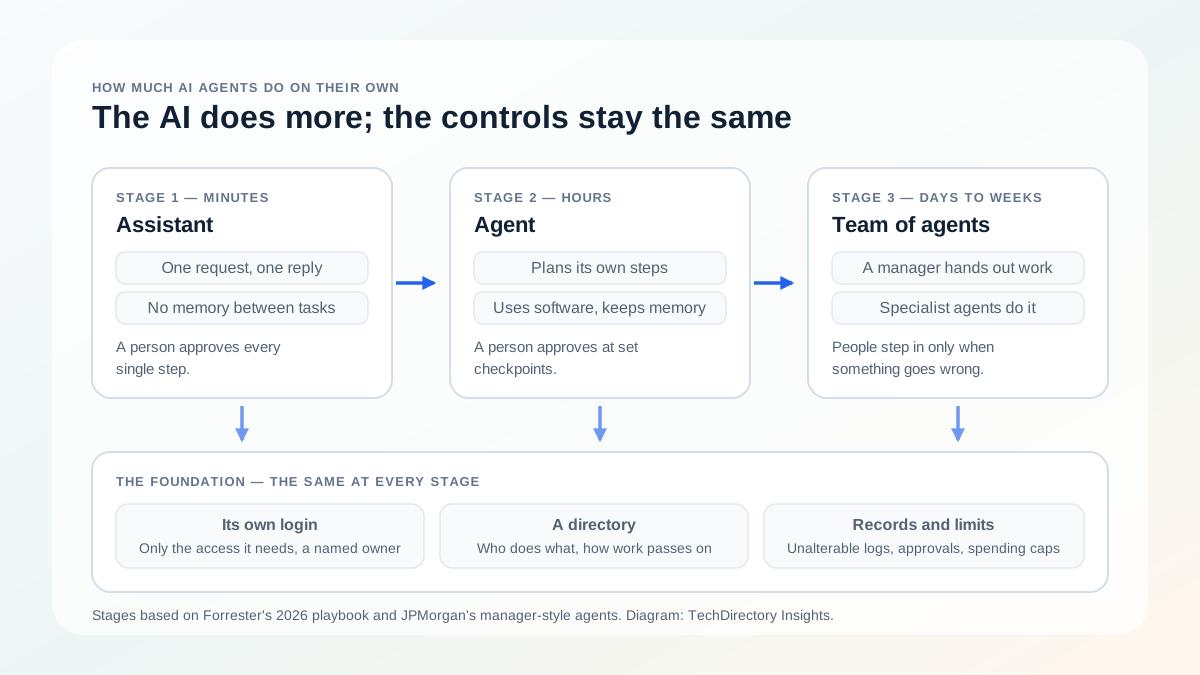
JPMorgan Chase plans to put AI agents into live use this year that work on their own for hours at a stretch. Derek Waldron, the bank's chief analytics officer, told CNBC in June that the current generation runs for two or three minutes after a person tells it what to do. The next one, he said, will break down a problem the way a team manager does, hand the pieces to other agents, and keep going — potentially for days or weeks.
Almost no other company can say that sentence out loud. That gap is the defining fact of business AI in mid-2026.
The research firm Forrester put the diagnosis in the subtitle of its June report: companies are chasing this technology, and few are catching it. Three-quarters of business leaders say they are doing something with AI agents. Only a small minority have anything meaningful running in their actual business, beyond what Forrester's analysts dismiss as chatbots wearing a new label. Systems where several agents work together at scale are rarer still.
The distance between JPMorgan and the average company is not access to the AI itself. The best models are a credit-card payment away. The distance is everything around them: a way to coordinate the work, a way to control what each agent is allowed to touch, a record of what it did, and a genuine redesign of how the work flows. It is unglamorous plumbing, and it is what turns a capable model into something you can let loose on your business. What follows is what the leaders built, what everyone else is stuck on, and what closing the gap costs.
How JPMorgan Did It
JPMorgan is the example the market keeps pointing at, and the reason is the order it did things in. It built the controls first and widened what the AI was allowed to do afterwards. Most companies do the exact opposite.
The foundation is an internal platform the bank started rolling out in 2024, which reached roughly 200,000 employees within eight months. Rather than letting staff plug directly into AI companies' systems, it sits in between — controlling access to models from OpenAI and Anthropic, and carrying the record-keeping, the permission rules and the quality checks the bank built around them.
The work it does reads like a census of office time. Drafting reports. Reviewing compliance. Analysing contracts, an application descended from an earlier programme that was already saving hundreds of thousands of hours of review work a decade ago. Supporting the call centre. And helping write software, which the bank credits with a 10% to 20% productivity gain across its technology teams. Executives describe the spread of the platform as a change in culture more than a change in tooling.
The money showed up before the independence did. In the private bank, agents that scan markets, client holdings and research overnight — preparation no human assistant could finish before morning — contributed to a roughly 20% lift in gross sales. The bank has suggested advisers could cover 50% more clients as they shed work that is not client-facing.
Bloomberg reported in July that a JPMorgan team built investing agents that sort market conditions into four types and shift money between shares and bonds accordingly. Tested against two decades of historical data, the best version beat the traditional mix of 60% shares and 40% bonds once the risk taken was accounted for.
None of this happened because the bank found a better model. It happened because a technology budget approaching US$20 billion a year was pointed at the boring scaffolding — controlling which model gets used, who is allowed to do what, how quality is checked, and what gets written down — years before agents could act on their own. When that independence finally arrived, JPMorgan had somewhere to put it.
Why Three-Quarters of Companies Stall
Companies stall because an agent that works for hours is not a chatbot. It is a system with moving parts spread across your business, and most organisations have never built the discipline that requires.
The technology is no longer the limit. OpenAI has run an internal software-development process for months with barely any human intervention. The software firm Cursor sells coding agents that run for long stretches. Anthropic has demonstrated research agents that work for days. The proof exists. What does not exist, inside most companies, is the machinery underneath it.
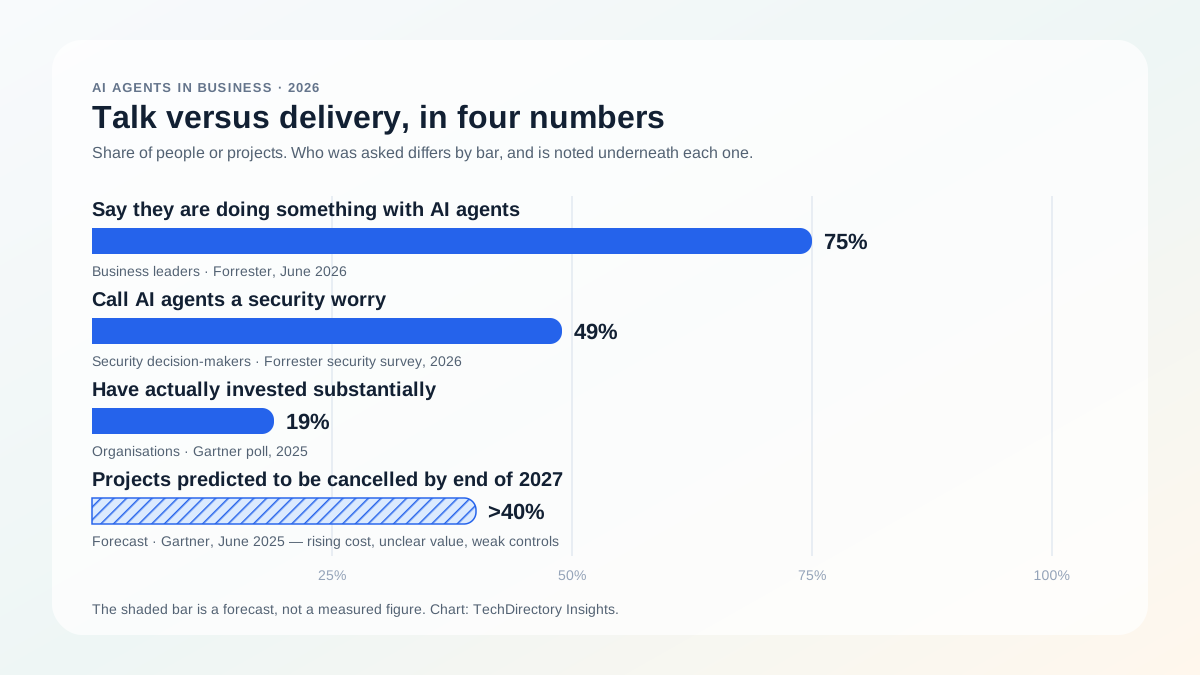
Forrester's survey work puts hard edges on the stall. More than half of companies report gaps in their controls even after adopting the main American government framework for managing AI risk — because a written policy cannot constrain a system that acts on its own and reaches into other software while it works.
In Forrester's 2026 security survey, 49% of security decision-makers named AI agents as a worry, and it is a genuinely new kind of threat rather than a bigger version of an old one. Agents can pretend to be one another. They can gain access they were never meant to have, through gaps in how non-human accounts are managed. And they multiply faster than the systems meant to keep track of them.
Then comes the cost nobody budgets for. Forrester calls it the trust tax: every action an agent takes on its own has to be recorded and made defensible to an auditor or a regulator later. That is real engineering work, and it never appears in the business case.
Coordination adds its own failure. Stitch a dozen separate agents together without a shared directory of who does what and a way to route work between them, and the system decays into duplicated effort and drift. What breaks is not the number of agents. It is the complexity of the job you gave them.
Even Bank of New York, about as advanced as a heavily regulated institution gets, has yet to capture the full value of its own programme — though Forrester notes it holds the scarcest asset in the market: staff who know how to manage highly independent systems inside a tightly regulated business.
Confusion about which supplier to back freezes whatever momentum remains. Teams argue over whether to use agents built into software they already own, such as Salesforce or Microsoft's tools, or to commission a consultancy build, or to construct their own on top of Anthropic and OpenAI. While they argue, the trial gets renewed for another quarter.
Where the Money Is Actually Going
Demand concentrates in agents embedded in a real process with a number attached to them — not in general-purpose chat.
Customer service is the most developed area. Tools from Salesforce, Intercom and Zendesk, plus custom voice systems, resolve enquiries around the clock, and mature deployments handle more than half of them without a person. The cost per enquiry makes the payback fast enough for a finance director to see it land inside one financial year.
Software engineering moves fastest. Coding tools now work across the whole development process rather than just suggesting the next line, and they were the first place where long-running independence proved stable. Behind them sit the quieter categories where companies actually clear a return-on-investment review: sales operations, back-office processing, IT support, and the specialised agents that regulated industries build for themselves.
| Type of agent | Examples in use | How mature it is in 2026 | Where the return shows up |
|---|---|---|---|
| Customer service and support | Salesforce Agentforce, Intercom Fin, Zendesk AI, custom voice systems | Most mature | Over half of enquiries handled without a person, round-the-clock cover, lower cost per enquiry |
| Writing software | Claude Code, Cursor, GitHub Copilot | Growing fast | Faster delivery. JPMorgan reports 10–20% productivity gains in its engineering teams |
| Sales operations | Chasing leads, qualifying prospects, tidying customer records, preparing for meetings | Fast payback | Sales staff win back time not spent selling, which often exceeds 60% of their week |
| Back-office processing | Invoices, customer identity checks, onboarding, contract review — often alongside older automation software | Established | More work completed end to end without a human touching it. Fewer errors to redo |
| IT and security | First- and second-line support tickets, sorting alerts, responding to incidents, investigating scam emails | Established | Faster resolution. Less routine work reaching specialist analysts |
| Specialist finance agents | Spotting fraud, forecasting cash, JPMorgan's market-condition investing agents | Still emerging | Better returns for the risk taken. Being able to prove what happened is the gating requirement |
| Several agents working together | One agent plans, others carry out the work, another checks it — spanning a whole process | Rare in real use | Step-change value, but only on processes genuinely redesigned around it |
Gartner expects agents built for specific tasks to be embedded in 40% of business software by the end of 2026, up from under 5% a year earlier. The same firm predicts AI agents will outnumber human salespeople ten to one by 2028 — and that fewer than 40% of salespeople will say the agents made them more productive. Both forecasts can be true at once. Embedding the technology is a purchasing decision. Getting value from it is an operating one.
What It Costs to Run
The AI itself is the cheap part. The lasting costs sit in usage charges, in the control systems, and in the organisational surgery of redesigning how work flows.
An agent that works for six hours is not one question and one answer. It is thousands of separate steps, each one billed by the amount of text processed. Mature platforms answer this by sending simple steps such as sorting and extracting to cheaper, faster AI, and reserving the expensive frontier model for the actual thinking. They also reuse and compress what gets sent, trading engineering effort against the monthly bill.
Cost discipline is one reason every serious deployment, JPMorgan's included, keeps the ability to switch between AI suppliers. That switch is leverage against both the price and the risk of being locked in.
The control systems are the second line item. A permanent, unalterable record of every instruction, plan, action and piece of data touched. A directory of which agent does what and how work passes between them. Checkpoints where a human has to approve, and a way to undo. And a login system that gives each agent its own credentials, only the access it needs, a named human owner, and a defined end of life.
Forrester's position is that this monitoring has to run while the agent runs — permissions enforced automatically, not reviewed once a quarter. Very little of it comes ready-made, which is why consultancies now quote these projects the way they once quoted large business-system replacements.
The downside case is already priced in. Gartner predicts more than 40% of these projects will be cancelled by the end of 2027, killed by rising costs, unclear business value, or inadequate controls — and its own polling found only 19% of organisations have invested substantially in the first place. The projects that die will mostly be the ones that bought agents before laying the track.
Lay the Track First
The organisations pulling ahead do the work in the opposite order from the market: coordination first, redesign of the work second, agents last.
Forrester's playbook comes down to three moves. Build the coordination layer — a shared directory and clear rules for how work passes between agents and existing systems — before adding a single agent. Redesign a handful of genuinely painful processes around the new capability, rebuilding the roles and the approvals, rather than bolting agents onto processes still paced for humans. And treat every agent as an identity you govern: its own credentials, only the access it needs, a full record, and a named owner. Widen what agents are allowed to do only as the controls prove themselves, starting with narrow tasks behind approval checkpoints and an undo button.
For Singapore companies the sequence carries extra weight. Banks and insurers answer to the financial regulator's technology-risk expectations. Personal data flowing through instructions, agent memory and activity records stays subject to Singapore's data-protection law. And the regional head offices that centralise shared services are exactly where long-running agents land first. The governance problem is the same one ServiceNow spent its 2026 conference selling against — examined in our earlier analysis of the control tower problem — and the questions to ask there transfer unchanged to any agent supplier.
What This Means for Your Business
Five things follow from the evidence above.
- Your competitors' announcements are mostly not deployments. Three-quarters report activity. Only 19% have invested substantially. If a rival's press release is driving your timeline, you are pacing yourself against a claim rather than a capability.
- The order of work decides the outcome. Every organisation that made this work built the coordination, permissions and record-keeping first. Every forecast of failure points at cost, unclear value and weak controls — all consequences of skipping that step. This is the single most repeated finding in the research.
- Budget for the trust tax explicitly. Recording and justifying every action an agent takes is real engineering work. It does not come in the box, and it is the line item that turns a promising trial into an abandoned project when it appears halfway through.
- Security here is different in kind, not degree. Agents can impersonate each other, acquire access they were never granted, and multiply faster than your inventory tracks. Half of security decision-makers already flag this. It is not the same conversation as securing a chatbot.
- Pick problems with a number attached. The categories delivering returns all share three traits: high volume, a clear before-and-after measure, and limited damage if something goes wrong. Customer enquiries, support tickets, invoices. Not open-ended judgment.
What to Do Next
In the order that the evidence says actually works.
- Build the coordination layer before you buy a single agent. A shared directory of what each agent does, and clear rules for how work passes between agents and your existing systems. Without it, a dozen agents become duplicated effort rather than a workforce.
- Give every agent its own login, restricted access and a named human owner. Not a shared account. Not inherited human permissions. Include a defined end of life, so agents do not accumulate quietly.
- Turn on complete recording from day one. Every instruction, plan, action and piece of data touched, in a form that cannot be edited afterwards. Retro-fitting this after an incident is the expensive way to learn the lesson.
- Pick one genuinely painful process and redesign it, rather than bolting agents onto five. Rebuild the roles and the approval steps around what the agent can do. Bolting agents onto a process still paced for humans is the most common way these projects fail.
- Set spending limits and an undo path before you widen the leash. Cap the usage charges, cap the rate, and make sure you can stop an agent and reverse what it did. Then extend its independence only as the controls prove out.
- If you are a regulated Singapore business, involve risk and compliance at the design stage. The financial regulator's technology-risk expectations and Singapore's data-protection law both apply to what flows through an agent's instructions, memory and records — not just to your databases.
The Advantage That Is Slipping
What 2026 leaves behind is a widening spread. The technology improves quickly. Companies get ready slowly. The distance between the two is where both the value and the casualties will come from.
Gartner projects that 15% of day-to-day work decisions will be made without a human by 2028, and that a third of business software will carry this capability by then. JPMorgan's manager-style agents will have two years of real operating history by that date. Most of its competitors will still be reconciling trial results.
Waldron drew the sharper conclusion, and aimed it past his own industry at the software companies themselves. "The moat around certain types of software companies is most certainly diminished," he told CNBC.
Frequently asked questions
What is the difference between an AI assistant and an AI agent?
An assistant answers a single request in minutes, with a person approving each step. An agent takes on a job, plans the steps itself, reaches into other software to get things done, remembers what it has already done, and can keep working for hours or weeks. That makes it behave like a system with moving parts across your business, so it needs coordination, controlled access and complete record-keeping that an assistant never required.
Why do most business AI agent projects stall in trials?
Forrester's 2026 research points to uncertainty about the return, gaps in controls that persist even after adopting the main American government framework for managing AI risk, security risks such as agents impersonating one another and gaining access they were not granted, confusion about which supplier to back, and the cost of making every action an agent takes defensible to an auditor afterwards.
What AI agents is JPMorgan using in 2026?
JPMorgan's internal AI platform reached roughly 200,000 employees within eight months of its 2024 rollout. In 2026 the bank plans agents that work on their own for hours, manager-style agents that hand work to other agents, overnight research agents credited with a roughly 20% lift in private-banking gross sales, and investing agents that sort market conditions into four types and beat the traditional 60% shares and 40% bonds mix when tested against two decades of historical data.
Which types of AI agent deliver a return fastest?
Customer support agents with a measurable share of enquiries handled without a person, coding tools, sales operations agents that win back time not spent selling, back-office processing such as invoices and customer identity checks, and IT service-desk triage. They all share the same three traits: high volume, a clear before-and-after measure, and limited damage if something goes wrong.
Sources and further reading
- CNBC — JPMorgan Chase plans to deploy more powerful AI agents this year (June 9, 2026)
- Forrester — The State Of Agentic AI In 2026: Companies Are Chasing, Few Are Catching (June 3, 2026)
- Forrester — The State Of Agentic AI, 2026 (report)
- Bloomberg — JPMorgan Builds AI Agents That Beat 60/40 Model in Backtests (July 9, 2026)
- Gartner — Over 40% of Agentic AI Projects Will Be Canceled by End of 2027 (June 25, 2025)
- Gartner — By 2028, AI Agents Will Outnumber Sellers by 10x (November 18, 2025)
- Tech in Asia — JPMorgan Chase plans more autonomous AI agents
- Forbes — How JPMorgan Chase Is Building The AI-Powered Bank Of The Future (July 1, 2026)
Related resources
Go deeper on this topic
Reader notes
Questions, corrections, and field notes
Curated notes from verified readers. Submissions are reviewed before publication.
Loading reader notes...


