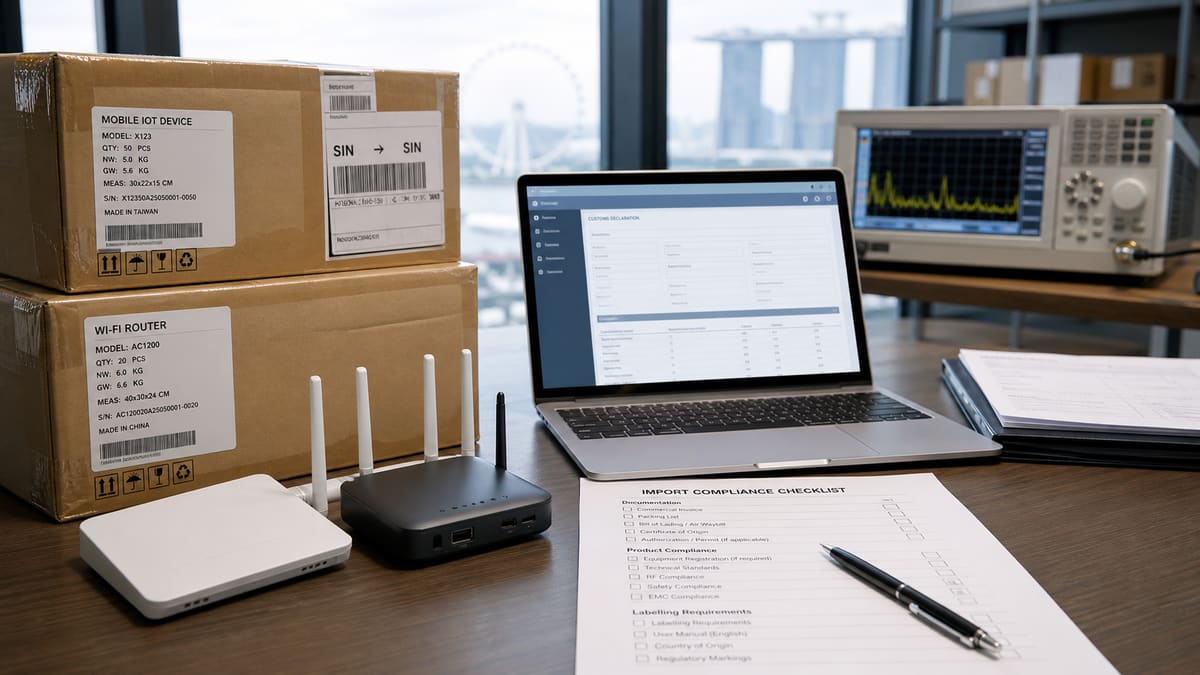
What counts as telecom equipment importing in Singapore?
Telecom equipment importing in Singapore means bringing in equipment capable of telecommunication or radio-communication use, whether the label says router, handset, IoT gateway, modem, base station, short-range device, PBX, wireless sensor or industrial controller. IMDA reads the interfaces. A cellular module, Wi-Fi radio, Bluetooth radio, wired telecom port, antenna change, SIM profile or RF transmitter can move a product from ordinary electronics into telecom-equipment compliance.
The compliance issue is not only whether a box clears the border. A device can enter a warehouse and still be unlawful to sell or deploy locally if the dealer status, equipment registration, Supplier's Declaration of Conformity and TradeNet declaration do not line up. That is why importers, distributors, system integrators and enterprise buyers should treat IMDA type approval as a procurement-control issue, not a late logistics form.
Singapore's three gates to market entry
The practical framework is simple: who is allowed to deal in the equipment, whether the exact model is approved for local sale or use, and whether the import declaration matches the regulatory record. A fourth question can appear for radio systems: does operation require a separate frequency, power or station approval?
| Gate | What it checks | Buyer risk if missed |
|---|---|---|
| Telecommunication Dealer's Licence | Whether the importer, reseller or distributor is licensed to deal in the equipment category. | The sales channel may be unable to lawfully import, stock, sell or re-export the equipment. |
| Equipment registration | Whether the exact model is registered or exempted under IMDA rules for local sale or use. | A technically capable product can still be blocked, recalled or unsellable in Singapore. |
| TradeNet declaration | Whether the customs permit includes the correct CA licence number, HS code, product code and registration number where applicable. | Shipments can be delayed because the broker, invoice and IMDA record disagree. |
| Radio operation approval | Whether the actual use needs spectrum assignment, station licensing or output-power permission. | A registered radio product may still be unusable in the intended deployment. |
The dealer licence is the importer gate
A business that commercially imports, sells, offers for sale, hires or possesses telecom equipment for sale generally needs the right IMDA dealer licence. The Class Licence fits local distribution of approved or exempted equipment. The Individual Licence reaches wider, including non-registered equipment handled for re-export.
| Licence type | Typical use | Procurement meaning |
|---|---|---|
| Telecommunication Dealer's Class Licence | Importing and selling equipment approved for Singapore local use, or equipment listed in the First Schedule exemption category. | Suitable for local resale of registered models, but not a clean fit for export-only stock or unregistered regional inventory. |
| Telecommunication Dealer's Individual Licence | Handling approved local-use equipment and non-registered equipment for re-export purposes. | Better suited to regional distributors, bonded-stock operations, demo pools and export-only inventory controls. |
Buyers should verify the licence holder, not only the brand on the product. In a real supply chain, the manufacturer, Singapore distributor, reseller, logistics importer and service integrator may be different entities. The accountable Singapore party matters when IMDA asks for evidence or a product has to stop selling.
ESER, SER and GER: the model-registration gate
IMDA equipment registration is the formal route for declaring that a named telecom-equipment model meets the applicable Singapore technical requirements. The common routes are Enhanced Simplified Equipment Registration (ESER), Simplified Equipment Registration (SER) and General Equipment Registration (GER). The route depends on the device type, risk profile and evidence needed.
| Route | Common fit | What to watch |
|---|---|---|
| ESER | Lower-risk equipment that can be self-declared through a faster route, often including common short-range devices. | Auto-approval does not remove evidence liability. The supplier must still hold conformity proof for post-market checks. |
| SER | Selected equipment categories such as cellular mobile terminals where defined documents and certificates can support the application. | Foreign certificates can help, but Singapore-specific VoLTE, emergency-call and wireless-mode requirements still matter. |
| GER | Equipment needing broader technical evaluation, including many complex radio or network devices. | The evidence pack must map the actual model, antenna, firmware, RF function and user documentation to IMDA specifications. |
The supplied article noted a standard five-year registration validity for ESER, SER and GER records, with published processing targets of three working days for SER and ten working days for GER when submissions are complete. In practice, the bottleneck is rarely the form. The bottleneck is upstream evidence: test reports, product labels, module certificates, photographs, user manuals, SAR data, safety evidence and manufacturer statements.
The evidence pack is where many imports fail
The Supplier's Declaration of Conformity is not a marketing promise. It is a local claim that a specific model, with specific functions and supporting documents, conforms to the applicable IMDA technical specifications. CE, RED, FCC or other overseas evidence can reduce duplicate testing, especially where IMDA-recognised mutual recognition arrangements apply, but foreign evidence is not a Singapore passport.
A credible Singapore compliance pack should include the model identifier, hardware revision, firmware branch, supported radio bands, antenna details, RF exposure evidence where applicable, EMC and safety reports, user documentation, product photographs, label artwork, module certificates and a change-control record. For cellular equipment, the pack should also cover Singapore network assumptions such as VoLTE profiles, emergency calling and any 2G default setting.
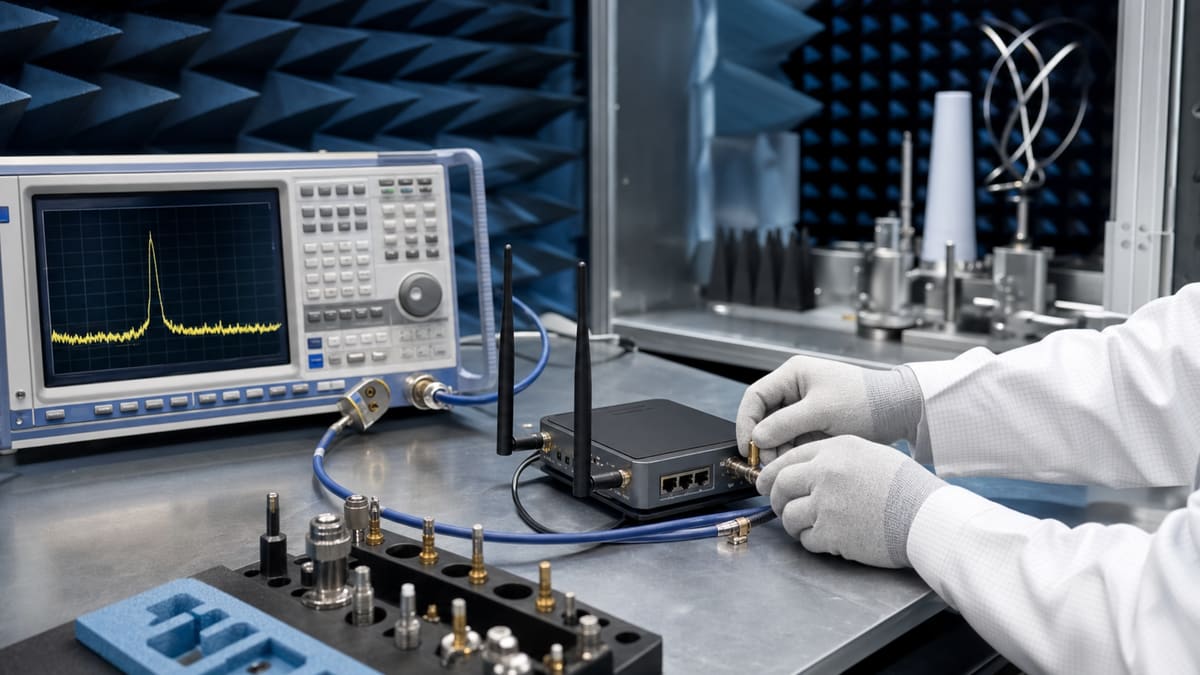
TradeNet turns product master data into border compliance
Singapore Customs states that every imported telecommunication equipment item should be declared through TradeNet to IMDA, with the Customs permit obtained before the goods arrive in Singapore. For licensed dealers, the declaration should include a valid IMDA Telecommunication Dealer's Class or Individual Licence in the CA Licence Number field, plus the appropriate HS code, product code and equipment registration number where applicable.
The quiet failure point is master-data mismatch. A model suffix in the invoice does not match the registration record. A broker uses a generic product code. The CA licence belongs to the wrong importing entity. A re-export shipment is routed under the wrong licence. A family-series assumption hides a changed antenna. None of these mistakes is dramatic. They still delay shipments.
The rules now test device behaviour, not only radio hygiene
Older type-approval thinking focused on frequency, output power, spurious emissions, electromagnetic compatibility, electrical safety and human exposure. Those checks still matter. Singapore's newer telecom-equipment posture also asks whether a device behaves safely on public networks.
IMDA TS CMT Issue 1 Rev 4, dated March 2026, requires voice-capable cellular mobile terminals to support VoLTE, turn VoLTE on by default, interoperate with Singapore mobile network operators, handle emergency numbers sent by the serving network and make emergency calls via VoLTE. The same specification requires 2G connectivity to be switched off in factory default configuration unless the user deliberately enables it, and it adds emergency cell broadcast requirements.
Anti-scam enforcement has also moved into hardware controls. GSM gateway devices with five or more SIM card slots are treated as prohibited telecommunication equipment from 1 February 2025. That matters for SIM banks, messaging gateways, high-density cellular modems, M2M gateways and any import model built around many SIMs inside one device.
- Do not rely on the product name. A "gateway" can be a radio device, a router, a SIM bank, an IoT endpoint or a base-station-adjacent system depending on interfaces and intended use.
- Do not treat ESER as a paperwork shortcut. Faster registration shifts evidence risk to the supplier rather than removing the evidence requirement.
- Do not assume registration grants spectrum rights. Radio operation can still need separate written approval, assignment or licensing.
Firmware can become a regulatory event
Product teams often treat firmware updates as maintenance. A regulator may see a compliance-affecting change. Firmware can alter band enablement, power tables, roaming behaviour, VoLTE profiles, 2G defaults, Wi-Fi channel availability, DFS behaviour, SIM management, authentication flows and emergency-alert handling.
Importers should classify changes before shipment, not after customer complaints. Antenna changes, output-power changes, new radio modules, altered network interface cards and compliance-affecting software changes can require re-registration before the modified equipment is supplied for local use. That is why supplier contracts should require advance notice for hardware, radio, firmware, antenna and SIM-profile changes.
Buyer checklist for IMDA telecom equipment import compliance
FAQ
Do I need IMDA approval to import telecom equipment into Singapore?
Commercial importers usually need the right IMDA Telecommunication Dealer's Licence and, for local sale or use, equipment registration unless the equipment is exempted. Selected controlled or prohibited equipment may need prior IMDA approval before entry.
What is the difference between ESER, SER and GER?
ESER is the fastest self-declaration route for lower-risk equipment. SER covers selected equipment such as cellular terminals. GER is the broader route for equipment needing fuller technical evaluation and supporting test evidence.
Does CE or FCC approval replace IMDA registration?
No. Foreign test reports and certificates can support an IMDA submission, especially under mutual recognition arrangements, but the Singapore supplier still has to map the exact model to IMDA technical requirements.
What should be declared in TradeNet for telecom equipment?
Singapore Customs says imported telecom equipment should be declared through TradeNet. Licensed dealers should declare the valid IMDA dealer licence number, HS code, product code and equipment registration number where applicable.
Are GSM gateway devices allowed in Singapore?
GSM gateway devices with five or more SIM card slots are treated as prohibited telecommunication equipment from 1 February 2025. Devices with four or fewer SIM slots still need careful licensing, registration and customer-use checks.
Selected sources
- IMDA - Equipment Registration
- IMDA IRIS - Equipment Registration Guide
- IMDA IRIS - Telecommunication Dealer's Licence
- Singapore Customs - IMDA TradeNet requirements
- IMDA - Mutual Recognition Arrangements
- IMDA TS CMT Issue 1 Rev 4, March 2026
- IMDA - Equipment registration past notices
- Singapore Statutes Online - Telecommunications (Dealers) Regulations
Find telecom and compliance support
Browse Singapore telecom providers, network integrators and technology vendors that can help with equipment selection, local deployment, documentation and operating-model checks.
Browse telecom providers →